Starting a business in France: entrepreneur visa (Talent Passport) guide
Complete guide to the France entrepreneur visa (Talent Passport - Business creation): eligibility, €30,000 minimum investment, application steps, family, and steps after arrival.

International Mobility Expert
Starting or taking over a business in France as a non-EU foreigner is possible through the entrepreneur visa, part of the Talent Passport scheme, under the “Business creation” category. This guide covers eligibility criteria, application steps, and what to do after you arrive so you can launch your startup in France with confidence.
Overview: France entrepreneur visa (Talent Passport - Business creation)
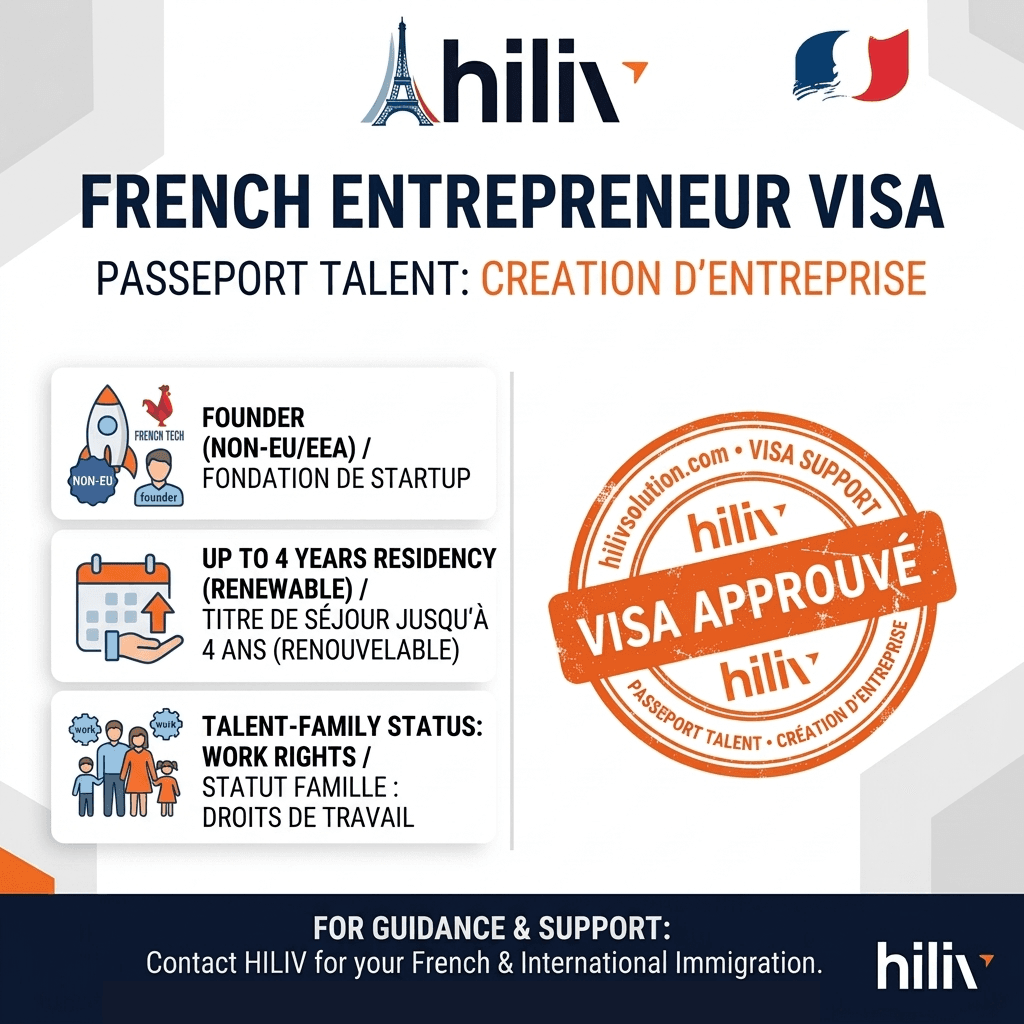
The French entrepreneur visa is part of the Talent Passport, specifically the “Business creation” category. It is aimed at founders and startup creators from outside the EU (nationals of countries outside the European Union and European Economic Area) who want to start or take over a business in France.
This long-stay visa lets you live in France while launching your company. Applicants first receive a long-stay visa, then a multi-year residence permit “Talent Passport - Business creation” of up to 4 years, renewable if the business continues, which allows you to work on your project in France. Your spouse and minor children can join you under the “Talent - Family” status, allowing them to live (and work) in France.
In short, the entrepreneur visa simplifies immigration for founders and reflects France’s support for international talent.
- ✓Visa renewable for several years
- ✓Family reunification (spouse and children under Talent - Family status)
- ✓Access to the French startup ecosystem (French Tech, incubators)
- ✓Ability to set up or invest in a French company
Need help with your talent visa for France?
Our team of experts helps you obtain your talent passport and settle in France.
More than 100 talent passports obtained
Eligibility criteria
To be eligible for the Talent Passport - Business creation, you must meet several conditions:
Minimum investment
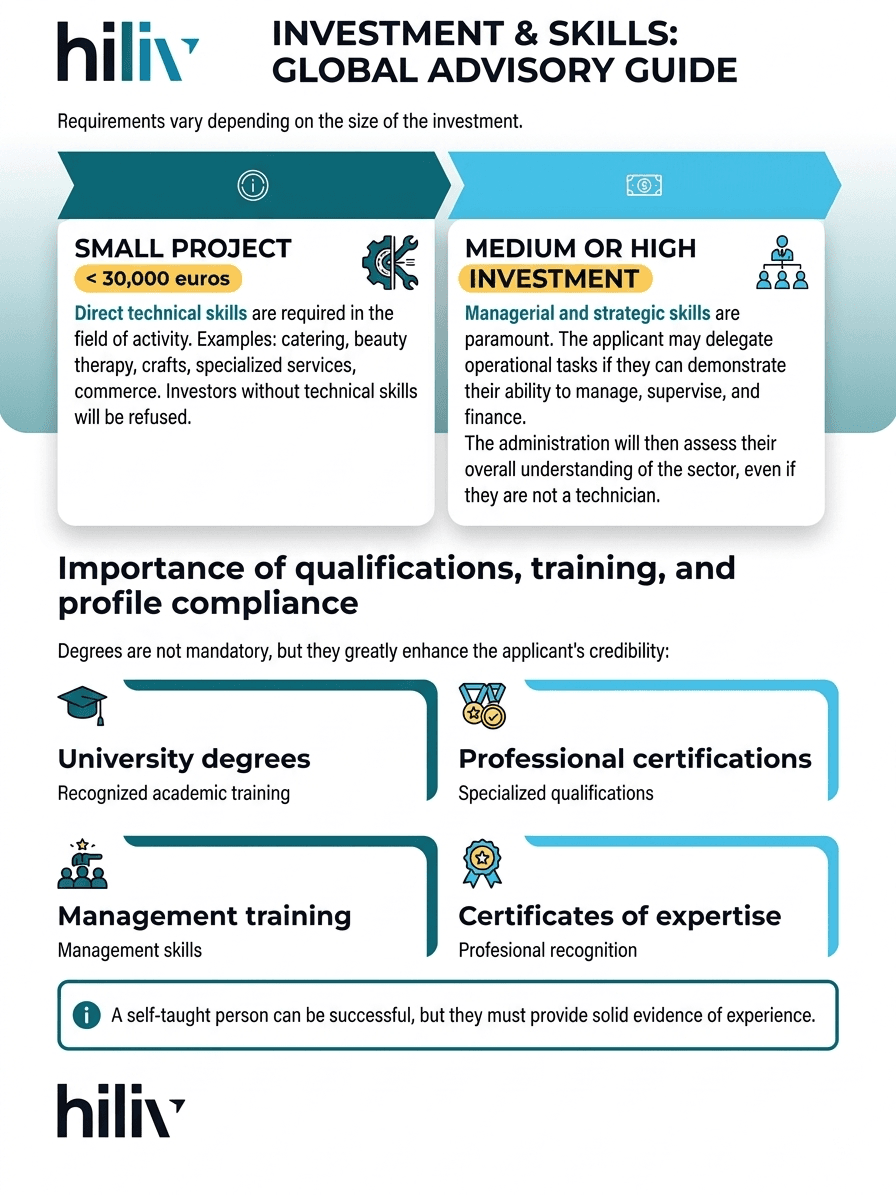
You must make a direct economic investment of at least €30,000 of personal funds in the business project. This capital must be invested directly in the company’s activity (e.g. as share capital, reinvested profits, or loans between affiliated companies) and demonstrates your commitment to creating the company. Purely financial investments are not eligible.
Business plan: “genuine and serious” project
Your business plan must describe a real, economically viable project. It should be solid, well documented, and have real market potential. The project must be validated as “genuine and serious” by a competent body (e.g. a public body or a structure recognised by the state). This attestation is generally required during the visa procedure. You will need to provide evidence and prove the viability of your business plan; this may include a letter certifying the solidity and feasibility of your project. This attestation shows the authorities that your project is credible.
Degree or experience
You must have a higher education degree (at least a Master’s or equivalent) or at least 5 years of professional experience at a comparable level. This criterion ensures the entrepreneur has the skills needed to run and develop the project (the degree or experience should be related to your sector, or demonstrate equivalent managerial ability).
Financial resources
You must have sufficient personal resources to support yourself (and your family) while the business gets off the ground. In practice, you must show that you have personal resources at least equivalent to the French gross annual minimum wage (SMIC), i.e. around €21,600 per year (2024), to support yourself during the launch phase. This criterion ensures you can cover your living costs before the company generates revenue.
Meeting all these criteria is essential. If your project involves a regulated activity (health, finance, etc.), you will also need to obtain the required licence or professional certification.
Application steps
Obtaining the entrepreneur visa involves several key steps:
1. Visa application
The first step is to submit a long-stay visa application to the French consulate or embassy in your country of residence. Depending on the length of your project, if your stay is less than one year, you will receive a long-stay visa equivalent to a residence permit (VLS-TS). This visa is marked as equivalent to a residence permit and requires specific validation after you arrive in France. Applications are made via the official France-Visas portal.
2. Arrival in France
Upon arrival in France, you must complete the required administrative steps, including validating your VLS-TS visa online or with the competent authority.
3. Multi-year residence permit application
Within three months of your arrival in France, you must apply for a multi-year residence permit at the prefecture, via the dedicated online platform administration-etrangers-en-france.interieur.gouv.fr. This step is essential to ensure the regularity of your stay and to continue your entrepreneurial activity.
3.1 Prepare the business plan and obtain certification
Write a detailed business plan covering the company, market research, investment needs and financial forecasts. If your project involves research or innovation, it is important to highlight research and development activities, as this strengthens the credibility and eligibility of your application. Submit this plan to the official platform or an approved body to obtain a viability attestation (“genuine and serious project”). This usually involves registering on Démarches Simplifiées and requesting an attestation from the Ministry of the Economy (DRIEETS). Once validated, you will receive an attestation valid for one year.
3.2 Gather the required documents
Collect all supporting documents for the visa application: project attestation, proof of personal investment (bank statements or loans), proof of resources or salary, degree or experience certificates, pre-incorporation documents (even if the company is not yet formed). Also have your passport, ID photos, and if needed a CV or cover letter. If necessary, have your documents translated into French: this speeds up the process. For a detailed list of documents, see our article on essential documents for a France visa application.
4. Submit the “Talent - Business creation” visa application
Submit your application via France-Visas or at the French consulate/embassy in your country of residence. Select the “Talent Passport - Business creation” category. Attach all supporting documents, especially the attestation and financial proof. Pay the application fee (approximately €99) and book an appointment for any interview. Once approved, the long-stay visa allows you to enter France for up to 4 years (renewable). If the stay is less than one year, you receive a VLS-TS to be validated online on arrival.
5. Arrive in France and register the company
Within two months of arrival, you must officially register your company, whether to start a business in France or launch a new venture. For a company (LLC/SARL, SAS, etc.), registration is done at the Register of Commerce and Companies (RCS) at the Commercial Court. This gives your company a SIRET number and legal existence. Alternatively, you can choose the micro-entrepreneur (micro-enterprise) status for a simpler setup. In all cases, define the legal form, address, and obtain any required licences. Opening a business bank account in France at this stage is essential to deposit the capital invested in the company.
6. Obtain the Talent Passport residence permit
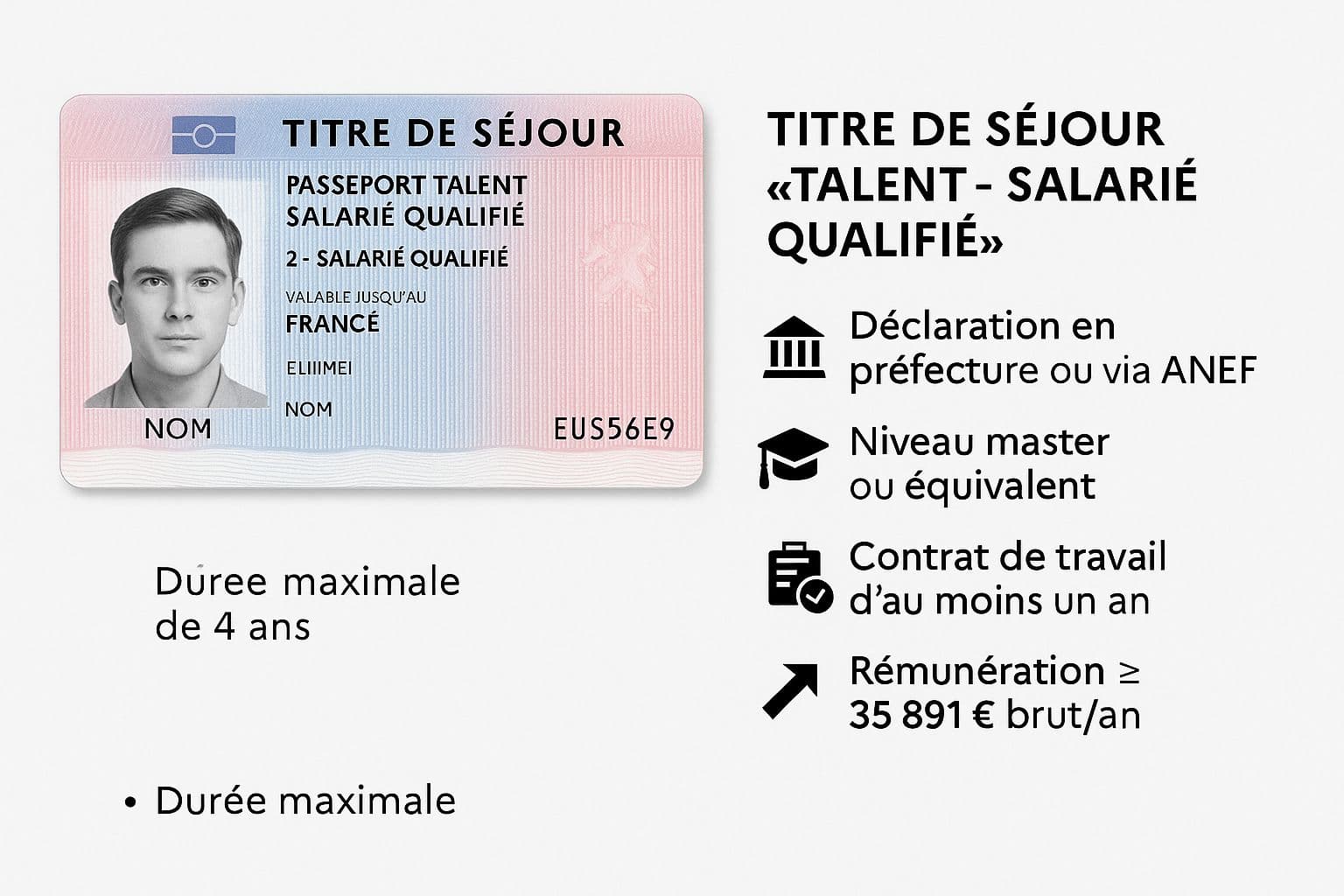
After registration, apply for the multi-year “Talent - Business creation” residence permit at the prefecture, via the dedicated online platform (link above), within the first two months after arrival. Submit all supporting documents again (passport, visa, attestation, proof of company registration, proof of resources, etc.). Note: the long-stay visa equivalent to a residence permit (VLS-TS) is equivalent to a residence permit until the final permit is issued. If a legal representative is involved in the procedure, you may need to provide documentation proving their mandate and authority. Once approved, you receive a residence permit valid for up to 4 years, depending on the project duration. The application fee is approximately €225.
By following these steps, from business plan certification to prefecture registration, you streamline your application.
After arrival: growing your business
Once the legal steps are done, focus on running your company in France.
As an entrepreneur, you can work as a self-employed person, which allows you to run your business independently in France.
In addition, developing an innovative economic project in France can open up further opportunities, including public support and access to certain specific visas.
Registration
Ensure the company is correctly registered. For a company (LLC/SARL, SAS), you must file annual accounts and comply with formalities. For the self-employed, ensure registration with the social security scheme (URSSAF or SSI) and commercial registration if required. Keep all documents (articles of association, K-bis extract, etc.) for any checks.
Tax and obligations
French companies pay corporation tax (26% to 28% in 2026) on profits, and may be liable for VAT, social contributions and local taxes. Micro-entrepreneurs pay a flat percentage on turnover. You must also ensure regular declarations: corporation tax, VAT (if applicable), social charges. It is strongly recommended to work with an accountant to navigate French rules and benefit from any schemes (e.g. Research Tax Credit). Payroll and social charges are high: factor these costs into your budget.
Hiring employees
You can hire French or EU nationals without additional formalities. For any employee from outside the EU, they must obtain their own residence permit or work visa (Talent Passport investor or skilled employee, or standard work authorisation). In practice, each foreign employee needs a valid visa or residence permit, sponsored by the company. Procedures for hiring foreign employees include applying for the appropriate visa and meeting French employment criteria. Note that innovative companies may benefit from specific schemes or visa programmes that make it easier to hire international talent. Important: your employees cannot “benefit” from your visa, except for family members under the Talent Family status. Comply with French labour law for contracts, hours, benefits, and declare all hires to URSSAF.
Meeting your obligations is essential: pay salaries through official payroll, comply with regulations, and file regular tax and social declarations. Once these basics are in place, you can focus on growing your startup in the French market.
Family and dependants
Bringing your spouse and children
When you move to France with a “Talent Passport” residence permit, you can bring your spouse and dependent children, which makes the transition to life in France easier for the whole family. Your family members will receive a multi-year residence permit allowing them to live, study and travel with you in France for the same duration as your permit. Your spouse and children will have access to public education and the healthcare system, which supports their wellbeing and integration in France.
To bring your family, you must prove that you have sufficient annual resources to support all dependants. The minimum required is an income at least equivalent to the French minimum wage (SMIC), i.e. around €21,600 per year in 2024. This financial threshold ensures your family can live comfortably in France without financial difficulty. The “Talent Passport” scheme is designed to facilitate family reunification, allowing business creators and foreign talent to settle in France with their loved ones.
Rights and procedures for family members
Family members who join you in France under the “Talent Passport” benefit from a set of rights and advantages. Spouses can work in France subject to obtaining the necessary authorisations; dependent children can attend public schools and access the healthcare system. The family members’ residence permit is linked to the main holder and is valid for the same maximum duration (up to 4 years, on a renewable multi-year basis).
If the main holder’s permit expires, family members must apply for a new permit to extend their stay. The application requires supporting documents (marriage or birth certificate, proof of resources, valid passport, documents proving your professional situation, e.g. an employment contract or business plan for your business project in France). Administrative fees: €225 for the spouse and €99 per visa for each accompanying family member.
The “Talent Passport - Family” permit is specifically designed for family reunification of founders, employees and other foreign talent. It allows family members to live, work and study in France, subject to a genuine and serious project and sufficient resources. This permit is renewable on a multi-year basis, depending on the nature of the project and the main holder’s current professional activity. In the event of divorce or separation, family members may be eligible to apply for a new permit if they can show sufficient income and stable housing in France. The French government’s approach, through the “Talent Passport” and related permits, aims to attract foreign talent and support the integration of their families into the French economy and society.
To apply for a permit for family members, contact the French embassy or consulate in your country, or the local authorities if you are already in France. Prepare all required supporting documents, including those proving your professional situation and family ties. The procedure is designed to be as smooth as possible for foreign creators and employees coming to France with the French Tech Visa or the “Talent Passport - Business creation” permit.
By meeting these conditions and following the right procedures, you ensure your family can fully enjoy life, work and study in France with you, while you build your business and your new life.
Case study: switching from visitor to entrepreneur status
If you are already in France on another visa or residence permit, it is often possible to switch to entrepreneur status.
Note
Change of status
The process must be started 2 to 4 months before your current permit expires. If you have a valid permit (student, talent, seasonal, etc.), you apply for the Talent - Business creation card via the Démarches Simplifiées platform (the same one used for attestations). You must meet all the usual criteria (degree/experience, investment, project attestation, etc.) and provide up-to-date documents to the prefecture. Once accepted, you receive the Talent card without having to leave France.
Note for visitors
If you are in France on a short-stay visa (Schengen or tourist) without a residence permit, it is generally not possible to change status from within France. You will need to return to your country of origin and submit a Talent Passport application at the local French consulate. Short-stay visa holders are therefore excluded from this route, as the entrepreneur visa requires a long-stay visa application from abroad.
This flexibility allows people already in France (e.g. students or early-stage entrepreneurs) to switch to the long-stay Talent permit, provided they meet all the criteria.
Conclusion: launching your startup in France
France offers a favourable environment for foreign entrepreneurs. Its dynamic startup ecosystem (French Tech, incubators, tax incentives, large domestic market) makes it an attractive place for innovative projects. Paris, Lyon and Toulouse are home to active tech hubs. Public schemes (Bpifrance, incubators) often support entrepreneurs and facilitate access to funding. Entrepreneurs can thus launch a development or investment project in France, supported by the local ecosystem and dedicated initiatives.
To navigate the administrative and cultural complexity of settling in, specialised services can help. Hiliv offers tailored support for entrepreneur relocation, for steps such as finding housing, opening a bank account, social protection, or connecting you with legal and financial experts. Using these services eases the transition and lets you focus on your project. Business France, as a reference body, also provides resources and support for visa procedures and integration into the French ecosystem. By meeting the entrepreneur visa conditions and making the most of the French business environment (and Hiliv’s support network), you maximise your chances of success in growing your startup in France.
Need help with your talent visa for France?
Our team of experts helps you obtain your talent passport and settle in France.
More than 100 talent passports obtained
Frequently asked questions
What is the minimum investment amount for the France entrepreneur visa?
You must make a direct economic investment of at least €30,000 of personal funds in the business project. This capital must be invested directly in the company’s activity (e.g. share capital, reinvested profits, or loans between affiliated companies). Purely financial investments are not eligible.
How do I get the “genuine and serious project” attestation for the Talent Passport?
Your business plan must be submitted to the official platform (Démarches Simplifiées) or an approved body to obtain a viability attestation. The attestation request is usually made to the Ministry of the Economy (DRIEETS). Once validated, you receive an attestation valid for one year. The project must be deemed economically viable and credible.
Can I bring my family with the entrepreneur visa?
Yes. Your spouse and minor children can join you under the “Talent - Family” status. They receive a multi-year residence permit allowing them to live, study and travel with you for the same duration as your permit. The spouse can work in France after obtaining the required authorisations. You must prove resources at least equivalent to the French minimum wage (SMIC) to support everyone.
Can I change status (e.g. from student) to entrepreneur from within France?
Yes, if you already hold a valid residence permit (student, talent, seasonal, etc.), you can apply for the Talent - Business creation card via the Démarches Simplifiées platform, 2 to 4 months before your current permit expires. You must meet all the usual criteria (degree/experience, investment, project attestation). However, with a short-stay visa (Schengen/tourist) only, you cannot change status from within France: you must return to your country and apply at the consulate.
What are the deadlines for registering the company after arrival in France?
You must officially register your company within two months of your arrival in France. Registration is done at the Register of Commerce and Companies (RCS) at the Commercial Court for an LLC (SARL), SAS, etc. This gives your company a SIRET number and legal existence. Opening a business bank account in France is essential at this stage to deposit the invested capital.
What are the visa and residence permit application fees?
For the “Talent Passport - Business creation” visa application, the fee is approximately €99. For the multi-year residence permit issued by the prefecture after your arrival, the fee is approximately €225. For family members: €225 for the spouse and €99 per visa for each accompanying member.