French Student Visa Application: Requirements & Process 2026
Complete guide to obtaining a French student visa (VLS-TS). Requirements, step-by-step process, documents needed, and tips for international students in 2026.

International Mobility Expert
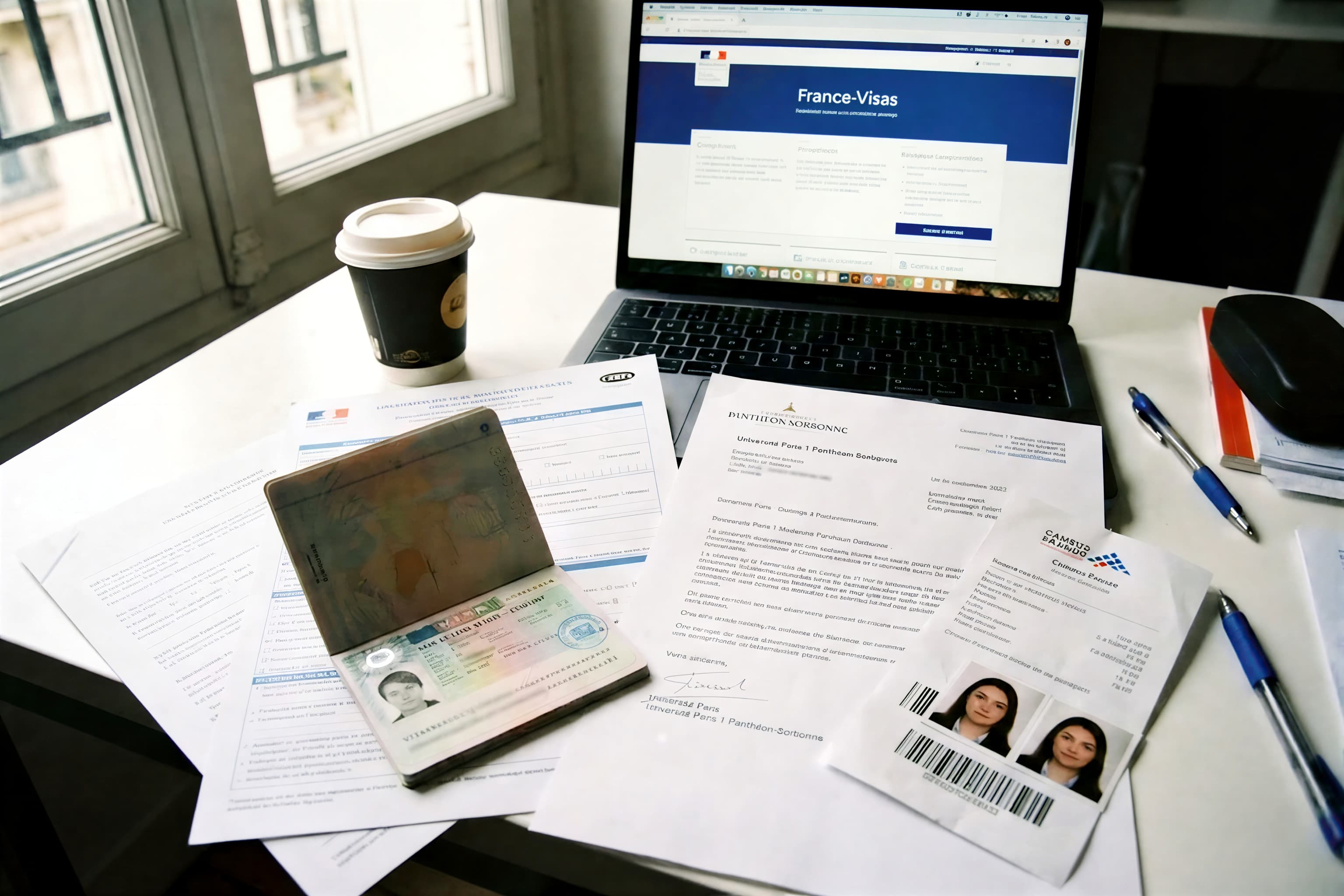
International students planning to study in France must often secure a French student visa before traveling. This guide covers what a French student visa is and who needs one, outlines the different visa types available, and highlights the visa application process as a key topic. We also detail the requirements, step-by-step application process, and offer tips for a successful application. Finally, we discuss next steps after visa approval and how Hiliv can assist you in your French study journey.
What Is a French Student Visa and Who Needs It?
A French student visa is an official authorization that allows international students to study in France. The most common long-stay student visa is the VLS-TS (Visa Long Séjour valant Titre de Séjour – étudiant), which acts as a residence permit for studies up to one year. Shorter programs may use a Schengen short-stay student visa for stays up to 3 months. It demonstrates to French authorities that you meet entry requirements and allows you to stay in France for your studies. Students must typically apply for their visa from their home country before traveling to France.
Overview of French Student Visa (VLS-TS Étudiant)
The VLS-TS (student) is a long-stay visa valid for up to one year and serves as a temporary residence permit: in practice, the VLS-TS stay covers the first year, and this VLS residence permit allows you to remain legally in France to study. It is issued to students enrolled in undergraduate or graduate programs. After arriving in France, you must validate this visa online through the French Ministry of Interior website (ANEF portal) within 3 months of your arrival; this formality is completed after you enter French territory, and completing these necessary steps upon arrival in France is essential for a lawful stay. The VLS-TS allows you to live and study in France for the length of the visa, with the option to renew each year if your program continues, notably via a residence card (carte de séjour). Holders of a VLS-TS can also work part-time up to 964 hours per year, without prior authorization, which corresponds to 60% of the normal working time in France. Algerian nationals, however, may only work up to 50% of annual working time. To validate your VLS-TS, you will need to pay a validation fee of €50 online. A €150 tax then applies for renewing student status.
Do You Need a Student Visa? (EU vs. Non-EU, Short Stay vs. Long Stay)
- EU/EEA/Swiss Citizens: Citizens of the European Union, European Economic Area, and Switzerland do not need a visa to study in France, regardless of program length. They may enter freely with a valid ID or passport but should still have health insurance and sufficient financial resources.
- Non-EU Citizens (short stay): A short-stay student visa (Schengen visa) may be required if you are from a non-EU country and your course lasts 90 days or less, unless your nationality is exempt. This applies to short language courses, summer school, or exam visits. Some countries (like the USA, Canada, Australia, etc.) are visa-exempt for stays under 90 days. Requirements for a short-stay visa may differ for students from non-European countries, depending on your nationality.
- Non-EU Citizens (long stay): If you are a foreign student who wants to come study in France on a program longer than 3 months, you must apply for a long-stay student visa (VLS-TS). This visa will allow you to study for up to one year in France, after which you can renew or extend it if necessary.
Important note for students with EU residence permits from other countries: Students who are nationals of countries outside the EU/EEA/Switzerland must apply for a French student visa even if they already hold another European residence permit. The only exceptions are: (1) if your student residence permit already bears the mention "mobility" (or "§16b Abs 1" for German residence permits), or (2) if you hold a valid "long-term resident" card (carte de résident longue durée union européenne) delivered by another EU country. Students with a "long-term resident" card who arrive in France must apply for a French student residence permit within 3 months of their arrival via the ANEF portal.
Please note that enrolment conditions differ depending on your nationality, so always check the specific requirements for your country.
Types of French Student Visas
France offers several main categories of student visas:
- Short-Stay Student Visa: For studies or programs lasting up to 3 months (e.g. language courses, exchange visits, exams). This is a standard Schengen C visa marked for study purposes and is also suitable for those attending a training course or short-term educational program. The short stay visa is commonly used for students enrolling in brief courses or diploma preparations.
- Long-Stay Student Visa (VLS-TS): For academic programs longer than 3 months (typically 4 months to 1 year, and renewable). The VLS-TS "étudiant" visa must be validated within 3 months of arrival and functions as a residence permit. Students in degree programs (Bachelor’s/Master’s) generally receive this visa.
- Special Short-Stay "Étudiant-Concours" Visa: This visa is for attending entrance exams or interviews in France (valid up to 90 days). Note: This visa is specifically designed to allow successful candidates to regularize their situation directly at the prefecture without returning to their home country to apply for a long-stay visa.
- Temporary Long-Stay Visa (VLS-T): This visa allows you to stay in France for 4 to 12 months to obtain a higher education diploma. Unlike the VLS-TS, it does not need to be validated upon arrival. However, it cannot be renewed and does not grant the same rights as VLS-TS (such as the ability to work part-time).
Choose the visa type based on your program length and goals. The VLS-TS gives broader rights (e.g. ability to work part-time, renewability) compared to a short-stay Schengen visa. When applying, students should carefully consider the nature of their training course, as well as their courses and diploma preparations, to ensure they select the correct visa category.
Need help with your student visa for France?
Our team of experts guides you through all the steps to obtain your French student visa.
More than 300 student visas obtained
French Student Visa Requirements
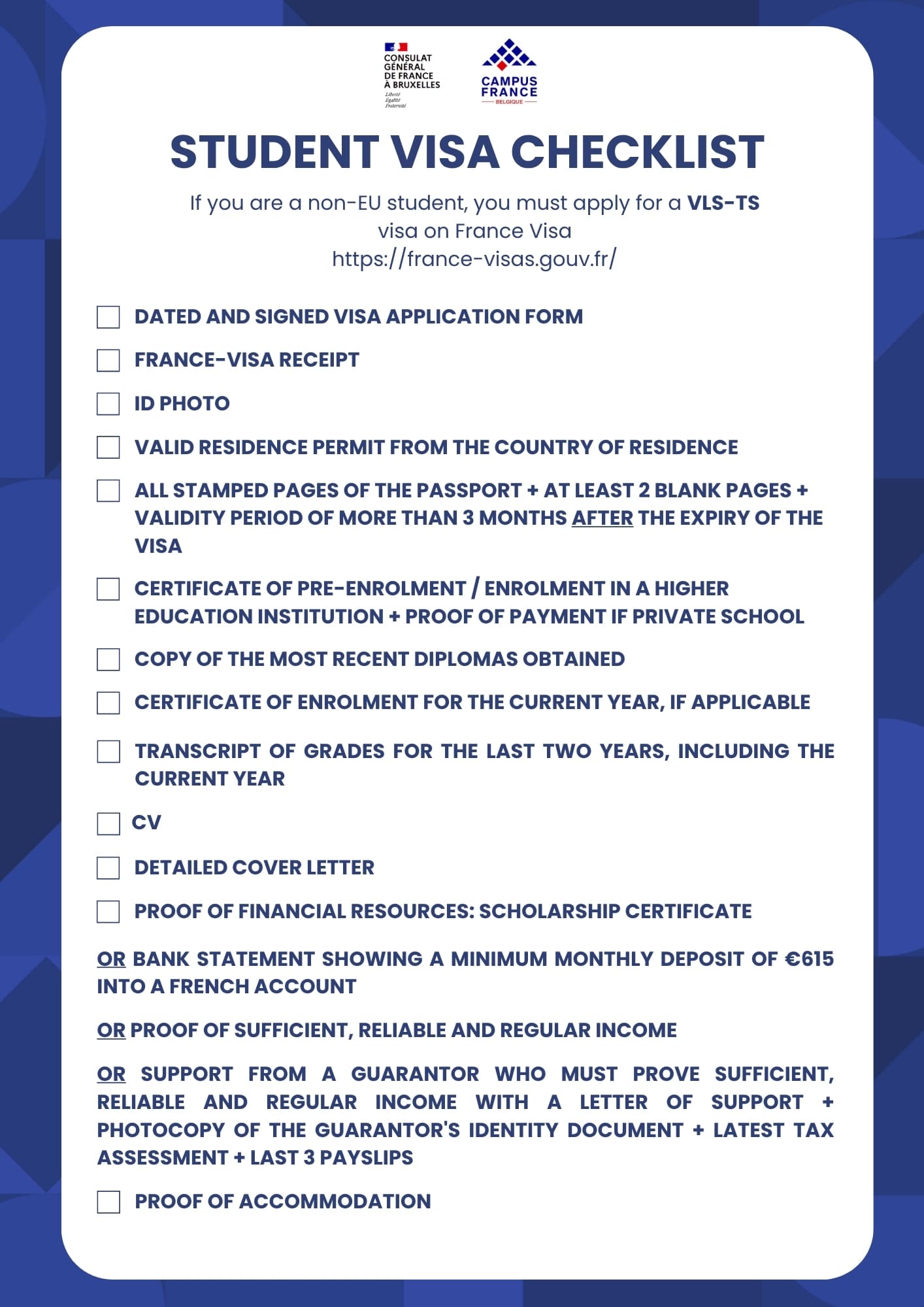
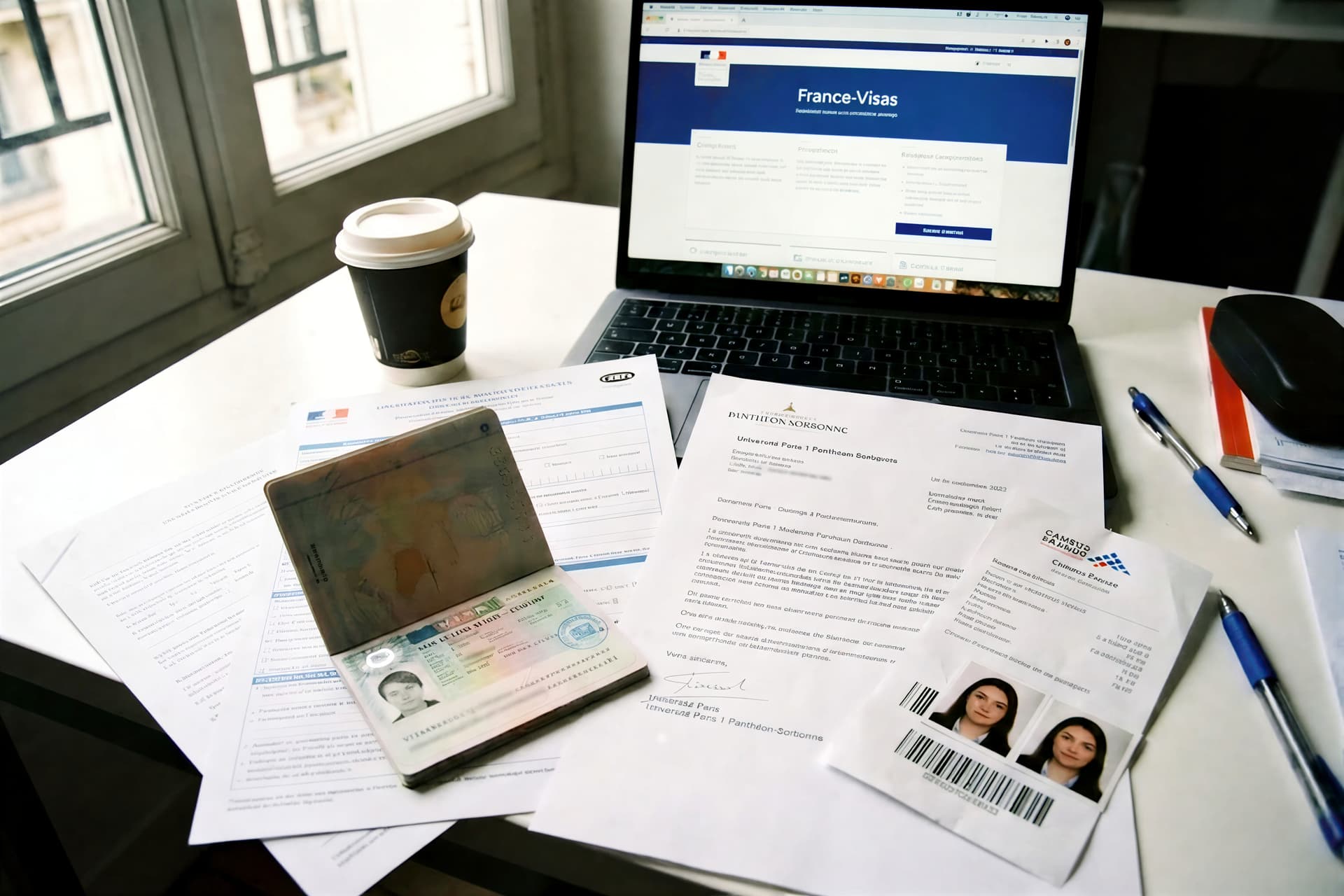
To apply for a French student visa, gather these essential documents, including all the required documents and supporting documents needed for your application. Supporting documents to provide include in particular a valid passport and an admission certificate. The documents required may vary depending on your program and nationality.
- Completed visa application form
- Valid passport
- Recent passport-sized photographs
- Acceptance certificate from a French institution
- Proof of accommodation in France
- Proof of sufficient financial resources to meet visa requirements
- Proof of medical insurance
- Other supporting documents, including proof of address and financial resources
Make sure to bring all the documents required, including the CERFA form, receipts, and any additional supporting paperwork, to your appointment at the visa centre or embassy. Prepare all the documents in advance to avoid delays in your application process.
Acceptance Letter from a French Institution
You must have an official acceptance letter from a recognized French university or school, as well as an enrollment certificate if it has already been issued. This document should confirm your admission to a higher education institution, your effective enrollment in the program, the start date, and the duration of studies. Visa officers use this letter to verify that you are enrolled in a legitimate course and also appreciate the coherence of your academic path.
Financial Means Proof (bank statements, scholarship)
France requires proof that you can financially support yourself. Generally, you need about €615 per month for living expenses; from 1 August 2026, the minimum will be €877.50 per month. You can demonstrate this through the following elements and, depending on the case, other supporting documents may be requested:
- Recent bank statements in your name or a sponsor’s name
- A blocked account showing sufficient funds
- A scholarship award letter
- An official letter from a sponsor or family member.
Make sure your proof clearly covers the full duration of your stay.
Health Insurance Coverage
Valid health insurance is mandatory. If you are under 28 or an EU citizen, you can usually register for French student social security (CPAM) after arrival, online on the official website. Otherwise, purchase private international student insurance covering at least one year of medical expenses in France. EU students should present a valid European Health Insurance Card (EHIC). Attach proof of your insurance policy or EHIC to your visa application.
Valid Passport and Passport Photos
Provide a passport that is valid for at least six months beyond your planned stay and has blank visa pages. Include two recent passport-size photos that meet French visa standards (35x45mm, white background, no shadows). Ensure photos are printed on quality photo paper and match the consulate’s guidelines.
Need help with your student visa for France?
Our team of experts guides you through all the steps to obtain your French student visa.
More than 300 student visas obtained
Application Process Step-by-Step
Follow these steps to obtain a student visa for France, as the procedure includes several key steps:
- Check if you need to follow the Campus France "Études en France" procedure: For students from certain countries (listed on the France-Visas website), you must follow the compulsory "études en france" / "Study in France" procedure through Campus France before applying for your visa. This is a separate process managed by the Campus France office in your country and, for some countries, creating your online file is done on this platform with the submission of applications and supporting documents. Depending on the country or file, this procedure may also condition admission and include an academic interview. Without completing this procedure, the French Consulate will refuse your visa application.
- Complete the online application form: For all countries, the procedure starts online on the official France-Visas website, where the long-stay visa application form must be completed online. For long-stay student visas, you now have the option to submit digital copies of your supporting documents directly when filling out your online application. This optional feature can speed up the process at the visa application center. Note: You must still print your final application form (CERFA) without the word "DRAFT" and bring all original documents to your appointment.
- Schedule and attend your in-person visa appointment: After submitting your online visa application, visa applicants are required to schedule and attend an in-person visa appointment at the visa center or French consulate. Processing times vary by country and season, but you should allow at least 15 days for visa processing. Applications can be submitted no earlier than 3 months before your departure date for long-stay visas. At the visa center, you will submit your application, provide biometric data, and hand in your paperwork. Pay the visa fee at this stage. A service fee may also be charged at the visa center, depending on your location.

Schedule and Attend Visa Appointment
After submitting your online application, schedule an appointment at the French consulate or visa center (TLS/VFS) in your country; this service provider may also charge a service fee. At your in-person visa appointment, you will:
- Present all the required documents, including your printed application form, original documents, and copies.
- Provide biometric data (fingerprints and a digital photo).
- Pay the visa fee (for some countries, the cost of a VLS-TS or student visa is €99). Fees may vary depending on the student’s nationality.
- Attend a brief interview if required. Be prepared to explain your study plans, choice of school, and how you will finance your stay. Student visa processing times generally range from a few days to two weeks depending on the country and period. Stay honest and concise.
Pay Visa Fees and Await Processing
Visa fees vary by country and visa type (typically 50-100 EUR). Processing times also vary but generally take a minimum of 2-3 weeks. Pay this at your appointment (some centers require payment in advance). The process can begin no sooner than 90 days (3 months) and no later than two weeks before the departure date for long-stay visas.
Check with the consulate for local timelines. During this period the consulate may request additional paperwork, so respond quickly if contacted.
Need help with your student visa for France?
Our team of experts guides you through all the steps to obtain your French student visa.
More than 300 student visas obtained
Tips for a Successful Application
Start Early and Double-Check Documents: Begin your application at least 3 months before your planned departure. Use a checklist to ensure you have all required documents (completed forms, photos, acceptance letter, financial proof, etc.) correctly prepared. Incomplete applications are the most common reason for delays or refusals.
Tip: Make sure your diploma preparations and academic qualifications meet the French requirements before applying. Understanding the diploma requirements and course setup is essential for a smooth application process.
Tip: If you plan to enroll in a French language course, such as an intensive French language program, include this in your application and highlight your commitment to language proficiency.
Tip: Students from other countries should check for any additional requirements or procedures specific to their country of origin, as visa application steps and enrollment conditions may vary.
Prepare for Interview Questions about Study Plans
Practice answering typical visa questions. For example, be ready to discuss why you chose your program and university, your career goals, and how you will support yourself. Clear, confident answers will impress the visa officer.
Avoid Common Mistakes
Submit fully completed and signed forms. Ensure your passport meets validity and size requirements. Don’t submit outdated financial documents. Label everything clearly. If translations are needed, use a certified translator. Attention to detail builds confidence in your application.
Next Steps After Visa Approval
- Traveling to France: Once your visa is granted and approved, double-check the dates and spelling on the visa sticker. Check the exact wording in the remarks section of your visa, as different visa types require different steps upon arrival in France. Book your travel and arrive in France before your course start date. Keep all visa documents handy for border control.
- Validating the Visa as a Residency Permit: If you have a VLS-TS, you must validate it within 3 months of arrival. This involves completing an online validation through the French Ministry of Interior website (ANEF portal) and paying a validation fee of €50. You will need: a valid email address, your VLS-TS visa, your date of entry into France, your address in France, and a credit card to pay the fee.
Sometimes a health check is required. After validation, you will receive a confirmation by email of the registration of your visa, and your residence permit will be the visa on your passport along with the online validation PDF.
- Registering at University and Opening Bank Account/CPAM: Enroll at your French school or university as soon as possible to activate your student status. To obtain a student status in France, you must complete university registration and any required formalities. If your permanent housing is not yet available, you can use a temporary address for the first three months. As proof of accommodation, a hotel reservation may be accepted in some cases. An attestation d’accueil (hosting certificate) can also serve as proof of accommodation. Open a French bank account to manage finances (many banks offer student accounts). Register for French health insurance (CPAM) through the government website. Campus France and your university will typically provide guidance on these steps.
Conclusion – Beginning Your Studies in France
Obtaining a French student visa is a detailed process, but with careful preparation and reliable information, you can make it smooth. Keep organized records, follow official guidelines, and meet all deadlines. Before you know it, you’ll have your visa and be on your way to an exciting academic adventure in France.
Encouragement and How Hiliv Can Assist
Studying in France is a rewarding experience, and Hiliv is here to help make it easier. From guidance on visa requirements to finding housing and settling in — with some universities also offering a buddy system to help international students integrate upon arrival — our expert team can assist you at every stage. With the right support and preparation, you'll be ready to start your French education journey with confidence!
Need help with your student visa for France?
Our team of experts guides you through all the steps to obtain your French student visa.
More than 300 student visas obtained
Frequently Asked Questions about French Student Visas
Do EU citizens need a visa to study in France?
No, citizens of the European Union, European Economic Area, and Switzerland do not need a visa to study in France, regardless of program length. They can enter freely with a valid ID or passport but should still have health insurance and sufficient funds.
What is the difference between a short-stay and a long-stay student visa?
A short-stay visa (Schengen) is for studies lasting up to 90 days. A long-stay visa (VLS-TS) is for programs longer than 3 months (typically 4-12 months) and acts as a residence permit, allowing you to work part-time and renew it in France.
What is a VLS-TS étudiant visa?
The VLS-TS (Visa Long Séjour valant Titre de Séjour - étudiant) is a long-stay visa valid for up to one year that serves as a temporary residence permit. In practice, the VLS-TS stay covers the first year. It allows you to live and study in France, work part-time up to 964 hours per year without prior authorization (60% of normal working time), and can be renewed annually via a residence card if your program continues. A €150 tax applies when renewing student status.
What is the "Étudiant-Concours" visa?
This is a special short-stay visa (up to 90 days) designed for attending entrance exams or interviews in France. It allows successful candidates to regularize their situation directly at the prefecture without returning to their home country to apply for a long-stay visa.
What is the difference between VLS-TS and VLS-T visas?
The VLS-T (Temporary Long-Stay Visa) allows you to stay in France for 4 to 12 months but does not need validation upon arrival. However, unlike VLS-TS, it cannot be renewed and does not grant the right to work part-time.
When should I start my visa application?
You should start the process at least 3 months before your program start date. Applications can be submitted no earlier than 3 months before your departure date for long-stay visas. Processing times vary but generally take a minimum of 2-3 weeks.
What is the Campus France "Études en France" procedure and which countries are concerned?
For students from certain countries (listed on France-Visas), you must complete a compulsory "études en france" / "Study in France" procedure through Campus France before applying for your visa. This includes creating an online file, submitting applications and supporting documents, and potentially attending an academic interview. Depending on the country, this procedure may also condition admission. Without this, the French Consulate will refuse your visa application.
How much money do I need to prove for the visa?
France requires proof that you can financially support yourself, generally about €615 per month for living expenses; from 1 August 2026, the minimum will be €877.50 per month. You can demonstrate this through recent bank statements, a blocked account, a scholarship award letter, or an official letter from a sponsor. Depending on the case, other supporting documents may be requested.
What proof of accommodation is accepted, knowing that requirements may vary by country of origin?
You must provide proof of accommodation in France. If your permanent housing is not yet available, a temporary address can be used for the first three months. A hotel reservation may be accepted in some cases, and an attestation d’accueil (hosting certificate) can also serve as proof of accommodation. Exact requirements may vary depending on your consulate and country of origin.
What kind of health insurance do I need?
Valid health insurance is mandatory. If you are under 28 or an EU citizen, you can usually register for French student social security (CPAM) after arrival, online on the official website. Otherwise, purchase private international student insurance covering at least one year. EU students should present a valid European Health Insurance Card (EHIC).
Can I work in France with a student visa?
Yes, if you hold a valid VLS-TS (long-stay student visa), you are allowed to work up to 964 hours per year (60% of normal working time), without prior authorization. Algerian nationals are limited to 50% of annual working time. The VLS-T does not grant this right.
Do I need to validate my visa upon arrival?
Yes, if you have a VLS-TS, you must validate it online via the ANEF portal (French Ministry of Interior website) within 3 months of your arrival in France. You will need to pay a validation fee of €50. This validation makes your visa a valid residence permit.
What documents do I need to validate my VLS-TS online?
You will need: a valid email address, your VLS-TS visa, your date of entry into France, your address in France, and a credit card to pay the €50 validation fee. After validation, you will receive a confirmation by email.
Can I submit digital copies of documents with my visa application?
Yes, for long-stay student visas, you now have the option to submit digital copies of your supporting documents when filling out your online application. However, you must still print your final application form (CERFA) and bring all original documents to your appointment.
What are the passport requirements for a French student visa?
Your passport must be valid for at least six months beyond your planned stay and have blank visa pages. You also need two recent passport-size photos (35x45mm, white background, no shadows) printed on quality photo paper.
Do I need a visa if I have a residence permit from another EU country?
Yes, students from non-EU countries must apply for a French student visa even with another European residence permit. Exceptions: (1) if your permit has the "mobility" mention (or "§16b Abs 1" for German permits), or (2) if you hold a valid "long-term resident" card from another EU country. In the latter case, you must apply for a French student residence permit within 3 months via ANEF.
Are there specific formalities for mobility students from member states participating in certain programs?
Yes. If your student residence permit issued by another EU member state already bears the "mobility" mention (or "§16b Abs 1" for German permits), you may be exempt from applying for a French student visa under certain mobility programs. Always check with Campus France and the consulate for the conditions that apply to your situation.
What specific supporting documents are required for a vocational training application?
For vocational training, in addition to the standard documents (passport, financial resources, insurance, accommodation), provide an acceptance or enrollment certificate issued by the training organization, specifying the nature, duration, and dates of the program. Depending on the case, the consulate may request additional documents related to your background and the coherence of your training project.
How much does the visa cost?
Visa fees vary by country and visa type, typically ranging from €50-100; for some countries, the cost of a VLS-TS or student visa is €99. A service fee may also be charged at the visa center depending on your location. You will also need to pay a €50 validation fee for VLS-TS visas after arrival, then a €150 tax when renewing student status.
What happens at the visa appointment?
At your in-person visa appointment, you will present all required documents, provide biometric data (fingerprints and digital photo), pay the visa fee, and potentially attend a brief interview about your study plans and finances. Processing times generally range from a few days to two weeks depending on the country and period.
What should I do after my visa is approved?
After approval: (1) Double-check the visa dates and spelling, (2) Book travel to arrive before your course starts, (3) Validate your VLS-TS online within 3 months via ANEF, (4) Enroll at your university, (5) Open a French bank account, and (6) Register for French health insurance (CPAM).