French Student Visa Requirements: The Complete Guide for 2026
Studying in France? This complete guide for 2026 covers everything about French student visa requirements, from application steps and VLS-TS validation to financial proof and accommodation documents.

International Mobility Expert
Studying in France means navigating one of Europe’s most structured visa systems. Whether you’re eyeing the Sorbonne, a business school in Paris, or a language course in Lyon, understanding french student visa requirements is the first step toward making it happen.
The whole process might seem overwhelming at first glance—Campus France accounts, consulate appointments, validation deadlines. But here’s the reality: thousands of international students complete this process successfully every year, and with the right preparation, you can too.
This guide breaks down everything you need to know about obtaining a student visa for France, from eligibility and document checklists to post-arrival obligations. Let’s get you ready to study abroad in France.
Table of Contents
Key Takeaways
- Most non-EU/EEA/Swiss students need a French student visa (VLS-TS) for study programs over 90 days and must apply before arriving in France.
- Core student visa requirements include an official acceptance letter from a French institution, a valid passport, proof of funds (minimum €615 per month), and proof of accommodation for at least the first three months.
- Students from certain countries must first complete Campus France registration (check if your country requires the 'CEF procedure'). All students must then fill out the France-Visas online application form and book a consulate or VFS appointment 1–3 months before their departure date.
- Long stay visa holders must validate their visa online within 3 months of arrival via the ANEF. This VLS-TS (visa like titre de séjour) already functions as a residence permit. Students who wish to extend their stay beyond the initial visa period must apply for a residence permit renewal 2-3 months before expiration.
- Processing times vary depending on country and season, so students should apply as soon as the consulate allows—often up to 3 months before the program start date.
Who Needs a French Student Visa?
Your visa requirements depend on two factors: your nationality and how long you plan to study in France. Let’s break this down clearly.
Non-EU/EEA/Swiss citizens generally need a student visa to study in France. This includes students from:
EU, EEA (Iceland, Norway, Liechtenstein), and Swiss nationals can study in France without a visa. You’ll still need a valid passport or national ID card, and you may need to register with local authorities once you arrive on French territory.
Short Programs
Some nationalities—including citizens of Singapore, South Korea, and several Latin American countries—can enter France visa-free for short stays. However, if you’re planning long-term studies, you’ll still need to obtain a student visa before you can legally enroll.
Types of French Student Visas
France offers several study-related visa categories. Choosing the right one depends on your program length and purpose.
Short-Stay Study Visa (Type C)
This visa covers courses, exams, or language programs lasting up to 90 days. Common uses include:
- Summer language intensive courses
- Short-term research visits
- Entrance exams at French institutions
The short stay visa doesn’t require validation upon arrival and allows stays up to 90 days within any 180-day period within the Schengen Area.
Long-Stay Student Visa (VLS-TS "Étudiant")
This is the standard french visa for international students pursuing:
- Full-time degree programs (Bachelor’s, Master’s, PhD)
- Exchange programs lasting 3–12 months
- Language courses exceeding 90 days
The VLS-TS serves a dual purpose—it functions as both an entry visa and a temporary long stay visa equivalent to a residence permit for your first year. Visas issued under this category are typically valid for 4–12 months and renewable in France.
Étudiant-Concours Visa
If you’re traveling to France specifically to sit an entrance exam at a French institution, this temporary visa allows you to:
- Enter France for the exam
- Return home after the exam
- Apply for a full student visa if admitted (without leaving France in some cases)
Mineur Scolarisé Visa
For students under 18 enrolling in French schools, the school going minor visa applies. Requirements differ significantly:
- Parental authorization documents required
- Guardian arrangements in France must be documented
- Additional safeguarding documentation
Core French Student Visa Requirements
While exact requirements vary depending on your home country and the consulate handling your application, the following documents are standard across most visa applicants.
Passport Requirements
| Requirement | Specification |
|---|---|
| Validity | At least 3 months beyond planned departure from Schengen Area |
| Blank pages | Minimum 2 visa pages available |
| Issue date | Within the last 10 years |
Official Acceptance Letter
You need written proof of admission from a recognized French institution. This document must clearly show:
- Course title and level (Bachelor’s, Master’s, language course, etc.)
- Program duration with start and end dates
- Full-time enrollment status
An official acceptance letter or pre-registration confirmation (attestation de pré-inscription) from your university, grande école, or language school is non-negotiable.
Accommodation Evidence
Consulates require proof of housing for at least your first three months in France:
- University housing: CROUS or campus residence confirmation
- Private rental: Signed lease in your name
- Host family: Attestation d’hébergement (hosting letter) with the host’s ID and recent utility bill
- Temporary: Hotel booking or short-term rental for initial period
Financial Proof
France enforces strict financial self-sufficiency requirements. The minimum threshold is approximately €615 per month (around €7,380 for a full academic year).
Acceptable documents required include:
- Personal bank statements from the last 3–6 months
- Scholarship award letters from official bodies
- Sponsor’s financial guarantee with their bank statements
- Proof of government-funded or employer-funded programs
Large, last-minute deposits raise red flags. Consulates look for consistent, regular income that demonstrates genuine financial stability.
Health Insurance
Requirements differ by visa type:
- Short-stay: Schengen-compliant travel insurance (minimum €30,000 coverage for medical and repatriation)
- Long-stay: Private coverage initially, then enrollment in French student social security (Sécurité Sociale)
Additional Supporting Documents
| Document | Details |
|---|---|
| Visa application form | Completed via France Visas website |
| Photos | 2 recent biometric photos (EU format: 35x45mm, white background) |
| Travel itinerary | Flight booking or reservation (not necessarily fully paid) |
| Visa fee receipt | France Visas receipt showing payment |
| Academic records | Transcripts, diplomas, school reports |
| Language certificates | DELF/DALF for French programs, IELTS/TOEFL for English-taught courses |
All the documents in languages other than French or English typically need certified translations.
Need help with your student visa for France?
Our team of experts guides you through all the steps to obtain your French student visa.
More than 300 student visas obtained
Campus France Registration (If Applicable)
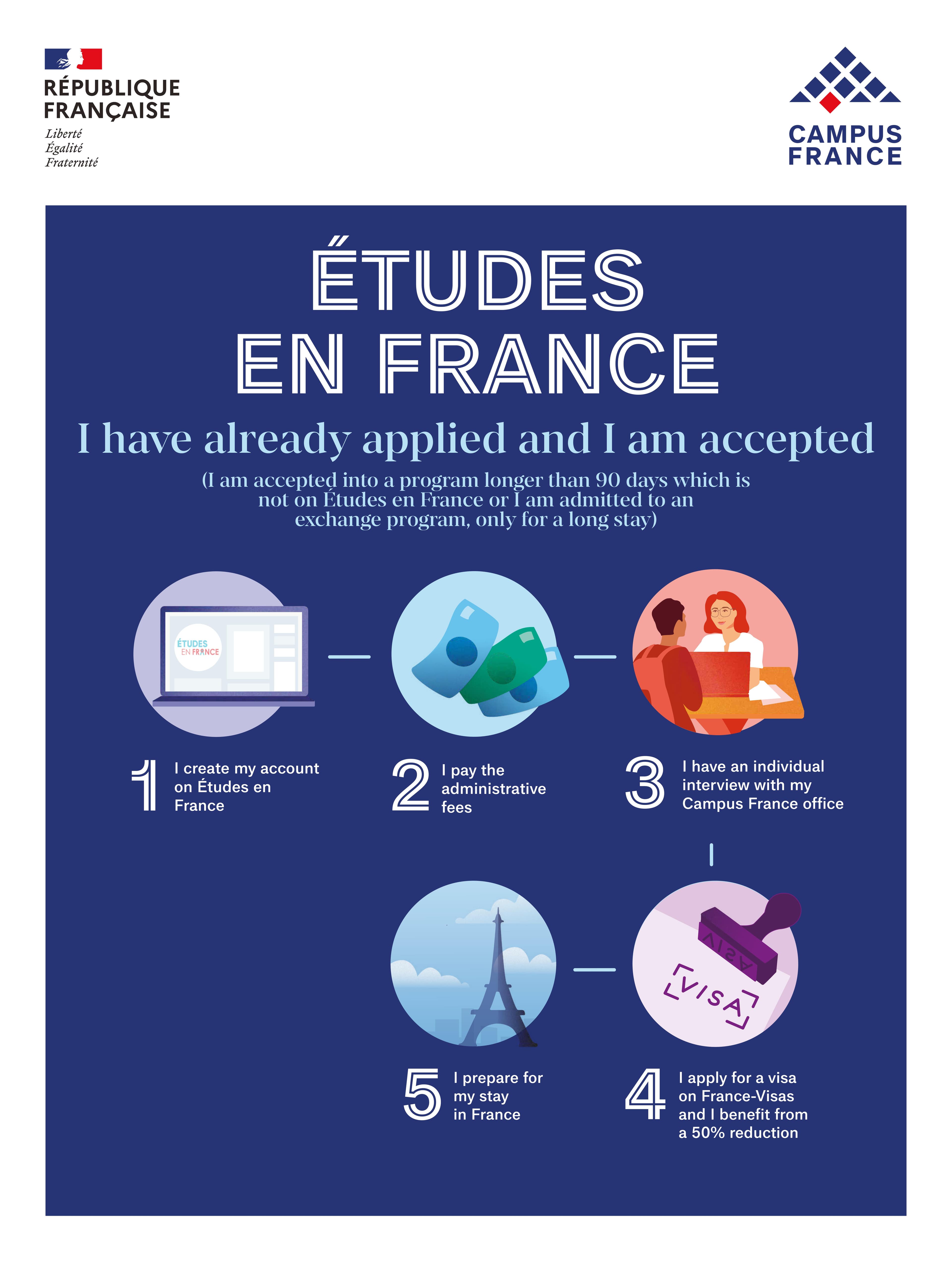
Many students from non European countries must complete the Campus France procedure before the French consulate will accept a visa application. This extra step adds time to your application process, so plan accordingly.
Countries Requiring Campus France
The "Etudes en France" platform is mandatory for students from countries including:
- Algeria, Morocco, Tunisia
- Brazil, Mexico, Argentina
- China, Vietnam, India
- Nigeria, Senegal, Cameroon
- United States (Campus France USA)
- Turkey, Russia
Check the official Campus France website for the definitive, up-to-date list of participating countries.
Campus France Application Steps
- Create an account on the Etudes en France portal
- Upload documents: Academic transcripts, diplomas, CV, passport copy
- Select French programs and submit applications to institutions
- Pay the Campus France fee (typically €100–€200, varies by country)
- Attend an interview (some countries require this to assess academic motivation)
- Receive validation and the “attestation” approval
The Campus France registration process can take 2–3 weeks during busy periods, especially before Fall semester applications. Build this time into your planning.
Once Campus France validates your file and issues approval, you can proceed to your online visa application through France Visas.
How to Apply for a French Student Visa
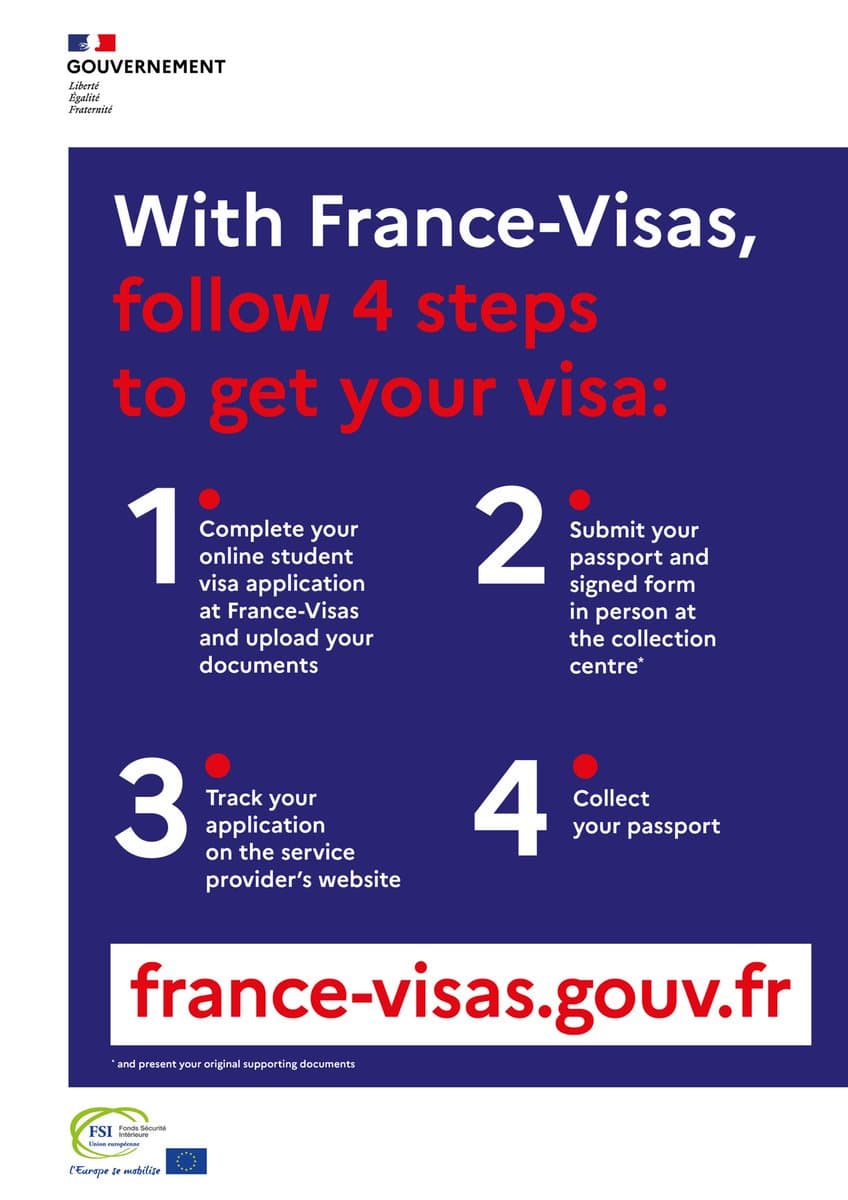
The visa application process combines an online application on the France Visas portal with an in person visa appointment at your French consulate or an external service provider like VFS or TLS.
Step 1: Start Your Online Application
Visit the france visas website (france-visas.gouv.fr) to:
- Check eligibility using the visa wizard
- Select “Long-stay student” as your visa type
- Complete the online visa application form
- Upload required document scans
- Generate your application reference number
After completing the visa online form, print your France Visas receipt—you’ll need this for your appointment.
Step 2: Book Your Visa Appointment
Schedule an appointment at:
- Your local French embassy or French consulate, OR
- A visa centre operated by VFS Global or TLS Contact
When to apply: Most consulates accept applications starting 90 days (3 months) before your course start date. Aim to book your appointment 1–3 months before your planned departure.
Hiliv Tip
Step 3: Attend Your In Person Visa Appointment
At the appointment, you’ll:
- Submit originals and copies of all the required documents
- Provide biometric data (fingerprints and photo)
- Pay the service fee and visa fee (approximately €50–€99)
- Answer brief questions about your study plans
Step 4: Track Your Application
You’ll receive a tracking number to monitor your visa process. Passports are typically returned with the visa approved via courier or in-person pickup after processing.
Need help with your student visa for France?
Our team of experts guides you through all the steps to obtain your French student visa.
More than 300 student visas obtained
Financial, Accommodation and Insurance Proofs in Detail
Three areas cause the most delays and refusals in student visa applications. Let’s examine each in detail.
Financial Documentation Deep-Dive
Consulates scrutinize financial proofs carefully to ensure you can support yourself throughout your stay.
Personal funds:
- Bank statements for the last 3–6 months showing regular balance above the threshold
- Avoid large unexplained deposits right before applying
Sponsored students:
- Sponsor’s bank statements and employment verification
- Signed affidavit of support
- Proof of relationship to sponsor
Scholarship recipients:
- Official award letter stating amount and duration
- Confirmation that funds cover tuition and/or living expenses
Accommodation Documentation
| Type | Required Evidence |
|---|---|
| CROUS/University housing | Official confirmation letter with dates |
| Private rental | Signed lease agreement in your name |
| Hosted by family/friend | Attestation d’hébergement + host’s ID + recent utility bill |
| Temporary booking | Hotel confirmation for initial weeks |
Insurance Requirements
For short-stay visas:
- Schengen travel insurance with minimum €30,000 coverage
- Must cover medical emergencies and repatriation
- Valid for entire trip duration
For long-stay student visas:
- Private health insurance initially
- Registration in French student health insurance (Sécurité Sociale) after arrival
- Some students may need to show coverage until French registration is complete
Translation Requirements
Every document in a foreign language may need a certified translation into French (or English, depending on consulate rules). Use sworn translators recognized by your local consulate.
After You Arrive in France: Validation and Residence Permits
Getting your visa approved is a major milestone, but the administrative journey continues once you enter France.
VLS-TS Validation (Mandatory)
Within three months of arrival in France, all VLS-TS holders must validate their long-stay visa online via the ANEF platform (the French government’s digital system for foreign nationals). This step was previously handled by OFII and is still commonly referred to as “OFII validation.”
The process involves:
- Accessing the ANEF validation portal
- Entering your visa details and French address
- Purchasing an electronic fiscal stamp (approximately €50)
- Submitting your validation request
Failing to validate your visa within the three-month window can make your stay irregular, potentially leading to deportation and visa bans. Some students may be called for a medical visit or orientation session as part of this process.
Carte de Séjour for Extended Studies
If your studies extend beyond your initial visa validity (typically one academic year), you must apply for a Carte de Séjour “étudiant” at your local prefecture.
Key points:
- Apply several months before your current visa expires
- Multi-year residence permits (up to 5 years) are available for longer degree programs
- Renewal requirements include proof of academic progress
Work Rights
Students holding a valid residence permit in France can work part-time:
- Up to 964 hours per year (approximately 60% of full-time)
- No separate work permit required
- Work should not interfere with studies
Your carte de séjour also allows travel within the Schengen Area without additional visas.
Processing Times, Fees and Practical Tips
Processing Timeline
Visa processing times vary depending on nationality, season, and file completeness.
| Factor | Typical Range |
|---|---|
| France Visas processing | 2–4 weeks standard |
| Complex cases / peak season | Up to 8 weeks |
| Campus France validation | 2–3 weeks additional |
Fee Structure
| Fee Type | Approximate Cost |
|---|---|
| Long-stay student visa (VLS-TS) | €75 |
| Campus France fee | €100–€200 (varies by country) |
| VFS/TLS service fee | €20–€50 |
| ANEF validation stamp | ~€50 |
| Certified translations | Variable |
Some scholarship recipients may qualify for reduced visa fees.
Practical Preparation Tips
- Start 3–4 months before your course begins to allow for Campus France processing, appointment scheduling, and unexpected delays
- Organize documents clearly in the order specified by the consulate checklist
- Make photocopies of everything (2–3 sets)
- Double-check names and dates against your passport—inconsistencies cause rejections
- Arrive early to your average appointment with all printed confirmations
- Keep digital backups of all documents
Trust Official Sources
Requirements can change from one academic year to the next. Only official French sources provide up-to-date rules:
- France-Visas (france-visas.gouv.fr)
- Campus France (campusfrance.org)
- Your local French consulate website
Relying on outdated information from forums or unofficial guides can derail your application.
Need help with your student visa for France?
Our team of experts guides you through all the steps to obtain your French student visa.
More than 300 student visas obtained
Final Thoughts
Navigating french student visa requirements takes effort, but thousands of students from other countries successfully complete this process every year. The key is starting early, gathering all the documents methodically, and following the official steps in sequence.
Whether you’re pursuing higher education at a prestigious university or an exchange program at a language school, proper preparation makes all the difference. Start your application as soon as your acceptance letter arrives, keep your documents organized, and stick to official guidance.
France offers world-class education, rich culture, and a gateway to Europe. With your visa secured, you’ll be ready to focus on what really matters—your studies and the incredible experience ahead.
Need Help with Administration?
Settling in a new country involves more than just a visa. From validating your VLS-TS to opening a bank account and finding housing, the paperwork can be daunting.
Hiliv assists international students and expatriates in France with all administrative procedures. We ensure your transition is smooth, compliant, and stress-free.
FAQ – French Student Visa Requirements
How much money do I need to show for a French student visa?
Most consulates require proof of at least €615–€740 per month of your planned stay. For a standard 10-month academic year, this means demonstrating access to approximately €6,150–€7,400. This can come from personal bank statements showing consistent balances, official scholarship letters, or a financial guarantee from a sponsor with supporting bank documentation.
Can I work in France on a student visa?
Yes. Long-stay student visa and residence permit holders can work part-time up to 964 hours per year (roughly 20 hours per week during term time). This is an automatic right—no separate work permit is needed. However, your primary purpose must remain studying, and some internships may follow separate regulations depending on whether they’re mandatory for your degree.
Do I need to buy a return flight before my visa is approved?
Not necessarily. Many consulates accept a travel itinerary or refundable reservation rather than a fully paid ticket. Check your specific consulate’s requirements before purchasing non-refundable flights. It’s generally wise to wait until you see your visa approved before making final travel arrangements.
What happens if my French student visa is refused?
Refusal letters typically state the reasons for rejection and may explain your appeal options. Common issues include incomplete documentation, insufficient financial proof, or unclear accommodation arrangements. You can usually reapply after addressing the specific problems identified. For complex cases, consulting the consulate directly or seeking advice from a qualified immigration adviser may help.
Can I bring my spouse or children on my student visa?
Family members cannot be included on a standard student visa. Your spouse and children would need to apply separately for their own visas—typically a family reunion visa or long-stay visitor visa. This requires additional documentation, including proof of relationship, higher financial thresholds to support multiple people, and potentially accommodation proof for the entire family.