How to Get a NIE in Spain: The Step-by-Step Guide
Discover how to get your NIE in Spain with our complete guide. Follow our steps to simplify your administrative procedures and successfully settle in.

International Mobility Expert
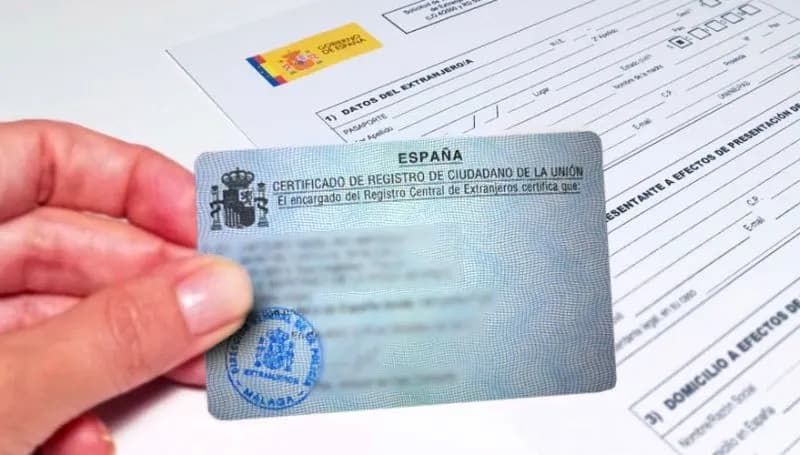
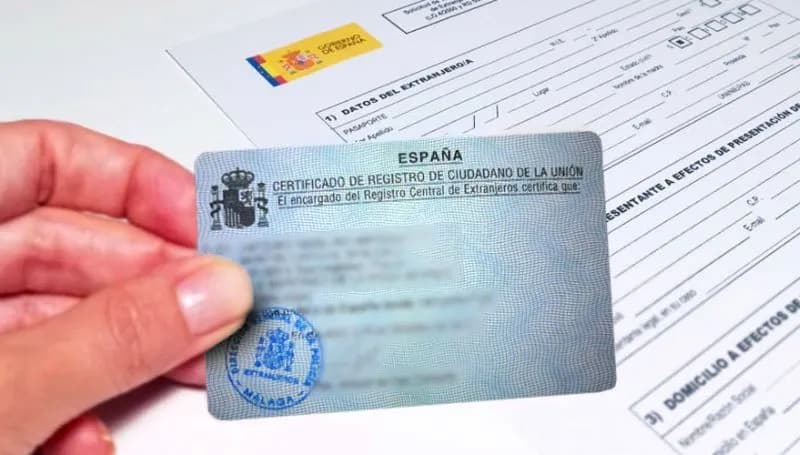
The NIE (Número de Identificación de Extranjero) is the foreigner identification number assigned by the Spanish administration to non-nationals. This identification number consists of an initial letter (X, Y, or Z), followed by seven digits and an alphabetic verification character, giving it a unique multi-character structure. It is not an identity document in itself, but it must always be presented with a valid identity document, such as a passport, national identity card, or national ID card, during formalities and administrative procedures in Spain.
The NIE is different from the NIF (Número de Identificación Fiscal), which is used for the tax identification of individuals or legal entities in Spain. The NIF is essential for all tax-related procedures, while the NIE is required for all administrative formalities and procedures, especially for buying or renting a property, signing an employment contract, or opening a bank account. The foreigner identification number is generally permanent, but some associated documents, such as residence certificates, may require periodic renewal. When applying, it is necessary to provide accurate information on the official forms to ensure the data transmitted to the administration is correct.
Summary of the main steps to get a NIE:
- Prepare the required identity documents (passport, national identity card, or national ID card).
- Fill out the official forms with all the requested information.
- Make an appointment with the competent authority (consulate, police station, or immigration office).
- Follow the administrative procedures and formalities until you obtain the foreigner identification number (NIE).
This step-by-step guide details how to get a NIE in Spain, whether on-site or from abroad, to facilitate your procedures.
Introduction to the NIE
The NIE (Número de Identificación de Extranjero) is the cornerstone of any administrative procedure for foreigners in Spain. This personal number, assigned by the Spanish national police, uniquely identifies each foreigner in the Spanish administrative system. Whether you are a European citizen or not, obtaining the NIE is essential as soon as you wish to carry out operations with legal or financial implications in Spain.
Without this identification number, it is impossible to open a bank account, purchase real estate, sign an employment contract, or even pay certain taxes. The NIE is therefore the key that opens the doors to administrative and economic life in Spain. It concerns all foreigners with an interest in Spain, whether it is a plan to settle, an investment, or simply a one-time procedure requiring official identification.
Obtaining the NIE is often the first step for any foreigner wishing to integrate into the Spanish economic fabric. This number, composed of letters and numbers, will accompany you throughout your journey in Spain, whether for managing your bank account, signing official documents, or carrying out procedures with local administrations. Thanks to this guide, you will discover how to easily obtain your foreigner identification number and successfully carry out your projects in Spain.
Need help obtaining your white NIE in Spain?
Our team of experts helps you obtain your white NIE (non-resident) without traveling.
More than 300 white NIEs obtained
"Julia est super efficace : NIE obtenu en quelques jours."
Marie
Espagne
Preparing the necessary documents
The first step is to gather all the required documents for your NIE application. The documents to be provided may vary slightly depending on the region or the application channel, but generally include:
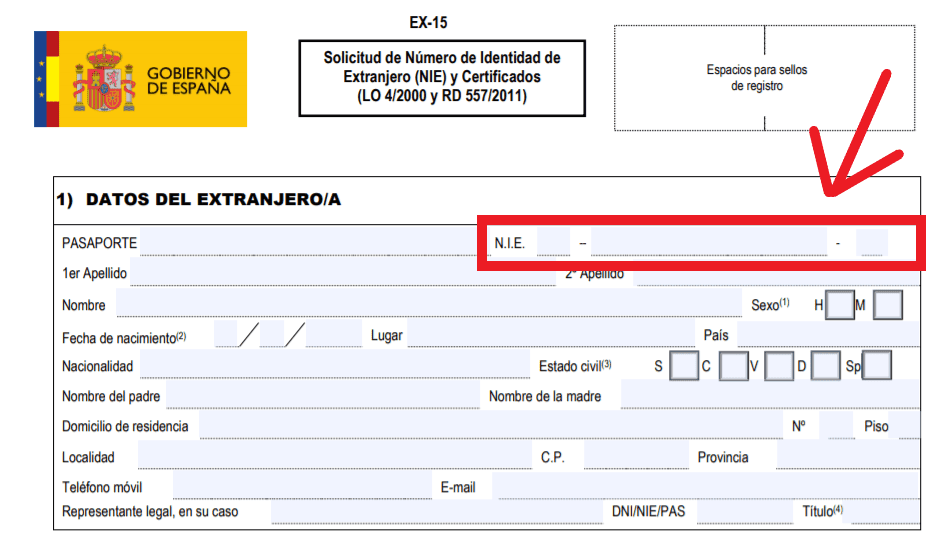
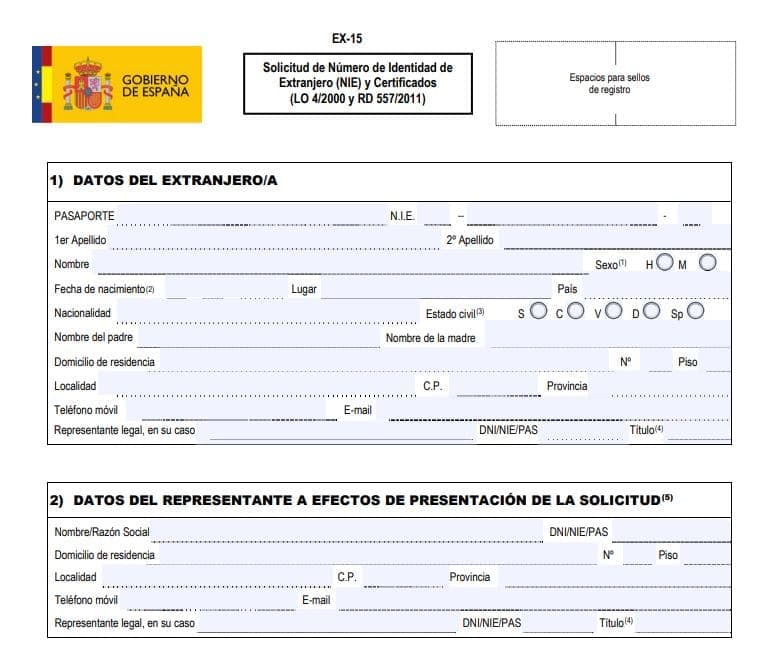
- Form EX-15 duly completed and signed (official NIE application form, available).
- Valid identity document: your passport (or identity card for EU nationals), original and photocopies of the identity pages. Copies must be single-sided and not double-sided. If a third party submits the application on your behalf, a certified copy of your identity document may be accepted.
- Proof of the reason for the application: a document proving the reason why you need the NIE (e.g., an employment contract, a promise to purchase real estate, an internship contract, proof of inheritance, etc.). If these documents are not in Spanish, an official translation may be necessary to speed up the process.
- Proof of payment of the administrative tax (Modelo 790 Código 012): this is the tax form to be completed (available here) and the receipt proving that you have paid the fees (around €10 to €15) for issuing the NIE. Generally, you will be asked to bring the completed 790-012 form and the proof of payment made at a bank.
- Identity photographs: two passport-type photos may be required in some regions or depending on the office. Check local practices – for example, some prefectures do not ask for them, while others do.
- Additional copies and other supporting documents if applicable: it is prudent to have copies of all your documents. For minors or persons under guardianship, specific documents (birth certificate, family book, etc.) as well as the guardian’s identity document will be required. If you intend to appoint a representative to apply on your behalf, you must provide them with a notarized power of attorney in Spanish expressly authorizing them to carry out the procedure, as well as a copy of their identity document.
The preparation of the file generally requires the applicant's presence during submission. The applicant must appear in person or be legally represented to ensure the validity of the procedure.
The NIE application can be made at a police station in Spain, at a general police office, or at a Spanish consulate abroad. It is also possible to submit the application at an authorized police station, depending on the location and the administrative procedures in force.
Tip
Remember to fill out the EX-15 and 790-012 forms in advance, preferably on the computer for better readability. These forms must be completed in capital letters. It is essential to carefully follow the official instructions to avoid any errors when preparing the file. Also, have cash to pay the tax if necessary, although payment is usually made at a bank.
Scheduling an administrative appointment
Once your file is ready, you must make an appointment online to submit the NIE application in Spain. Indeed, in most regions, a prior appointment is mandatory to go to the immigration office (Oficina de Extranjería) or the police station authorized for foreigners. The appointment is made on the official website of the Spanish government dedicated to administrative procedures (sede electrónica of the Ministerio de Administraciones Públicas). The procedure is as follows:
- Go to the official online appointment platform (at the address sede.administracionespublicas.gob.es).
- Select the province in which you wish to carry out the procedure.
- Choose the type of procedure "Asignación de NIE" (NIE assignment) from the list of services offered for the chosen province.
- Enter your personal details (name, passport number, etc.) and validate the request to get an appointment slot. A confirmation email will usually be sent to you once the appointment is confirmed.
Warning: appointment slots fill up quickly. It is not uncommon, especially in large cities like Madrid or Barcelona, for the site to display "No hay citas disponibles" (no appointments available) when you try to book. If you face this situation, do not be discouraged. Here are a few tips to get an appointment:
Tip
Log in at strategic times. In large cities, new slots are often released at the beginning of the week. For example, in Barcelona or Madrid, new appointments open on Monday morning from 8 am. Log in at that time and, if no slots appear, refresh the page every 5 minutes until 9 am to watch for openings. Many applicants get an appointment by being persistent during this time slot.
Tip
Target a smaller city. If appointments are impossible to get in the provincial capital, you can try to make an appointment at a police station in a small town in the same autonomous community. Small police stations are also authorized to issue NIEs, and the demand there is much lower, so the waiting time for an appointment is reduced. you will probably have to travel to this town on the day, but it can save you time. Go there very early in the morning (at least one hour before opening) because the order of passage may depend on the arrival time, and you may have to try several times to complete the process.
Tip
Use a professional as a last resort. If you are in a hurry or cannot get an appointment, there is the option of mandating a lawyer or a gestor in Spain to carry out the procedure on your behalf, with a notarized power of attorney. This service has a significant cost (expect around €250, plus ~€80 in notary fees for the power of attorney). This "turnkey" solution can unblock the situation if you have the means, but make sure the chosen professional is trustworthy.
With patience and perseverance, you will eventually get an appointment. Once your appointment is confirmed, print the confirmation and prepare your documents for the day.
Need help obtaining your white NIE in Spain?
Our team of experts helps you obtain your white NIE (non-resident) without traveling.
More than 300 white NIEs obtained
"Julia est super efficace : NIE obtenu en quelques jours."
Marie
Espagne
Submitting the application at the police station (in Spain)
On the day of the appointment, go to the police station or the Oficina de Extranjería indicated, with all your original documents and copies. It is possible to submit your NIE application directly at a police station or at a general police office, depending on the locality. It is advisable to arrive a little early. Even with an appointment, allow a margin of time, as a delay or an influx of users can lengthen the wait. Do not plan anything important in the following hours, as it is not uncommon to wait a while on site.
On site, the procedures are generally as follows:
- An agent will check your file: completed EX-15 and 790-012 forms, identity document, supporting documents, and copies. If a document is missing or a form is incorrectly filled out, your application may be rejected or delayed. So make sure everything is complete and compliant with local requirements. The procedures to follow at a police station are strict, so it is important to prepare each required document well.
- Fingerprinting: in some offices, especially for non-EU citizens, you may be asked to provide fingerprints when applying for a NIE (this step is more systematic for issuing a TIE residence card, but not always necessary for a temporary NIE). Nevertheless, be prepared for this eventuality.
- Payment of the tax: if you have not yet paid the Modelo 790-012 tax before the appointment, you will have to do it at this stage. The agent will give you the payment form (if not already done) so you can go to a nearby bank to pay the ~€10 fee. In some large cities, it is imperative to go through a bank as cash payments at the police counter may be refused. Go to the nearest bank, pay the amount (in cash or via your account if you have one in Spain), and have the payment receipt stamped. Keep this receipt carefully, as you will need to return it to the police station as proof of payment.
- Issuance of a receipt and follow-up of the application: once your file is accepted and the payment is made, you will return to the police station to submit the proof of payment (if you went out to do it) and finalize the application. The administration will then provide you with a receipt document attesting that your NIE application is being processed. This receipt (resguardo) may be necessary if you need to prove that you have started the procedures. You will either be given a deadline to come and collect your NIE, or the procedure to receive it. In many regions, the NIE (i.e., the certificate with your number) is not issued immediately on the same day. You will have to come back to pick it up at the same place once it is ready. Sometimes, you will be given a second appointment or an estimated date of availability of the document. In other rarer cases (small towns, low traffic), the NIE can be issued in a few hours on the same day. In any case, do not leave without knowing how your NIE will be given to you. Note that force majeure circumstances, such as strikes or exceptional events, may extend the processing time by the general police.
Application via the consulate from abroad
If you are not in Spain or cannot go there, it is quite possible to obtain a NIE via a Spanish consulate in your country. This option is intended for non-residents in Spain and involves longer delays. Here's how to proceed:
- Identify the competent consulate: You must apply at a consulate general of Spain that you depend on geographically (based on your place of residence). For example, a resident of Grenoble will have to go to the consulate general of Spain in Lyon, not Paris. So make sure you determine the consulate corresponding to your home and prepare a recent proof of address (electricity, water, internet bill, or rent receipt less than 3 months old) which will be requested to prove your residence in the consular district concerned. The choice of consulate depends on the applicant’s country of residence: if you reside in France, you must go to the competent consulate general of Spain in France; for other countries, you will have to contact the Spanish consulate in the country concerned.
- Make an appointment at a consulate: The procedures are done only by appointment at a consulate general of Spain. Each consulate has its own appointment system (online via their website, via a dedicated platform, by e-mail, or by phone depending on the city). Go to the website of the Spanish consulate nearest you to find out the procedure. For example, for Paris, appointments are made via the Cita Consular portal (select "Paris" then the "NIE" service). For other cities like Brussels, Luxembourg, Lyon, Marseille, etc., the modalities vary (some use the Bookitit platform, others set appointments by email or phone). If your consulate’s website is not clear, do not hesitate to contact the consulate by phone or email to ask for the NIE appointment procedure.
- Prepare the file for the consulate: The NIE application file via a consulate general of Spain is very similar to the one in Spain, with a few peculiarities. The applicant will generally have to present on the day of the appointment:
- The original EX-15 form completed + 1 copy.
- The Modelo 790-012 form completed + the means of payment for the tax. In consulates, the tax (€9.84 in 2022) is often payable on site in cash or by check (payable to the Consulate of Spain) – check beforehand as each consulate may have its own payment methods.
- Your original passport or identity card + a good quality photocopy.
- The proof of address in your country (electricity, gas, internet bill, or rent receipt less than three months old, etc.) to prove that you reside in the area covered by the consulate.
- Possibly, a stamped, self-addressed envelope. Some consulates ask you to provide a stamped envelope to send you the NIE certificate once it is ready. Other consulates, like Paris, prefer sending it by email (in this case, make sure to clearly indicate your email address on the form).
- Supporting documents for the reason for the application: just like in Spain, you must bring the document that justifies your NIE application (sales contract, job offer, etc.), possibly with a translation into Spanish if the document is in another language.
- If a representative submits the application for you: this is only allowed in case of major impediment on your part. The representative will then have to provide a notarized and apostilled power of attorney from a notary specifying that they can represent you for the NIE application, as well as a copy of their identity document. Warning: a power of attorney drawn up at the town hall or privately will not be accepted – it must be notarized and bear the Hague Apostille to be valid. This option is therefore restrictive and should only be considered as a last resort if the applicant absolutely cannot travel in person.
- Submit the application at a consulate: On the day of the appointment, the applicant must go to the consulate general of Spain with all the documents listed above. The procedure is generally simpler than in Spain because consulates have less traffic. A consular agent will check your complete file. If everything is in order, your application will be accepted and sent to the authorities in Spain for processing. The consulate does not issue the NIE itself on the spot; it acts as an intermediary. It may give you a filing receipt, but the actual NIE number will be communicated to you later once approved by the central police station in Spain.
- Processing times via the consulate: Applying from abroad takes longer than in Spain. Allow for a period of several weeks to receive your NIE. On average, the consulate general of Spain in Paris indicates a delay of about two weeks for obtaining the NIE. However, this period may be extended depending on the workload of the central service in Spain: it can range from a few weeks to nearly two months in some cases. So be proactive and anticipate this delay in your projects (for example, do not sign a final deed of real estate purchase without a NIE thinking you will get it in a few days via the consulate).
Delay and collection of the NIE
The waiting times for obtaining the NIE vary depending on the application method and location:
- In Spain (on site): the delay can be very short or a few weeks depending on the region. In some less busy police stations, the NIE can be ready in a few days. Elsewhere, especially in large cities, it can take several weeks due to the volume of applications. Generally, you will be informed of the indicative delay when you submit your file. Do not hesitate to ask the agent how long it will take to collect your NIE.
- From abroad (via consulate): the delay is longer because the consulate sends your application to the central Spanish authorities and then waits for the response. The average delay is about 2 weeks according to the Spanish consulate in Paris, but it can extend to several weeks (sometimes up to 6–8 weeks) depending on the circumstances. Factors such as holiday periods, a surge in applications, or administrative delays can prolong the wait.
Once the NIE is assigned, how do you collect it? This also depends on the place of application:
- If you applied in Spain: your NIE (in the form of a paper certificate with your foreigner identification number) will be collected directly from the office where you submitted the application. Often, you will be asked to come back after a certain period with your receipt to collect the document. In some cases, you can authorize a third person to collect it for you, but they will need a power of attorney or the original receipt. Inquire at the time of submission.
- If you applied via a consulate: you will not return to the consulate just for collection. The NIE will be sent to you remotely. Most consulates now send the NIE certificate by email (PDF) to the email address you provided. That is why it is important to clearly indicate a readable email address on your form. Some consulates also offer postal delivery if you have left a stamped envelope, or upon request. For example, you might receive a paper copy of the certificate by postal mail in the envelope you provided. In any case, the document will contain your NIE number, your name, and the date of issue. Keep it carefully: this number will be used throughout your procedures in Spain and it remains valid for life (the NIE has no expiration date).
Important remarks: The NIE is a simple tax and administrative identification number for foreigners. It is not a residence permit. The NIE obtained via a consulate or in Spain allows you to carry out procedures (open an account, sign contracts, pay taxes...), but it does not authorize you to reside in Spain and does not prove residence in Spain. If you plan to settle in Spain for more than 3 months, additional steps are necessary: EU nationals will have to register with the Central Register of Foreigners and non-EU nationals will have to obtain an appropriate visa or residence permit before they can reside legally.
Need help obtaining your white NIE in Spain?
Our team of experts helps you obtain your white NIE (non-resident) without traveling.
More than 300 white NIEs obtained
"Julia est super efficace : NIE obtenu en quelques jours."
Marie
Espagne
By following this step-by-step guide, you maximize your chances of getting your NIE quickly and smoothly. Make sure you are well prepared, anticipate delays, and do not hesitate to seek advice from official sources (consulates, Spanish government websites) in case of doubt. With your NIE in hand, you can carry out your projects in Spain with peace of mind!
Sources: Official guides and user feedback on the NIE procedure, Spanish government and Spanish Consulate in France websites, as well as practical advice from residents who have completed these procedures.