S1 Form Spain: Accessing Healthcare and Public Health System for EU Expats
A complete guide to the S1 form in Spain. Learn how EU and UK expats can access the Spanish public healthcare system, eligibility, and alternatives like the Convenio Especial.

International Mobility Expert
Moving to Spain as an EU or UK citizen gives you access to one of Europe's most efficient and accessible healthcare systems. Spain's public healthcare system, known as the Sistema Nacional de Salud (SNS), offers near-universal coverage to legal residents and is funded through taxes and social security contributions.
The registration process is essential for EU/UK expats to access public healthcare in Spain, as it ensures legal enrollment in the SNS and eligibility for health services.
EU and UK retirees, as well as certain categories of workers, can access Spanish public healthcare using the S1 form, allowing Spanish residents who are EU/UK expats to access healthcare in Spain while your costs remain covered by your home country. This enables access to public doctors, hospitals, and subsidized prescriptions under the same conditions as Spanish citizens.
For expats who are not eligible for an S1, access to healthcare is still possible through Spain's social security system or via private health insurance. Spanish residents and legal expats must complete the registration process to access public healthcare. This guide explains, step by step, how EU and UK newcomers can register for healthcare in Spain, both with and without an S1 form, with a 2026-oriented perspective.
Table of Contents
What is the S1 Form? (portable healthcare certificate for EU retirees)
The S1 form (previously known as E121 or E106) is a portable healthcare certificate issued within the EU and the UK. It confirms that your healthcare costs are covered by another European country while you live permanently in Spain, allowing you to access state healthcare in Spain.
The form is issued by the social security authority of the country paying your pension or providing your healthcare coverage. In practical terms, it proves that you remain insured in your home country while granting you access to Spain's public state healthcare system as a resident.
For example, if you receive a state pension from France, Germany, the UK, or another EU member state, that country can issue an S1 confirming your entitlement. Once registered in Spain, the S1 allows you to use public healthcare services without needing private insurance.
The S1 should not be confused with the European Health Insurance Card (EHIC), which is intended only for temporary stays. The S1 is designed specifically for long-term or permanent residence. Once registered, you can access Spain's healthcare system, while your healthcare costs continue to be reimbursed by your home country, covering routine medical care, specialist consultations, hospital treatment, emergency services, and most prescription medications.
It is important to note that while healthcare is largely free at the point of use, Spain applies modest co-payments for prescriptions and certain services. Core treatments, however, are heavily subsidized.
UK nationals can apply for an S1 if they receive a UK state pension or another eligible exportable benefit, even after Brexit.
Who Is Eligible (EU/UK pensioners, frontier workers)
EU and UK Pensioners and Benefit Recipients
If you receive a state pension or another exportable social security benefit from an EU or UK authority, you are generally eligible for an S1. This includes old-age pensions, disability pensions, and certain survivor benefits. Family members, such as spouses and dependent children, are usually covered under the same entitlement.
Who is not eligible for an S1: You will not qualify if you are not yet receiving a state pension or qualifying exportable benefit; if you are a digital nomad, remote worker, or self-employed in Spain; if you are an early retiree relying on savings or private pension income; or if you have no healthcare rights in your home country. In these cases, private health insurance or the Convenio Especial are the relevant alternatives.
Cross-Border and Posted Workers
EU regulations allow individuals who work in one country and reside in another to access healthcare through an S1. If you live in Spain but actively work in another EU country and return there regularly (as a rule daily or at least once a week), your employer's social security system may issue an S1. This grants access to Spanish healthcare under the same conditions as residents. Workers temporarily posted abroad for short periods may also qualify.
Other Exportable Benefits
Some exportable sickness benefits or occupational injury benefits can also grant S1 eligibility. However, certain allowances, such as non-exportable care-related benefits, do not qualify.
In short, only specific categories - such as pensioners or individuals receiving exportable benefits - are eligible for an S1. Always confirm eligibility with your home country's social security authority or pension provider.
Need help with your social security registration?
Our team of experts helps you get your social security number (NUSS) and register with the Spanish healthcare system.
Guaranteed registration and access to healthcare
How to Obtain and Register S1 in Spain (INSS registration)
Apply for the S1 in Your Home Country
Before moving to Spain, or shortly after arrival, request an S1 from the country responsible for your pension or benefits. Each country has its own process. Once approved, you will receive an official S1 document, usually by post.
Gather Required Documents
To complete the S1 registration process in Spain, you will need:
- The original S1 form
- Passport or national ID
- NIE (foreigners' identification number) or residence card
- A recent empadronamiento certificate (proof of address)
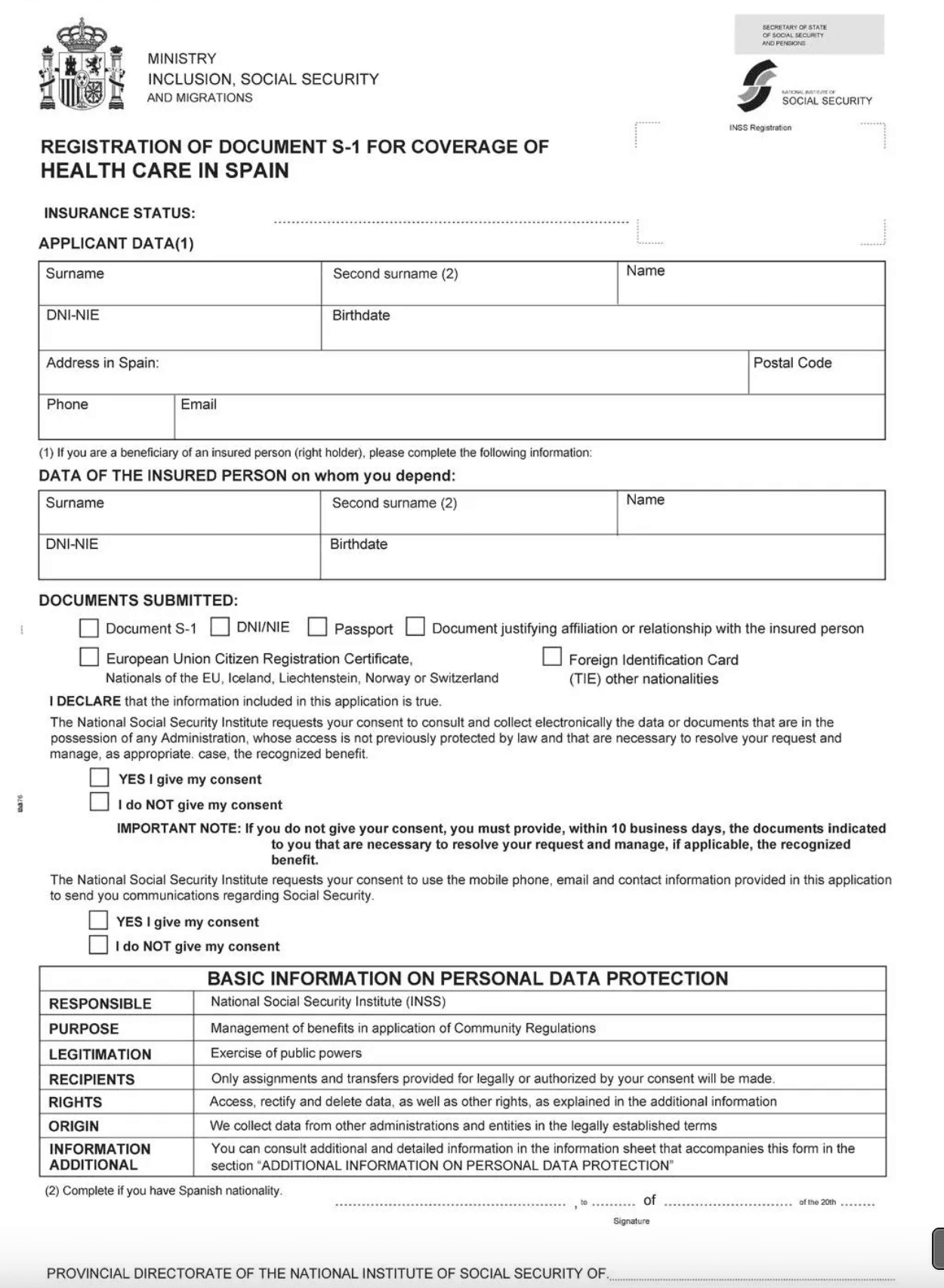
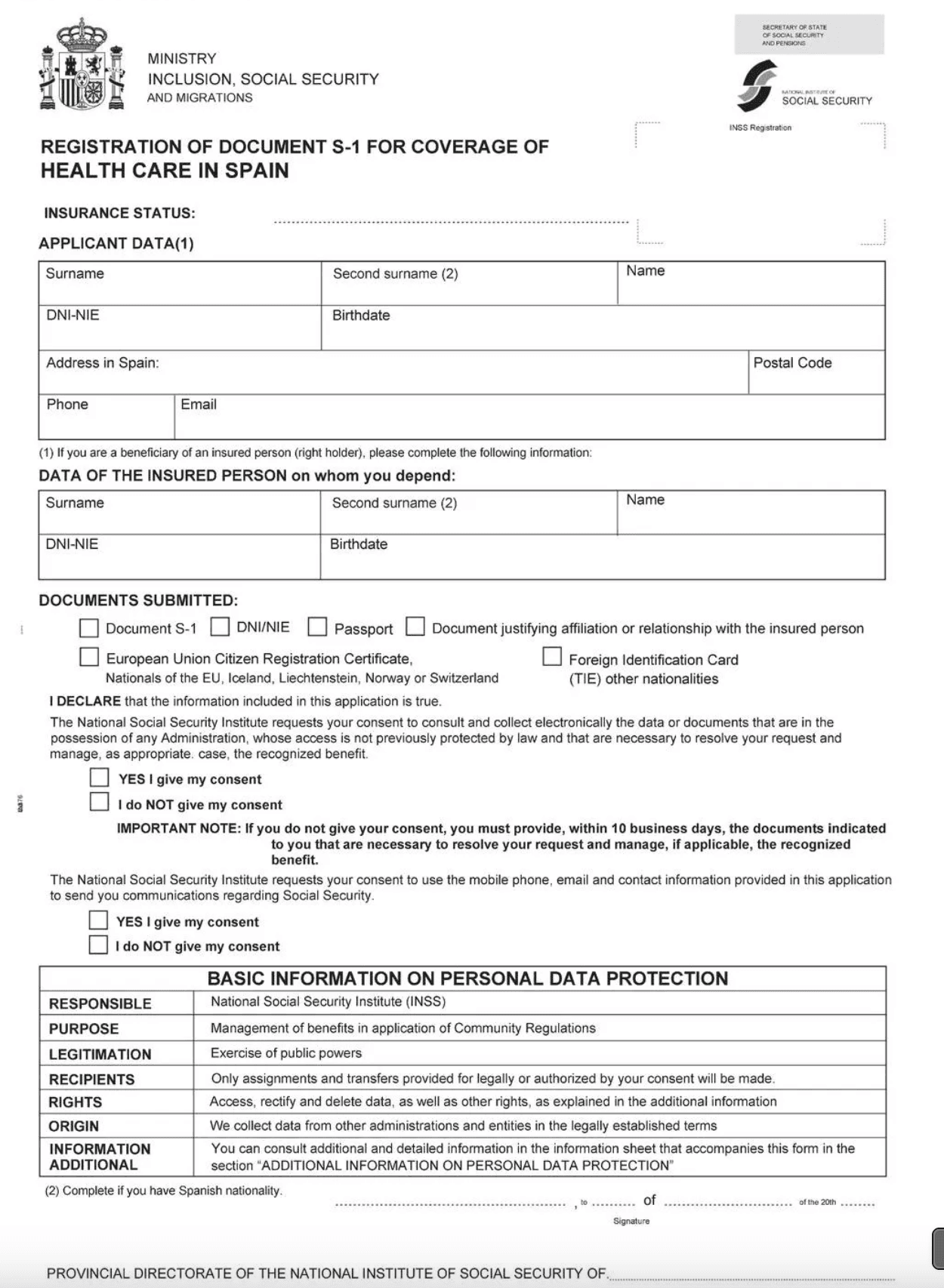
- A completed Spanish healthcare registration form
Register with the Spanish Social Security (INSS)
The S1 must be registered with the Instituto Nacional de la Seguridad Social (INSS). This registration process can be done in three ways:
- Online registration: Documents can be uploaded through Spain's social security platform. Online registration may require a digital certificate or secure identification, depending on the procedure.
- Public registry submission: Documents can be submitted through a town hall or public registry, which forwards them to the INSS. Local administration and local authorities play a key role in assisting with the process and ensuring your documents reach the correct department.
- INSS appointment: You may book an in-person appointment (cita previa) at an INSS office and submit documents directly.
Confirmation of Registration
Once processed, the INSS issues confirmation of your healthcare entitlement in Spain. This confirms your entitlement, after which your health record is created at the regional healthcare level.
After S1: Getting the Tarjeta Sanitaria (Spanish Health Card)
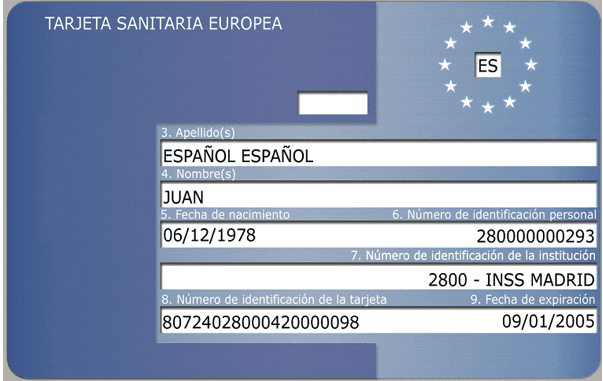
After registering your S1, you must obtain your Tarjeta Sanitaria Individual, the Spanish health card.
Visit your local Centro de Salud (primary healthcare center) with:
- INSS confirmation of S1 registration
- Passport or NIE
- Proof of address
At the administrative desk, your application will be processed. In some regions, the card is issued immediately; in others, it is sent by post within a few weeks. Procedures and waiting times can vary between Spain's autonomous communities due to the decentralized management of healthcare. Some regions also offer a digital version via mobile health apps.
The Tarjeta Sanitaria allows access to general practitioners, specialists, hospitals, emergency services, and reduced-cost prescription medications. Service quality and access may differ depending on the autonomous community, as each region manages its own healthcare system.
If your family members are covered under your S1, they should be registered at the same time and will receive their own health cards.
Once this step is completed, and you have obtained your NIE in Spain, you can access public healthcare under similar conditions to Spanish residents.
Spanish Health System Overview (Seguridad Social for workers)
Spain's public healthcare system is considered one of the best globally, combining universal access with high medical standards and long life expectancy.
Universal Coverage
Almost all legal residents have access to public healthcare. Employees, self-employed workers (autónomos), and many non-working residents contribute through the social security system, which finances healthcare services.
Free Healthcare
EU citizens can access public healthcare if they meet eligibility conditions, such as employment, registration, or holding an S1 and some undocumented migrants. This includes services like vaccinations, pediatric care, and essential medical treatments.
Social Security Number (NUSS)
Anyone working or self-employed in Spain must obtain a Social Security number. This number links your employment, contributions, and healthcare rights and is required to issue your health card.
Healthcare Entitlement
Once registered, individuals and their dependents have full access to public healthcare, including primary care, specialists, hospital services, maternity care, and pediatric services.
Costs and Co-payments
Most medical services are free at the point of use. Prescription medications are subject to partial co-payment, generally based on income level. Dental and vision care are limited within the public system, except for emergencies.
Regional Management
Healthcare is managed by Spain's autonomous regions, meaning procedures and waiting times may vary. However, core benefits are guaranteed nationwide. Many residents complement public care with private insurance for faster access.
Five-Year Residence Rule
Permanent residency after five years does not automatically grant healthcare access; eligibility still depends on your social security or residency situation.
Safety Net
Individuals who lose employment retain SNS coverage for up to 90 days after employment ends. This period is extended for those receiving unemployment benefits (prestación por desempleo), who remain fully covered throughout the benefit period.
Overall, Spain operates a tax-funded public healthcare model offering comprehensive coverage and high-quality care for residents contributing to the system.
Convenio Especial and Residency (alternative for non-S1 eligible expats)
For expats who are not eligible for the S1 form or do not qualify for public healthcare through employment or self-employment, the Convenio Especial offers a valuable alternative. This public health insurance scheme allows individuals to access the Spanish public healthcare system, including a wide range of healthcare services and hospital treatment, even if they are not contributing to social security through work.
To apply for the Convenio Especial, you must have been registered (empadronado) in a Spanish municipality for at least one year immediately prior to your application. This requirement ensures that the scheme is available to those who have established a genuine connection to their local community. Applications are handled by regional health authorities, with procedures varying by region.
The Convenio Especial provides access to public healthcare services, but excludes certain benefits such as prescription coverage and healthcare outside Spain. However, some services like dental care and optical services may not be fully included, so it's important to review the details before enrolling. The monthly fee for the Convenio Especial is based on your age, with higher rates for those over 65. This fee grants you access to the public healthcare system, but you may still need to pay out of pocket for certain treatments not covered by the scheme.
Overall, the Convenio Especial is a practical solution for expats seeking public healthcare coverage in Spain when other options, such as the S1 form or social security, are not available.
Private Insurance Options (if S1 not available)
Not all expats qualify for an S1 or immediate public coverage. EU and UK nationals who are economically inactive must arrange healthcare through alternative solutions, including a wide range of private healthcare options available in Spain.
Convenio Especial
Spain offers a paid public healthcare subscription for long-term residents without other coverage. Eligible residents pay a monthly fee, which increases with age, in exchange for access to most public healthcare services, with some limitations depending on the region and type of care. This option provides comprehensive coverage but requires continuous payment.
Private Health Insurance
Private health insurance is widely used by expats. Monthly premiums average approximately €58/month (around €698/year) for the general population, but can range from €80–€150/month for older expats or those seeking broader coverage. For Non-Lucrative Visa applicants, budget €1,500–€2,500 per year per person depending on age and health status. Private plans offer faster access, private hospitals, English-speaking doctors, and additional services such as dental and vision care. They also satisfy visa and residency requirements, as private insurance must meet specific visa requirements, including full coverage and no co-payments for most residency permits.
Supplementary Insurance
Many S1 holders also choose private insurance to reduce waiting times or cover services not included in the public system.
Residency Compliance
Health insurance is mandatory when applying for Spanish residency unless covered by S1 or social security. Many newcomers start with private insurance before transitioning to public coverage.
Choosing the Right Option
The decision between convenio and private insurance depends on age, medical needs, budget, and long-term plans. Pensioners often prefer S1 or convenio for cost efficiency, while younger residents may opt for private coverage. The European Health Insurance Card (EHIC) can provide temporary coverage for short-term visitors or new arrivals, but it does not replace comprehensive insurance.
In summary, the S1 form remains the most straightforward way for eligible EU and UK expats to access Spain's public healthcare system. When S1 is not available, Spain still offers reliable alternatives through paid public schemes or private insurance. Each route ensures compliance with residency rules and access to quality medical care while living in Spain.
Important distinction: Unlike in some other countries, private health insurance in Spain is supplementary to public coverage, not a replacement. Once you are a tax-paying resident, you are automatically covered by the SNS regardless of whether you also hold private insurance. Private cover is used to complement the public system - for faster access, English-speaking doctors, and services not covered publicly.
Healthcare Costs and Funding (what's free, what's paid, and how to budget)
The Spanish public healthcare system is primarily funded through social security contributions, which are automatically deducted from the salaries of employees and self-employed workers. Thanks to this funding model, most public healthcare services are free or available at a low cost to legal residents. This includes doctor visits, hospital stays, and many specialist care services.
However, there are some costs to be aware of. Prescription medications typically require co-payments, with the amount depending on your income and employment status. Dental care and certain specialist treatments are not fully covered by the public system, so you may need to pay out of pocket or consider private health insurance for more comprehensive coverage.
If you are enrolled in the Convenio Especial, you will pay a monthly fee based on your age, which grants you access to public healthcare services. It's important to factor this fee into your healthcare budget, along with any additional costs for services not included in the scheme.
Many expats choose to supplement public healthcare with private health insurance, which can cover extra services such as dental care, optical care, and faster access to specialist care. When planning your move to Spain, consider the potential costs of private health insurance, co-payments, and any out-of-pocket expenses to ensure you have a clear understanding of your healthcare budget.
Need help with your expatriation to Spain?
Our experts accompany you in all your administrative procedures and installation.
Emergency Services (how to access urgent care in Spain)
In case of a medical emergency, Spain offers a robust system for urgent care. The European emergency number 112 is available nationwide, 24 hours a day, and connects you to ambulance, police, and fire services. This number can be dialed free of charge from any phone, and operators may assist in multiple languages, particularly in major regions, but this is not guaranteed everywhere.
For emergency care, you can go directly to the nearest public hospital or local health center. Emergency care is provided in both public and private facilities, but costs may apply in private hospitals if you are not insured. Private hospitals and clinics may offer emergency services, but if you do not have private health insurance, you may be required to pay for treatment out of pocket.
Under the SNS, ambulance services are also covered. In public health centers and hospitals, emergency care is fully covered regardless of whether you have a Tarjeta Sanitaria, as emergency treatment cannot be refused to anyone on Spanish territory.
It's a good idea to familiarize yourself with the emergency services available in your area, including the addresses of local health centers and public hospitals. In rural areas, emergency care may be provided at the nearest health center, with more serious cases transferred to larger hospitals.
Language Barriers and Healthcare (navigating Spanish healthcare as a non-Spanish speaker)
Navigating the Spanish healthcare system as a non-Spanish speaker can be challenging, but there are several ways to make the process easier. In major cities and tourist areas, many doctors and medical staff speak English, especially in private clinics and hospitals. If you have private health insurance, you can often request appointments with English speaking doctors or use international clinics that cater to expats.
Public hospitals and health centers may offer translation services or have staff who can assist in English, but this is less common in rural areas. To bridge the language gap, consider using translation apps on your phone or bringing a Spanish-speaking friend or family member to appointments.
Before visiting a healthcare provider, check whether language support is available and, if necessary, request an English-speaking doctor when making your appointment. Many expats also find it helpful to learn basic Spanish medical terms to communicate more effectively with healthcare professionals.
Mental Health Support (accessing psychological and psychiatric care)
Mental health is an important part of overall well-being, and Spain's public healthcare system provides access to psychological and psychiatric care for residents. Mental health services are generally accessed through primary care, although access pathways may vary by region.
However, waiting times for mental health services in the public system can be long, and language barriers may make it difficult to find English-speaking therapists. Many expats choose to use private health insurance to access mental health support more quickly and to find professionals who speak their language. Private healthcare providers and clinics often offer a wider range of mental health services, including therapy, psychiatric consultations, and support groups.
Online therapy platforms are also an option for those seeking mental health support in English or other languages. If you need help navigating mental health services, contact your local health center, the Spanish National Health System, or your private health insurance provider for guidance on available resources in your area.
If you need assistance with your administrative procedures in Spain, including registering with the social security system or obtaining your NIE, Hiliv is here to help. Our experts can guide you through the process, ensuring a smooth transition to your new life in Spain.
What is the S1 form in Spain?
The S1 form is a portable healthcare certificate for EU and UK citizens. It proves that your healthcare costs are covered by your home country, allowing you to access the Spanish public healthcare system (Sistema Nacional de Salud) as a resident.
Who is eligible for an S1 form?
Eligibility is generally limited to state pensioners, individuals receiving certain exportable social security benefits, and cross-border or posted workers from the EU or the UK. Early retirees relying on savings or private pensions do not qualify.
How do I register my S1 form in Spain?
You must register your S1 form with the Spanish Social Security (INSS). This can be done online, through a public registry (like a town hall), or by booking an in-person appointment at an INSS office.
What is the Convenio Especial?
The Convenio Especial is a paid public health insurance scheme in Spain. It is an alternative for expats who are not eligible for the S1 form or social security through employment. It requires a monthly fee based on age and grants access to public healthcare services.
Do I need private health insurance in Spain?
If you are not eligible for the S1 form, social security, or the Convenio Especial, you will need private health insurance. It is also mandatory for certain residency applications. Many expats use private insurance to supplement public healthcare for faster access and English-speaking doctors.