Finding Housing in Spain: Complete Guide for Renting (or Buying) When Moving Abroad
The complete 2026 guide to finding housing in Spain as a foreigner: websites and agents, documents (NIE, income, fianza, aval bancario), remote viewings, scams to avoid, Madrid and Barcelona, and buying.

Table of Contents
When moving to Spain, renting is often the preferred way to get started. Distinguish long-term rentals (your main home) from tourist or seasonal rentals: the rules are not the same, and some vary by region. The good news is that no rule prevents foreigners from renting in Spain based on nationality or residence status.
| of rent: legal deposit (fianza) for a residential lease | 1 month |
|---|---|
| before the tenant can leave (30 days’ notice) | 6 months |
| the rent: income landlords often want to see | 3–4 times |
| of listings let within 24 hours (Q2 2026, Idealista) | 17% |
Residential leases are governed by the Urban Leases Law (LAU). A landlord may require proof of solvency but cannot turn you down because of your nationality. Once signed, the lease is also what you use to register on your town's padrón, a step you need for healthcare and residency paperwork.
Summary of the main steps
- 1Search the portals (Idealista, Fotocasa, Habitaclia…), expat networks and local agencies.
- 2Prepare your file: ID or NIE, proof of income, guarantees, Spanish bank account.
- 3View the flat (in person or by video) and rule out fraudulent listings.
- 4Sign a written lease that complies with the LAU before paying anything, then do the inventory and register on the padrón.
Renting an apartment in Spain – what you need to know
- Lease duration: the term is freely agreed. Leases are often signed for one year: when the term ends, the contract is extended year by year, unless the tenant opts out, up to the minimum duration set by article 9 of the LAU.
- Leaving early: the law lets the tenant leave once six months have passed, with at least thirty days' notice (article 11 of the LAU). The contract may provide for compensation if you leave early, so read that clause.
- Deposit (fianza): it is mandatory and equals one month's rent for a residential lease. The landlord may ask for an extra guarantee (aval bancario or additional deposit), capped at two months' rent for residential leases within the legal minimum term (article 36 of the LAU).
- Agency fees: since the 2023 housing law, property-management and contract-formalization fees on a residential lease are paid by the landlord. In practice, some agencies try to get around the rule ("temporary" contracts, admin fees): you should not pay a finder's fee for a main-residence lease.
- Running costs: on top of the rent, budget for water, electricity, gas and sometimes the rubbish-collection tax. Building charges (comunidad) and IBI (property tax) are normally paid by the landlord, but the contract may pass them on.
Where to start your search?
The market moves fast: use several search channels at once and be ready to react the day a listing appears.
Real estate websites
Idealista is Spain's largest property portal, with agency and private listings and an interface in several languages. Fotocasa is the other major national portal, Habitaclia is very popular in Catalonia, and Milanuncios, Pisos.com and YaEncontre also have large rental sections. Read listings carefully: some still expect a Spanish guarantor or a bank guarantee.
For a first move, Spotahome lists verified flats you can book remotely. Sites aimed at international buyers (Kyero, Spainhouses.net) also list rentals, and Trovimap offers a valuation tool to check whether a rent is in line with the area.
Facebook groups and expat networks
Expat mutual-aid groups (for example "Expats in Madrid – Housing", "Expats in Barcelona – Flatshare" or "Expats in Valencia") share listings from landlords looking for a trustworthy tenant, or from departing tenants who recommend their flat. You will also find flatshares and sublets, sometimes off-market.
Estate agents and apartment hunters
A local inmobiliaria knows its neighbourhood, can alert you as soon as a flat comes up and sometimes gives access to unadvertised homes. On a main-residence lease, its fees are paid by the landlord. If language or time is an issue, an apartment hunter or relocation service can shortlist properties, check listings and view flats for you (see below).
On site: word of mouth and "Se alquila" signs
Once you are there, tell people you are looking and keep your eyes open in your target neighbourhood: many flats are advertised with a "Se alquila" (for rent) sign on the balcony or window, with a phone number. These private listings are not always online.
Documents you need to rent in Spain
Landlords ask for proof of identity and of your ability to pay. Having a complete, scanned file before the first viewing often makes the difference.
- ID, passport or NIE
Many landlords and agencies ask for a NIE (foreigner identification number) for a long-term lease. A valid passport, or a national ID card for EU/EEA citizens, is often accepted to sign, but you will soon need the NIE to open a bank account and put utilities in your name. - Proof of income
Employment contract (or scholarship), last three payslips, or, if you are self-employed, your latest tax return and bank statements. As a market practice rather than a legal rule, landlords often want income of roughly 3 to 4 times the monthly rent. If your income comes from abroad (remote work, pension), bring bank statements. - Deposit and guarantees
The one-month fianza, plus possibly an extra guarantee within the legal cap. Without a work history in Spain, expect to be asked for an aval bancario (bank guarantee). A personal guarantor is less common than in some countries, but some landlords ask for one. - Spanish bank account
Most landlords want rent paid by direct debit from a Spanish IBAN, which you also need to put utilities in your name. Opening a Spanish account can often be done online before you arrive.
To strengthen your file: if you are not an EU citizen, include your visa or residence permit (it is not required to rent, but it reassures landlords). Add a short cover letter explaining your move and, if possible, references from previous landlords or employers, even abroad.
Renting before you arrive: remote viewings
It is common to secure a flat without visiting it in person. Viewings are often done by video call on WhatsApp, live with the agent or owner: ask to see every room, the state of the kitchen and bathroom, the view and the stairwell. Recorded walkthroughs or 360° tours complement, but do not replace, a live viewing.
If you fly in for a few days of viewings, book several slots in advance. In peak season, some landlords ask for a non-refundable holding fee to take the flat off the market: a bare payment without a signed document offers limited protection, so insist at least on a signed, dated document that sets out the terms.
Beware of scams!
Housing scams mostly target newcomers searching from abroad. Here are the classic traps:
To protect yourself:
- Stick to recognised platforms and established agencies.
- Check that the flat exists: reverse image search on the photos, Google Street View, live viewing.
- If you cannot travel, have the flat visited by a trusted contact or a professional service.
- Pay by bank transfer or card once the lease is signed, never in cash without a receipt, and keep all communication in writing.
Understanding the lease and inventory
Rental contract (contrato de arrendamiento): it is written in Spanish. Check the term, the extension and early-exit conditions, the deposit and guarantees, and how running costs are split. Have it translated or reviewed if needed before you sign.
Padrón registration: make sure nothing in the contract prevents you from registering on the padrón at that address: the lease is the most widely used proof of address.
Inventory (inventario): it is often less formal than in other European countries. On move-in, inspect everything, take dated photos of any defects and send them straight away to the agency or landlord so there is a written record of the initial condition.
Insurance and security: protecting your home and belongings in Spain
Home insurance (seguro de hogar) is not always mandatory for tenants, but it is highly recommended. For owners with a mortgage, the bank usually requires it (at least fire cover). In a flat, check that the policy also covers common areas. To take out a policy you will usually need the lease or deed, ID and an estimate of your belongings.
Flatshare or standard rental?
Flatsharing is very common in Spain, and not only among students: lower rent per person, shared bills, an instant social circle and often lighter paperwork on arrival.
To find a room, use Badi, Roomlala or the "piso compartido" section of Idealista. Budget around €400 to €600 per month for a room in Barcelona or Madrid.
Local specifics to know
Financial guarantees rather than a guarantor
Spanish landlords mostly think in terms of financial guarantees: aval bancario or an extra guarantee within the legal cap. Personal guarantors exist but are less common.
Often furnished
Many rentals are offered furnished and equipped, especially in big cities, which is convenient for a first move.
Building charges (comunidad): normally paid by the landlord, they can be passed on to the tenant if the contract says so. Check the clause.
How competitive is the Spanish rental market?

Demand far exceeds supply, especially in major cities. According to Idealista, 17% of rental listings were let within 24 hours in the second quarter of 2026, and the national average asking rent hit a record €15.3 per m² per month in July 2026 (up roughly 6.8% year on year). Population growth, foreign workers and retirees, and some owners pulling flats from the long-term market all add to the pressure.
For a foreigner, this means moving fast with a complete file. Without a Spanish work contract, expect requests for extra guarantees: knowing the legal cap (see above) helps you negotiate.
Housing in Madrid, Barcelona and other major cities
Competition is fiercest in Madrid and Barcelona, but also in Valencia, Málaga, Seville, Bilbao, Palma de Mallorca and the Canary Islands.
- Catalonia: Barcelona and many Catalan municipalities (over 270 as of late 2024) are declared high-pressure areas (zonas tensionadas), which allows rents on new contracts to be capped under the 2023 housing law. Barcelona also plans to phase out tourist-rental licences by November 2028.
- Madrid: no zona tensionada has been declared, so there is no legal rent cap, even though rents are the highest in the country (around €21.4 per m² per month in July 2026 according to Idealista, with an average sale price close to €4,700 per m²).
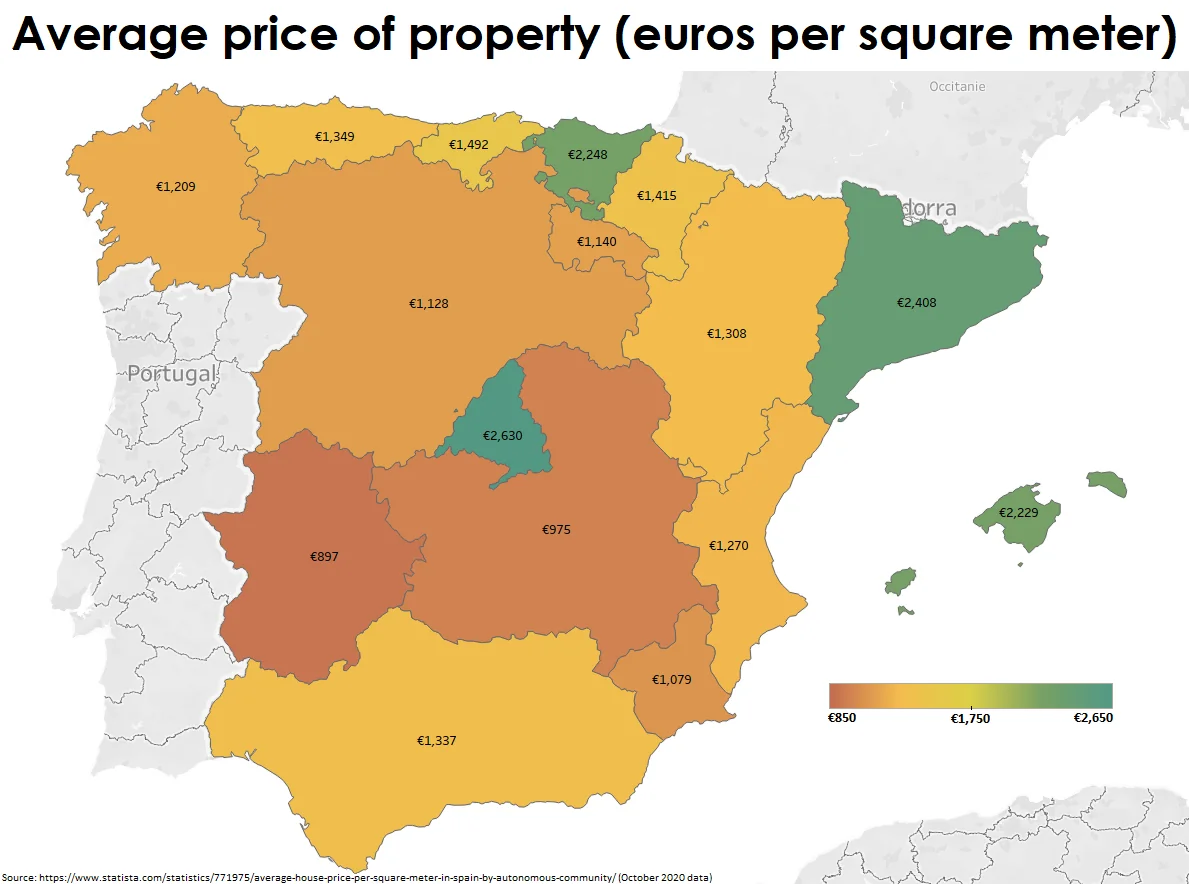
- The coast: on the Costa del Sol, Costa Blanca or Costa Brava, tourism pushes demand up from May to October. The Balearic Islands are the most expensive province to buy in (roughly €5,200–5,300 per m²), Ciudad Real one of the cheapest (around €785–805 per m²).
Focus on a few realistic neighbourhoods (transport, international schools, workplace). Historic centres such as Madrid's Chamberí or Barcelona's Eixample remain expensive; up-and-coming districts just outside them often offer more choice.
Housing cost examples in several cities
| City (district) | Type of home | Monthly rent |
|---|---|---|
| Madrid (centre) | Studio | €900 to €1,200 |
| Barcelona (Eixample) | 2-bedroom apartment | €1,400 to €1,800 |
| Valencia (Ruzafa) | 2-bedroom apartment | €900 to €1,000 |
| Seville | Studio | €600 to €900 |
| Major cities | Room in a flatshare | €400 to €600 |

To go further, see our guides to the best neighborhoods to live in Madrid, living in Barcelona and the cost of living in Spain.
Buying real estate in Spain
If you are settling for several years, buying may become an option. Foreigners can buy in Spain without being resident, provided a few conditions are met:
- Prerequisites: get a NIE, open a Spanish bank account and, ideally, hire a lawyer (abogado) to check the property and secure the transaction.
- Purchase costs: advertised prices exclude taxes and fees. Budget for ITP (regional transfer tax) on a resale home or VAT (IVA) at 10% on a new build, plus notary, land registry and legal fees. The agency commission is usually paid by the seller.
- Financing: Spanish banks lend to non-residents, but generally up to 60–70% of the property value; tax residents can usually borrow more.
For the full process, costs and pitfalls, read our guide to buying property in Spain as a foreigner.
Using a housing search service
If the market feels overwhelming, especially from abroad, a housing search service (apartment hunter, relocation service) can support you at every stage:
- 1Property selection
Your criteria (budget, area, size, furnished or not) are used to build a shortlist of verified listings, saving you hours on the portals and limiting the risk of scams.
- 2Viewings
Viewings are arranged for you, by video or in person, and the conversation with the landlord is handled in Spanish on your behalf.
- 3Negotiation and lease
Checks on the deposit and guarantees requested, on agency fees (paid by the landlord on a residential lease) and on your ability to register on the padrón, then an explanation of the clauses before signing and a secure deposit payment.
The Hiliv housing search service works this way, with English- and French-speaking real estate partners. We can also prepare the steps that strengthen your file: NIE, Spanish bank account, then empadronamiento once the lease is signed.
Hiliv service · Housing search in SpainFrequently asked questions about housing in Spain
Can foreigners legally rent an apartment in Spain?
Yes. No rule prevents foreigners from renting in Spain based on nationality or residence status. Landlords may require proof of solvency, but they cannot refuse to rent solely because you are a foreigner. A written lease is strongly recommended and is governed by the Urban Leases Law (LAU).
Do you need a NIE to rent an apartment?
Many landlords and agencies ask for a NIE for a long-term lease. A valid passport (or an EU/EEA national ID card) is often accepted to sign, especially for a temporary rental, but you will soon need the NIE to open a bank account and put water and electricity in your name.
How much deposit can a landlord ask for in Spain?
For a residential lease, the legal deposit (fianza) is one month's rent, furnished or not. The landlord may add an extra guarantee (additional deposit or aval bancario), capped at two months' rent for residential leases within the legal minimum term (article 36 of the LAU).
Who pays the agency fees?
Since the 2023 housing law, property-management and contract-formalization fees on a residential lease can no longer be passed on to the tenant: the landlord pays them. Seasonal or temporary rentals follow different rules, so always read the contract before signing.
What income do landlords typically expect?
As a market practice (not a legal requirement), landlords often want to see income of roughly 3 to 4 times the monthly rent. If your income comes from abroad (remote work, pension), bring bank statements or equivalent proof.
Can I register at the town hall (padrón) with a rental lease?
Yes. A lease is the most common proof of address to register on the padrón, which you need for healthcare and residency paperwork. Some town halls accept other proof of residence when there is no lease.
Is it safe to rent an apartment in Spain before arriving?
It is common for expats, but stay careful: never pay a deposit before signing a lease, favour video viewings and recognised platforms, and have the flat visited by a trusted contact or a professional service if you cannot travel.
Can I leave before the end of the lease?
Yes. The LAU lets the tenant leave once six months of the lease have passed, with at least thirty days' notice to the landlord. The contract may provide for compensation if you leave early, so check that clause before signing.
Are there rent caps in Madrid or Barcelona?
The 2023 housing law allows rent caps in designated high-pressure areas (zonas tensionadas). Barcelona and many Catalan municipalities have declared them. Madrid has repeatedly declined to do so, so no legal rent cap currently applies there.
What is the average rent in Spain in 2026?
According to Idealista, the national average asking rent reached €15.3 per m² per month in July 2026, and around €21.4 per m² in Madrid. The market moves fast: 17% of rental listings were let within 24 hours in the second quarter of 2026.
Is it easy to find a flatshare?
Yes, it is very common, especially in Madrid and Barcelona. Badi and the "piso compartido" section of Idealista are full of listings. It is a good way to keep costs down when you first arrive.
Can Hiliv help me find housing in Spain?
Yes. Our Spain housing search service shortlists verified listings, arranges viewings and reviews the lease. We can also help with your NIE, opening a Spanish bank account and your empadronamiento.
Official sources
Update history
- Content updated
- Article published
General information, up to date on 23 November 2026: it is not legal advice. Official rules and amounts can change; check your situation with the competent authority.
 Next step · 17 minBuying Property in Spain After Brexit: 2026 Guide for UK Buyers
Was this guide helpful?
- housing spain
- rent apartment spain
- buy house spain
- flatshare spain
- real estate spain
- expatriation
- fianza spain