Spouse Visa France: Family Reunification in France – Visas for Spouses and Family Explained
Complete guide to spouse and family visas in France: EU free movement, regroupement familial, marriage to a French citizen, Talent Passport Family, OFII, ANEF validation, and residence cards.

International Mobility Expert
Bringing your spouse or children to France depends on your nationality, your partner's nationality, and your residence status. This guide explains EU free movement, the regroupement familial procedure for non-EU residents, the long-stay “private and family life” route for spouses of French citizens, and the Talent Passport - Family fast track, plus what happens after arrival (ANEF, prefecture, healthcare, and school). For an overview of visa categories, see our France visa types guide.
Need help with France immigration paperwork? Hiliv supports individuals and families with visa preparation, document checks, and step-by-step guidance so your dossier is complete before you submit to the consulate, OFII, or prefecture.
Besoin d'aide pour vos démarches administratives en France ?
Nos experts vous accompagnent dans toutes vos démarches de visa, titres de séjour et installation en France.
Family reunification options
Several procedures allow you to bring a family member to France, depending on your status.
If you are a citizen of an EU country, your spouse or minor dependent children can freely join you in France under European freedom of movement rights. They do not need a visa for the first three months; after that, they must apply for a residence permit as a family member of an EU citizen at the local prefecture. This permit (free of charge) states “EU/EEA/Swiss citizen - all activities”, authorizes employment, and is generally valid for as long as the EU member's residence rights (up to five years). After five years of continuous residence, it can become a permanent ten-year card. Usual documents are required (EU passport, marriage or birth certificate, proof of address, etc.).
If you are a non-EU foreign national residing in France, family reunification is only possible through the regroupement familial procedure. The applicant (the resident foreigner) must have at least 18 months of lawful stay in France and provide proof of stable and sufficient resources over the last 12 months preceding the application. The required income threshold varies by family size: the equivalent of 1 SMIC (approximately €1,823/month gross) for a household of 2 to 3 people, rising to approximately €2,005/month for 4 to 5 people, and €2,187/month for 6 or more people. Note that certain social benefits such as RSA, family allowances, and Aspa are excluded from the calculation, as well as the requirement for suitable housing meeting sanitary and comfort standards. The minimum surface area required varies by geographic zone: 22 m² for a couple in zones Abis and A (major urban areas), 24 m² in zones B1/B2, and 28 m² in zone C. In all cases, 10 m² must be added per additional person (up to 8 people total), then 5 m² per additional person beyond that.
Check the official criteria before you file
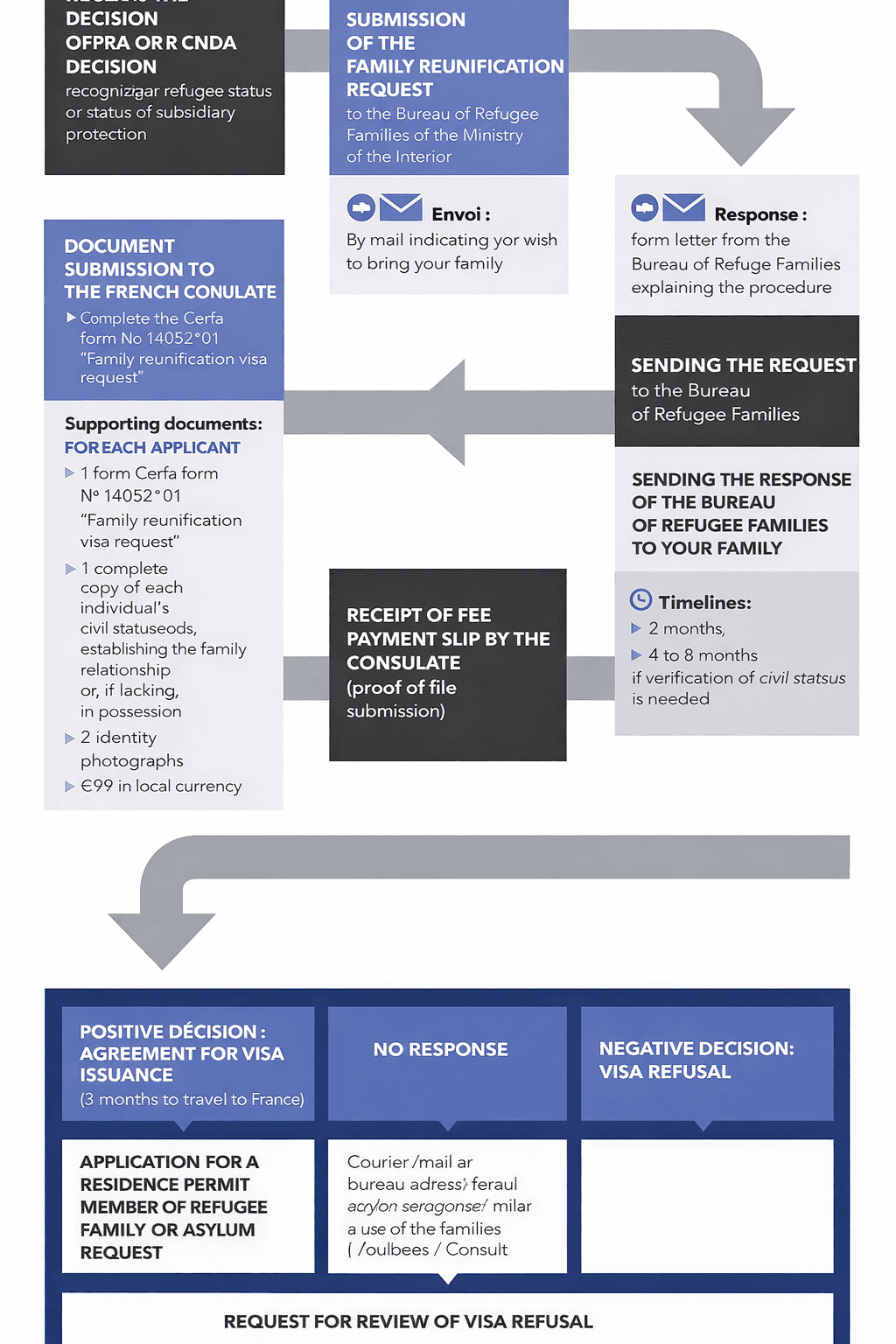
The application process involves careful evaluation of the applicant's family situation and submission of all required documents. The application is filed directly with the OFII (French Office for Immigration and Integration), either online or by registered post. After review by OFII and the mayor of the applicant's commune (verification of income and housing), if conditions are met, the prefect of the department issues a decision within six months of the complete file being received by OFII. In the absence of a response within six months, the request is considered refused (implicit refusal). Once the prefect approves the application, the consulate issues a long-stay “family” visa for the spouse and minor children. This long-stay visa (VLS-TS), issued by the consulate, allows entry to France and must be validated online via the ANEF portal (see also immigration.interieur.gouv.fr) upon arrival within three months of arrival. Each family member then obtains their residence permit from the prefecture (the VLS visa validated as a residence card). Minor children enter France with a visa marked “family reunification” and do not need a separate residence permit during their minority. Submitting a complete dossier is crucial to avoid delays or rejection. This process can take several months (case review, visa waiting periods). In practice, total processing times between OFII filing and the family member's actual arrival in France can range from six to twelve months.
Besoin d'aide pour votre demande de visa pour la France ?
Notre équipe d'experts vous accompagne dans toutes les démarches pour obtenir votre visa français, quel que soit le type.
Plus de 400 visas obtenus avec succès
Spouse visa in France (family reunification)
Eligibility
For marriage to a French citizen, the non-EU spouse qualifies if the marriage is registered in France (or transcribed in the French register if celebrated abroad), the couple still lives together, and there is no polygamy. The French spouse must have retained their French nationality. In this case, the foreign spouse must apply for a long-stay “private and family life” visa at the consulate before entering France.
If you are married to another foreigner residing in France, obtaining the visa generally requires the family reunification process (same residence, income, and housing requirements as above).
Required documents
You must assemble a complete application, including in particular:
- ✓Full marriage certificate (certified copy), with official translation and legalization if the certificate is foreign.
- ✓Proof of your spouse's French nationality (French passport or ID card).
- ✓Proof of the French spouse's resources (payslips, employer certificates, tax notices, proof of benefits…), demonstrating stable and sufficient income.
- ✓Proof of adequate housing (rental contract, property deed, or accommodation certificate + recent utility bill). The housing must meet minimum standards (minimum surface area and facilities).
- ✓Recent passport-size photos, copies of both spouses' passports, visa application form, fiscal stamps, etc.
- ✓Other documents depending on the situation: certificate of cohabitation, certificate of no polygamy, transcription of foreign marriage certificate in the French register, etc.
Note: all foreign documents must be accompanied by a translation into French by a certified sworn translator (traducteur assermenté), or certified by a French consular or diplomatic authority. For a checklist oriented to visa applications, see our article on essential documents for a France visa application.
Procedure (consulate and OFII)
Visa application at the consulate
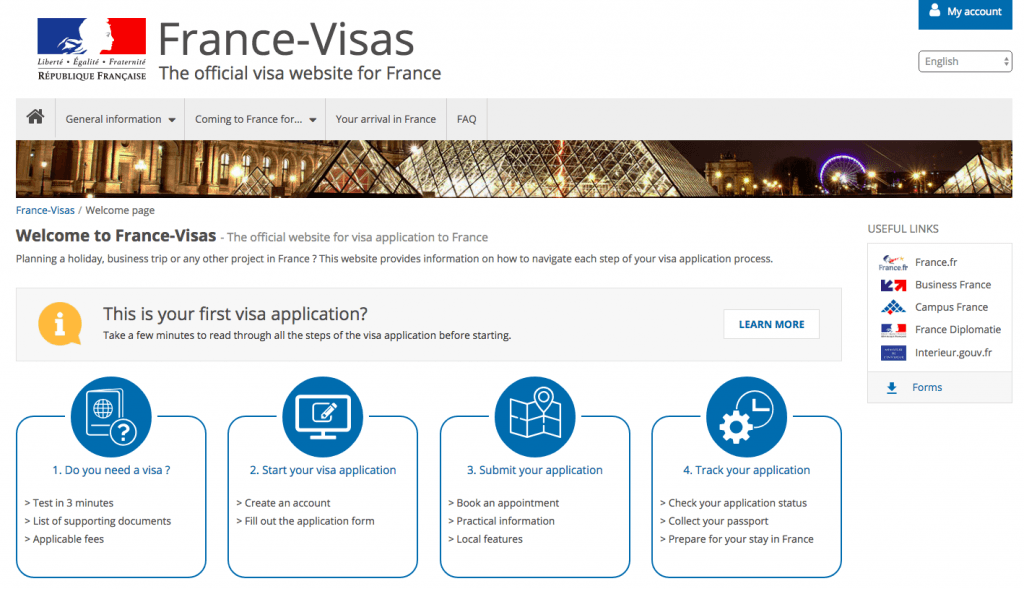
You must complete an online long-stay visa application as the spouse of a French citizen via France-Visas, then submit the full application to the French consulate in your country of residence, which acts as the competent authority for processing the spouse visa application. If the application is accepted, the consulate issues a long-stay visa marked “private and family life”. This visa, valid for up to one year, serves as a residence permit during the first year.
Entry into France
Upon arrival in France, the foreign spouse must validate their visa online on ANEF within three months. You must provide your arrival dates and a French address, then pay a residence tax (usually €75 for a standard family reunification residence permit application; €225 if applying for family reunification on the spot from within France, comprising a €25 stamp duty and a €200 tax). A validation certificate is issued.
Multi-year residence card
After one year of lawful residence, the spouse can apply at the prefecture for a temporary “private and family life” residence permit (valid for 1 year, renewable). This card is renewable and allows you to live and work in France. After five years of living together and of lawful residence in France, you may qualify for a ten-year resident card.
Family reunification (if applicable)
If the spouse in France is a non-EU foreigner, the process follows the family reunification application. This procedure is intended for spouses who wish to join their partner in France and reside in the country on a long-term basis, allowing them to permanently join their loved one. The spouse in France files the request with the local OFII office (or online via the OFII platform), which checks the conditions (18 months' residence, income, housing). The file is first reviewed by the mayor of the commune of residence, who verifies resource and housing conditions and gives a justified opinion within two months. The file is then forwarded to the prefect, who issues the final decision. If approved by the prefecture, the consulate issues a “family” visa, to be validated upon arrival as described above. Processing times can be long (sometimes six to twelve months between the OFII filing and the family member's arrival).
Reminder: If you are on a Talent Passport, family reunion rules are different (see below): there is no minimum 18-month residence requirement for the main applicant and timelines are usually shorter.
Talent Passport - Family
Fast track for talents
The Talent Passport is a multi-year residence permit for highly qualified workers (employees, researchers, entrepreneurs, artists, etc.). It includes a simplified procedure for the so-called “accompanying” family.
The spouse or PACS partner of the Talent Passport holder, as well as their dependent minor children, can benefit from the Talent Passport - Family status. They receive a special long-stay visa that allows them to reside in France within the same timeframe as the main talent.
This process is very fast: there is no minimum residence period required for the main talent (unlike family reunification) and visas can be processed in a few weeks. The family can even obtain their visa at the same time as the principal applicant if applications are submitted together. Minor children enter France with this visa, with the option to obtain a DCEM (Document de Circulation pour Étranger Mineur) rather than a standard residence permit.
Granted rights
With the “Talent - Family” status, the spouse is allowed to work freely in France with no further steps required. They receive a “Talent Passport Family” residence permit valid for the same duration as the main applicant's permit.
Minor children do not have their own residence card but can travel with a DCEM (valid up to five years). This family residence card expires on the same date as the main Talent Passport holder's permit, avoiding any administrative gap.
Procedure
From abroad
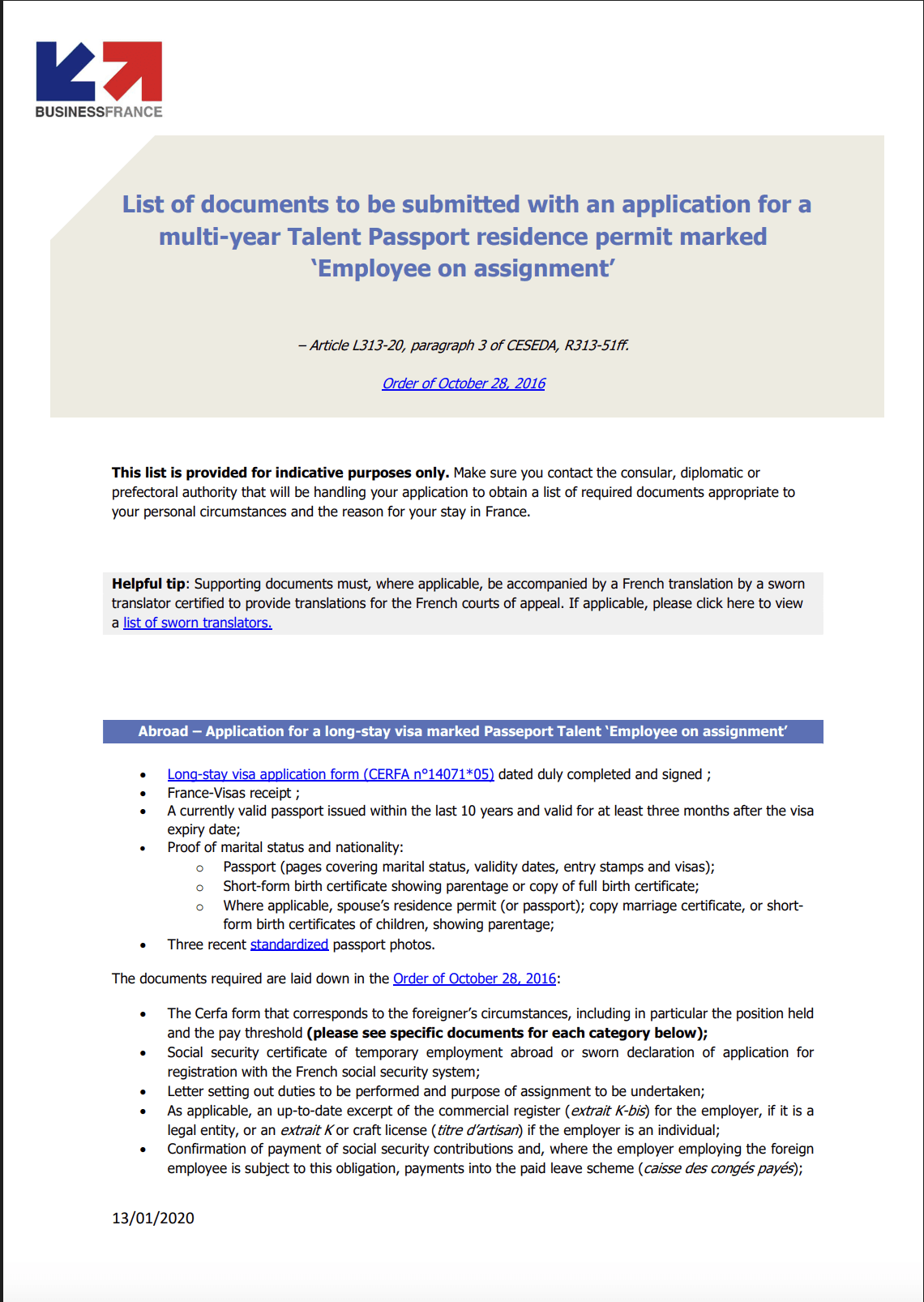
The family initiates a long-stay “Talent Passport - Family” visa application via the France-Visas portal. ANEF is used for applications from within France (change of status), not for initial visa applications from abroad. This can be done in parallel with the main applicant's request or later. The Cerfa n°14571 form must be filled in online and submitted at the competent French consulate. Required documents are standard: valid passport, signed application form, civil status documents (marriage certificate for the spouse, birth certificate for the children), ID photos, copy of the talent's residence permit or application certificate, etc. Each family member pays a visa fee (about €99) when submitting the application.
From France
If the spouse or child is already lawfully in France (on another visa or permit), they can apply for a status change at the prefecture via ANEF. Family links must be demonstrated (civil status certificates, main applicant's permit), as well as a valid passport and recent proof of address. After submitting the request online, the prefecture issues a provisional certificate and then the “Talent Passport Family” card can be collected at the prefecture.
After approval
Upon arrival or after validation, each member must validate their visa on ANEF (same steps as for any VLS), then finalize the residence permit at the prefecture (appointment and document collection). Processing times are generally short for talent status: a few weeks for the visa, and a few months for the card.
Dependent children
Visa and permit for children
Minor foreign children accompanying their parents must have an appropriate residence permit. In the case of family reunification or marriage to a French citizen, a long-stay “private and family life” visa is requested for them at the consulate, marked “family reunification” for children joining via the regroupement familial procedure, or “private and family life” for children of a foreign spouse of a French citizen.
If the parent has a Talent Passport, the minor child is eligible for the “Talent - Family” status via the DCEM (no regular card).
After arrival, the child's VLS visa must be validated on ANEF (just like for adults) or status changed as appropriate, then the child can attend French school.
In France, schooling is compulsory from age three and free in the public system. Parents must register their child promptly at the town hall for nursery (ages 3 to 6) or primary school (ages 6 to 11), providing the child's birth certificate, proof of address, and up-to-date vaccinations.
Special case: DCEM for minors
When a minor child joins a Talent Passport holder, they do not receive a regular residence card but can obtain a DCEM (Document de Circulation pour Étranger Mineur). This travel document, valid for up to five years, allows the child to re-enter France after travelling abroad.
It is issued by the prefecture upon request by a parent with parental authority, on presentation of the child's passport, family record book or birth certificate, and the parent's residence permit in France.
The DCEM does not replace the passport but facilitates international travel for resident foreign minors. Foreign children arriving alone may also, in some cases, receive a DCEM without a prior visa.
Rights and benefits for French citizens
As a French citizen, you have the legal right to bring your family members to live with you in France through pathways distinct from standard regroupement familial. Note: the formal regroupement familial procedure under French immigration law is technically reserved for non-EU foreigners residing in France who wish to bring their family. Spouses of French citizens follow a distinct process (long-stay “private and family life” visa) and are not subject to the same income and housing thresholds as the general family reunification procedure. This process allows your spouse, children, and other dependents to apply for a long-stay visa and, once in France, obtain a residence permit so your family can be reunited on French territory.
To sponsor your family, you must demonstrate your French nationality with a valid passport or national ID card, and provide proof that you have sufficient financial resources to support your family members during their stay in France. The route is designed to help families live together and build a stable family life in France, ensuring that your loved ones can join you legally and benefit from the rights associated with residence in France.
Once approved, your family members will receive a long-stay visa, which serves as their initial residence permit. This visa allows them to enter France and, after arrival, to apply for a multi-year residence permit, granting them the right to live, study, and, in most cases, work in France. As a French citizen, your ability to sponsor your family is a key benefit of your nationality, supporting family unity and integration into French society.
After arrival: settling your family
Registration with OFII and the prefecture
After arrival, all family members with a long-stay visa must validate their visa on the ANEF portal within three months. The process is done online: enter the visa details, date of arrival, and address in France, then pay the residence tax. This validation, overseen by the French authorities, makes the visa equivalent to a residence permit for the first year.
Each member can then go to the prefecture (usually by appointment) to collect their final (or multi-year) residence card. For example, a foreign spouse of a French national usually receives a one-year “private and family life” card during the first year, which can be renewed and upgraded to a multi-year card after demonstrating continued regular residence. All subsequent residence card renewals (or switch to a resident card) are done via ANEF and the prefecture, with registration procedures often involving OFII.
Additionally, family members benefiting from family reunification are required to undergo a medical examination organised by OFII upon arrival in France. The medical certificate issued at the end of this visit is essential to obtain the residence permit.
Access to healthcare and school
Once the family is lawfully residing in France, they are entitled to French social security. Under the Universal Health Protection scheme (PUMa), anyone working in France immediately has access to healthcare.
If the French or foreign spouse is employed and files the hiring declaration (DPAE) for their spouse, the whole family is covered. If not working, a foreigner with a residence permit can apply for health coverage at the local health insurance office. In practice, register with the CPAM (Primary Health Insurance Fund) in your area using your residence permit to obtain a Carte Vitale.
Foreign children can be enrolled in public schools without any condition (every child, regardless of status, has the right to education in France). The local town hall assigns a nursery or primary school based on sector. You must provide the birth certificate, proof of address, and vaccination records.
The French school system also offers support for non-French speaking children (reception classes, CLIN/CLINODE sections) to help them learn French gradually.
Integration programs
France promotes the integration of new arrivals through the Republican Integration Contract (CIR).
By signing this contract at OFII, you commit to following a one-year integration pathway, which includes a civic training course about French values and institutions and, if needed, up to 200 hours of French language lessons. This contract, free of charge, helps you learn French and understand French society. It is proposed when the first “private and family life” residence permit is granted to non-EU foreigners. Importantly, the obligation to sign a CIR applies to beneficiaries of family reunification and to spouses of French citizens. According to Service-Public.fr, the spouse and children over 16 who arrive via family reunification must sign a republican integration contract.
Note: Talent Passport holders and their families are exempt from the CIR.
Beyond the CIR, many local associations and town halls organize French language classes and support workshops (help with employment, housing, parenting, etc.) to help with your settlement.
Besoin d'aide pour votre demande de visa pour la France ?
Notre équipe d'experts vous accompagne dans toutes les démarches pour obtenir votre visa français, quel que soit le type.
Plus de 400 visas obtenus avec succès
Conclusion: bringing your loved ones to France
Whether you are an EU citizen, spouse of a French national, holder of a residence permit or a Talent Passport, French law provides procedures to reunite your family.
It is important to choose the right procedure (EU family card, “private and family life” visa, Talent Passport - Family, or family reunification) and carefully prepare your application (civil status documents, proof of income and housing, photos, etc.). Be aware that visa fees apply to most applications, and you should keep receipts as part of your documentation.
After arrival, online visa validation on ANEF and prefecture formalities are key steps to obtaining the necessary residence permits. Family members arriving via the regroupement familial procedure must also undergo a medical examination organized by OFII before the residence permit is issued.
Registering your children at school and opening social security rights will ensure a good start for your family.
Hiliv can support you in these complex steps: our team helps you prepare visa and residence permit applications, organize supporting documents, and plan key deadlines (consulate, OFII, ANEF, prefecture) so you avoid gaps in status. Explore our France destination services to see how we can assist your family's move.
With thorough preparation, bringing your loved ones to France can be done smoothly and with peace of mind. Remember, different procedures and requirements apply depending on whether you plan a short-term visit or intend to settle permanently.
Frequently asked questions
Does my EU spouse need a visa to live in France long term?
Citizens of EU/EEA countries and Switzerland can join you in France under free movement. They do not need an entry visa for the first three months; after that they should apply for a residence permit as a family member of an EU citizen at the local prefecture. That permit is free, states that the holder is a family member of an EU citizen, allows work, and is generally aligned with your own right of residence.
What income is required for regroupement familial (family reunification)?
The sponsor in France must show stable and sufficient resources over the 12 months before applying. Indicative monthly thresholds are roughly €1,823 gross (1 SMIC) for a household of 2 to 3 people, about €2,005 for 4 to 5 people, and about €2,187 for 6 or more. Certain benefits such as RSA, family allowances, and Aspa are excluded. Amounts and rules should always be verified against current official guidance.
How long does family reunification take in France?
The prefect has up to six months from when OFII receives a complete file. Silence after six months means an implicit refusal. In practice, total timelines from filing with OFII to the family member arriving in France are often in the range of six to twelve months, depending on the prefecture, consulate, and completeness of the dossier.
Is the spouse of a French citizen subject to regroupement familial income rules?
No. The formal regroupement familial procedure under French law targets non-EU foreigners in France bringing family. A non-EU spouse of a French citizen normally applies for a long-stay “private and family life” visa at the consulate and follows a distinct route, without the same income and housing thresholds as standard regroupement familial.
What is ANEF and when must I validate my visa?
ANEF is the French administration’s online service used to validate a long-stay visa (VLS-TS) after arrival. You generally must complete online validation within three months of entering France, pay the residence tax, and then complete prefecture steps for the physical residence permit.
Can the spouse of a Talent Passport holder work in France?
Yes. With “Talent Passport - Family” status, the spouse may work without an additional work permit. The family permit is aligned in duration with the main Talent Passport holder’s permit.
Do minor children get a residence card in every case?
It depends on the route. Under some procedures, children enter with an appropriate long-stay visa and follow the same validation steps. Children of Talent Passport holders may use a DCEM (travel document for foreign minors) instead of a standard titre de séjour card. Minor children joining through regroupement familial may hold a visa marked accordingly and do not always need a separate permit during minority; always confirm with the consulate and prefecture for your file.
What housing size is required for family reunification?
Housing must meet decency standards. Minimum floor area depends on the geographic zone (for example 22 m² for a couple in zones Abis and A, 24 m² in B1/B2, 28 m² in zone C), with additional square metres per extra person according to official rules.
Who must sign the Republican Integration Contract (CIR)?
According to Service-Public.fr, spouses and children over 16 arriving through regroupement familial must sign the CIR. Spouses of French citizens are also concerned. Talent Passport holders and their families are exempt.
Where should I check official visa and residence rules?
Use France-Visas for visa categories and forms, the Ministry of the Interior for immigration policy, OFII for family reunification filing, and Service-Public.fr for citizen-oriented summaries. Procedures change; always cross-check dates and fees.