NIE Madrid: Get your foreigner identification number in the Spanish capital
Complete guide to obtaining your NIE in Madrid. Discover the steps, required documents, office addresses and practical tips to successfully complete your procedures in the Spanish capital.

International Mobility Expert

Whether you're coming to study, work, or live in Madrid, obtaining the NIE (Número de Identidad de Extranjero) is an essential step. The topic of obtaining a NIE in Madrid is crucial for anyone wishing to settle or carry out administrative procedures in the Spanish capital.
This unique identification number, consisting of a letter followed by 7 digits and then a verification character in the form of a final letter, is assigned to you for life for all your activities in Spain. Without this precious key, it's impossible to complete many everyday administrative formalities. In this comprehensive guide, we explain how to obtain the NIE in Madrid, why the NIE is essential, the steps to obtain it in the Spanish capital, the required documents, addresses and tips specific to Madrid, as well as professional assistance solutions if the procedure seems complex to you.
📋 Table of Contents

Introduction to the NIE
The NIE, or Foreigner Identity Number, is the cornerstone of all administrative procedures for foreigners in Spain. Issued by the General Directorate of Police, this unique number allows each foreign person to be identified in all acts of daily life: opening a bank account, signing a work contract, registering for social security, or purchasing real estate. Without this document, it's practically impossible to carry out the essential procedures for your installation in Spain. This guide will walk you through step by step to understand the importance of the NIE, know what information to provide, and successfully complete your procedures with peace of mind.
Why do you need a NIE in Spain?
Obtaining the NIE is an essential prerequisite for any installation or residence in Spain. This number is required to justify your residence in Spain and begin administrative procedures related to your main residence. The NIE corresponds to the identity number for foreigners in Spain. It is a mandatory personal identification number for registering as a foreign resident and carrying out numerous procedures. It also serves as an identity and tax identification number for foreign residents. Note that the NIE is not a residence permit and does not replace a proof of residence: it does not grant the right to reside in Spain on its own.
Without this number, you will have difficulty renting an apartment, opening a bank account, buying or renting real estate. It will also be required to get a job, or subscribe to common services (phone, internet, electricity…). In other words, the NIE is essential for leading a normal life in Spain as an expatriate.
Here are the concrete situations where the NIE will be required:
- Opening a bank account in Spain (to receive a salary, pay rent, etc.)
- Signing a work contract with a Spanish employer
- Obtaining a social security number and accessing public health services
- Signing a rental lease for housing (apartment, house)
- Buying real estate in Spain
- Subscribing to service contracts (mobile plan, internet, electricity, water…)
Each family member, including children, must obtain a NIE: it is mandatory for all family members during installation, to ensure social coverage, social security registration, and tax compliance. Obtaining the NIE is therefore an essential procedure for each member, adult and child alike.
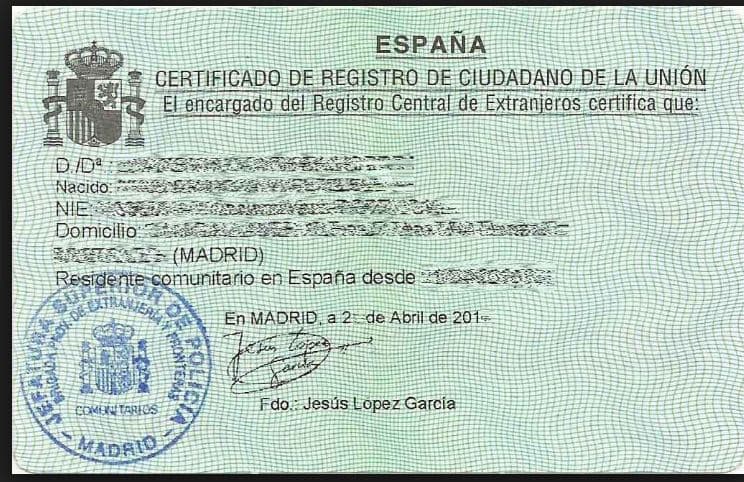
In summary, the NIE serves as a general identification key in practically all administrative and economic procedures in Spain. It also serves as a tax identification number (NIF) for non-Spanish nationals. Note that if you plan to stay more than 3 months in Spain, the law requires you to obtain this foreigner identification number and, for EU citizens, to apply for a resident registration certificate (certificado de registro or registro de ciudadano). This certificado is an official document attesting to your resident status and is required for many administrative procedures.
Since the NIE is assigned once and for all, it has no expiration date: you will keep it throughout your life, even if you leave and then return to Spain later.
To obtain the NIE, you must present an identity card, passport, or any other valid identity document. It is also important to gather all necessary papers and follow administrative procedures scrupulously to avoid any delays. Obtaining the NIE is essential for all administrative procedures in Spain.
👉 The NIE is not an identity document. It is important to distinguish the NIE from the Spanish national identity card (DNI) reserved for Spanish citizens, as well as the foreign identity card, which are official identity documents, whereas the NIE is only an identification number and does not constitute an identity document.
Steps to obtain your NIE in Madrid
The NIE is issued by the competent Spanish authorities, who are responsible for assigning the identification number and managing the administrative procedure.
Obtaining a NIE in Madrid involves following several administrative steps in order. You will need to book an online appointment with the competent service, prepare a file of documents to present, then the applicant must appear in person at the police station on the appointment day to finalize the application by paying the corresponding fee. Once these steps are completed, your NIE will be issued (generally in the form of a certificate or card depending on your status).
For people residing in another country, the NIE application can be made at the Spanish consulate in the country of residence. It is important to contact the nearest Spanish consulate to find out the specific procedure and required documents.
Book an online appointment (cita previa)
The first step is to book an online appointment slot (cita previa) with the foreign police services. Go to the dedicated official portal (Spanish Ministry of the Interior website) for online appointment booking. You must select the province “Madrid” then the type of procedure “Policía – Certificados y asignación NIE”, which corresponds to the NIE application service. You will then need to provide your information (passport number, name, nationality…) and choose an available slot.
Plan ahead as much as possible: in Madrid, slots go very quickly due to high demand. The time to get an appointment can reach two months, so it's advisable to start well in advance – ideally as soon as you know your installation date. Don't hesitate to book an appointment before your arrival in Spain if possible.
Tip for securing a slot: the appointment website generally releases new slots on Monday early morning (around 8:00 AM). Log in right at 8 AM and refresh the page frequently to book a slot as soon as a place becomes available. If no appointments appear, keep refreshing between 8 AM and 9 AM – many expatriates find that this morning time slot is when new availabilities are added. Additionally, last-minute cancellations can sometimes put places back online late in the evening (after midnight), it may be worth checking. In short, be an early riser and persistent in your online appointment search.
Prepare the required documents
Once you have the appointment (you will receive a confirmation by email), you need to carefully prepare all necessary documents. A complete file will avoid unnecessary back-and-forth. Here is the list of documents to gather:
- Valid passport or identity card (+ photocopy) – to prove your identity.
- Completed and signed EX-15 form – this is the NIE application form (available online on the ministry website). Fill it out legibly in capital letters and in Spanish.
- Completed Modelo 790 – Código 012 form – this form is for payment of the administrative fee for the NIE. You can download it online and fill it out in advance.
- Appointment confirmation – print the confirmation email or the PDF invitation file received when booking the online appointment. You will be asked for it at the office entrance.
Check several times that you have all required documents, including copies. It's prudent to prepare a set of photocopies of each document (passport, forms, proofs) just in case. Organize everything in a folder for the big day.
Attend the appointment at the police station
On the appointment day, go to the indicated address (generally specified when booking the appointment). In Madrid, the main foreigner's office is the Brigada Provincial de Extranjería y Fronteras, located at Avenida de los Poblados s/n, 28027 Madrid (Aluche district). This is the large police station dedicated to foreigner applications, easily accessible via Aluche metro (line 5) or bus. In central Madrid, there is also an Oficina de Extranjería branch at Calle de la Silva 19 (28004), near Gran Vía, which handles certain immigration procedures. Make sure to check the appointment location mentioned on your appointment and arrive on time (or even a bit early) – waiting lines can be long in these very busy offices.
On site, you will need to present your file at the counter or to the agent handling NIE applications. Before your appointment, you must go to a bank counter with the Tasa Modelo 790 document to pay the administrative fees. The NIE fee amounts to approximately €10 (€9.84 precisely). Once payment is made, the bank gives you a stamped receipt attesting to the payment and you must go to the appointment with this document.
Need help obtaining your white NIE in Spain?
Our team of experts helps you obtain your white NIE (non-resident) without traveling.
More than 300 white NIEs obtained
"Julia est super efficace : NIE obtenu en quelques jours."
Marie
Espagne
Then return to the police station with the bank receipt. By presenting this proof of payment, your file can be finalized. The NIE issuance can vary depending on the case: sometimes the NIE number (in the form of a paper certificate) is given to you the same day or a few days later, or you may be asked to come back to pick it up once ready. In Madrid, given the volume, it's common for the NIE (or card/TIE for non-Europeans) to be available a few days or weeks later – an appointment or indication will be given to you to come pick it up. In any case, your NIE number once assigned is permanent and you won't have to restart the procedure later. Carefully keep the document that will be given to you, and don't hesitate to make copies of your NIE certificate once obtained.

Processing times
Processing times to obtain a NIE in Madrid vary depending on the time of year and volume. Generally, you should count between 1 to 2 months for the complete procedure. It is therefore crucial to plan ahead and take these delays into account when organizing your arrival and administrative procedures in Spain. Keep in mind that any delay in presenting documents or booking an appointment can lengthen the time to obtain your identification number.
Application fees
The NIE application in Spain involves paying administrative fees, the amount of which is €9.84. This rate is subject to change, so it's recommended to check updated information on the National Police website or by contacting the Spanish General Consulate before starting your procedures.
Madrid specifics: addresses and practical tips
Obtaining a NIE in Madrid has some particularities related to the size of the city and the number of applications. The Spanish capital attracts many expatriates, students, and foreign workers, so the volume of NIE applications is extremely high. As a result, processing times tend to be longer than elsewhere: it's not uncommon to wait several weeks to get an appointment at a Madrid police station. So arm yourself with patience and plan your procedures as much as possible.
The main offices handling NIE applications in Madrid are those of the National Police authorized for the “Extranjería” service. The best known is the Comisaría de Policía Nacional d'Aluche (Provincial Brigade for Foreigners) mentioned above, at Avenida de los Poblados. This office centralizes a large part of applications and can therefore be congested. Another important service point is CNP Padre Piquer. Depending on your location, there are also offices in the outskirts of Madrid (for example in Leganés, Alcobendas, etc.), but these often handle specific cases of residence permits or other immigration procedures.
To maximize your chances in Madrid, follow these tips:
- Monitor the opening of new online slots: log in frequently on the appointment platform, especially at the beginning of the week. As mentioned earlier, early Monday morning is the strategic time when time slots are added.
- Prepare your file meticulously: make sure you have all requested documents, filled out correctly, and print them in multiple copies. A complete file will speed up your time at the counter.
- Arrive early on appointment day: delays are not tolerated and systematically lead to cancellation of your appointment. Our advice is therefore to plan your journey well in advance and arrive early.
- Consider neighboring municipalities: if getting an appointment in Madrid itself proves impossible within the desired timeframe, some opt for a police station in a small town in the Community of Madrid (or another province of Spain) where the volume is lower. This trick can work and save you time. However, be careful: it sometimes happens that offices outside Madrid refuse applications from people domiciled in Madrid itself. Make sure to inquire before taking this route, and don't hesitate to call on a professional.
Professional assistance services
Faced with the complexity of Spanish administrative procedures (language barrier, difficulty obtaining an appointment, forms in Spanish, etc.), you might consider using a professional assistance service. Lawyers or specialized agencies offer to help you obtain your NIE, for a fee, by handling the entire process on your behalf. The main advantage is time savings and simplicity: the provider takes care of filling out the forms correctly, booking the appointment, and possibly accompanying you, which saves you a lot of hassle.
Need help obtaining your white NIE in Spain?
Our team of experts helps you obtain your white NIE (non-resident) without traveling.
More than 300 white NIEs obtained
"Julia est super efficace : NIE obtenu en quelques jours."
Marie
Espagne
For example, Hiliv is an expatriate assistance service based in Spain that offers complete support for obtaining the NIE. Their offer includes an average processing time of 20 working days to obtain your foreigner number. These services provide real peace of mind. Calling on this type of professional can be wise if you're pressed for time or not comfortable with procedures in Spanish. You'll have the assurance of obtaining your NIE quickly, without stress, and can focus on the rest of your installation in Madrid.
Frequently asked questions about obtaining a NIE in Madrid
How long does it take to obtain a NIE in Madrid?
Processing times to obtain a NIE in Madrid generally vary between 1 to 2 months. This includes the time needed to get an appointment (which can take several weeks in Madrid due to high demand) and processing of your file. It is therefore crucial to plan ahead and book an appointment as early as possible.
What documents are needed to apply for a NIE in Madrid?
The required documents are:
- Valid passport or identity card (+ photocopy)
- Completed and signed EX-15 form (in capital letters and in Spanish)
- Completed Modelo 790 – Código 012 form (for payment of the fee)
- Appointment confirmation (email or printed PDF)
It is recommended to prepare several copies of each document to avoid any problems.
How much does a NIE application cost in Madrid?
The administrative fee to obtain a NIE is €9.84 (approximately €10). This amount must be paid in advance of the appointment at a Spanish bank using the Modelo 790 form. The bank-stamped payment receipt must be presented at the appointment at the police station.
Where is the office to obtain a NIE in Madrid?
The main office to obtain a NIE in Madrid is the Brigada Provincial de Extranjería y Fronteras, located at:
Avenida de los Poblados s/n, 28027 Madrid (Aluche district)
This office is accessible via Aluche metro (line 5) or by bus. There is also a branch at Calle de la Silva 19 (28004), near Gran Vía.
Make sure to check the exact address mentioned on your appointment confirmation.
Can you obtain a NIE in Madrid without an appointment?
No, it is mandatory to have an appointment (cita previa) to obtain a NIE in Madrid. Appointments are booked online on the official portal of the Spanish Ministry of the Interior. Without an appointment, you will not be received at the police station. It is therefore essential to book your online slot as early as possible, as availabilities go very quickly in Madrid.
When are new appointment slots available in Madrid?
New appointment slots are generally released early Monday morning (around 8:00 AM) on the appointment booking website. It is recommended to log in at this time and refresh the page frequently to book a slot as soon as a place becomes available. Last-minute cancellations can also put places back online late in the evening (after midnight).
Does the NIE expire?
No, the NIE is assigned once and for all and has no expiration date. You will keep it throughout your life, even if you leave and then return to Spain later. However, if you lose your NIE certificate, you will need to request a duplicate from the police, but your NIE number will remain the same.
Can you obtain a NIE in another city than Madrid if you live in Madrid?
Theoretically, some expatriates opt for a police station in a small town in the Community of Madrid or another province where the volume is lower. However, be careful: it sometimes happens that offices outside Madrid refuse applications from people domiciled in Madrid itself. It is therefore recommended to inquire before taking this route, or to call on a professional for advice.
Do I need to speak Spanish to obtain my NIE in Madrid?
It is not mandatory to speak Spanish, but it can greatly facilitate the procedure. Forms must be filled out in Spanish, and police officers may not speak French or English. If you don't master Spanish, it may be wise to call on a professional assistance service that can help you fill out the forms and accompany you during the appointment.
What is the difference between the NIE and the DNI?
The DNI (Documento Nacional de Identidad) is the Spanish identity card reserved exclusively for Spanish citizens. It is an official identity document in card format.
The NIE (Número de Identidad de Extranjero) is an identification number assigned to foreigners. It is not a full identity document, but a number inscribed on a certificate. The NIE serves as a unique identifier for all administrative and tax procedures in Spain for non-Spaniards.
In summary: the DNI is for Spaniards, the NIE is for foreigners.