Setting Up Business in France: Incorporation Guide for Foreign Founders
Complete guide to setting up a business in France as a foreign founder: choosing the right legal structure (SAS, SARL, auto-entrepreneur), registering with the Commercial Court, obtaining your K-bis extract and SIRET number, tax registrations, hiring employees, and aligning incorporation with your visa status (Talent Passport, entrepreneur visa).

International Mobility Expert

France's thriving economy and dynamic startup ecosystem make it an attractive destination for international entrepreneurs. Setting up a business in France is entirely feasible for foreign founders, but it involves navigating specific incorporation steps and legal requirements. This guide breaks down everything from choosing the right company structure to registering with authorities, obtaining a K-bis extract, handling taxes, and even aligning the process with your visa status. Whether you're launching a tech startup or expanding an existing company, this incorporation guide will help you start a company in France with confidence.
Introduction to Setting Up a Business in France
France stands out as an attractive destination for foreign entrepreneurs looking to launch or expand their business in Europe. With its robust economy, central location, and access to the European Union market, France offers a wealth of opportunities for those ready to navigate its business landscape. However, setting up a business in France requires a clear understanding of the country's legal requirements and administrative processes.
Choosing the right business structure is a critical first step, as it will determine your company's liability, tax obligations, and operational flexibility. For many foreign companies, the simplified joint-stock company (SAS) is a preferred option due to its adaptable governance and limited liability, making it especially suitable for startups and international investors. By familiarizing yourself with the necessary steps and regulations, you can turn the complexity of French company formation into a rewarding business venture.
Important for Non-EU Founders
Need help with your talent visa for France?
Our team of experts helps you obtain your talent passport and settle in France.
More than 100 talent passports obtained
Choosing the Right Legal Structure (SAS, SARL, Auto-entrepreneur)
One of the first decisions is selecting an appropriate legal structure for your French business. The choice will impact your liability, taxes, and administrative obligations. Selecting the correct business type and legal status is crucial, as it determines the company's obligations and opportunities. In France, foreign entrepreneurs commonly consider the following structures:
SAS
- ✓Flexible governance via custom bylaws
- ✓Ideal for startups and investors
- ✓Can be a SASU (single shareholder)
- ✓President under employee social security regime
- ✓No minimum capital (€1 legally)
- ✓Easy to issue shares to investors
SARL
- •Limited liability company (LLC equivalent)
- •Suitable for small/family businesses
- •1 to 100 partners (EURL if solo)
- •More rigid statutory rules
- •Gérant (majority) under self-employed regime
- •No minimum capital (€1 legally)
Auto-entrepreneur
- •Simplified sole proprietorship
- •Very easy to set up online
- •No limited liability protection
- •Revenue caps apply (2026: €72,600 for services)
- •Not suitable for raising capital
- •No partners allowed
SAS (Société par Actions Simplifiée)
A flexible joint-stock company well-suited for startups and investors. An SAS is a legal entity and a popular business type for startups. It can have a single shareholder (as a SASU) or multiple. It offers limited liability protection (shareholders' liability is limited to their contributions) and great flexibility in governance. This is often the preferred form for tech startups because you can define custom rules in the bylaws, issue shares to investors easily, and the company can be managed by a President (individual or company). Social charges for the President of an SAS are at the assimilated employee rate (full social security contributions if a salary is taken). There's no strict minimum capital (legally you can incorporate with even €1, though a reasonable capital is advised for credibility).
SARL (Société à Responsabilité Limitée)
A limited liability company comparable to an LLC, ideal for small and medium businesses or family enterprises. A SARL is a separate legal entity. It requires between 1 and 100 partners (if one partner, it's called an EURL). Like an SAS, it offers limited liability and a low minimum capital. However, SARL governance is more rigid, governed by the French Commercial Code with less flexibility to draft custom rules. The managing director (gérant) of a SARL who holds more than 50% of shares is considered self-employed for social security, which can mean lower social charges on their remuneration (but also fewer social benefits). SARLs can opt for corporate tax by default, though small SARLs may elect personal income tax treatment under certain conditions. Overall, a SARL is a solid choice for straightforward businesses not seeking rapid fundraising.
Auto-entrepreneur (Micro-entreprise)
This is not a separate company but a simplified sole proprietorship regime for single entrepreneurs. The micro-entrepreneur regime is a specific legal status for small business owners. Often chosen by freelancers or solo business owners, it's very easy to set up (just an online registration) with minimal accounting. The auto-entrepreneur status (now officially called micro-entreprise) has no limited liability, the business is tied to you personally (though recent reforms protect primary personal assets). It also comes with revenue caps (for 2026, €72,600 for intellectual/service activities and €176,200 for commercial/trading activities per year). If you stay under the threshold and simplicity is a priority, this regime offers simplified tax and social charge calculations. However, it's not suitable for raising capital or adding partners, and if your business grows beyond the limits or involves higher risk, you'll need to incorporate as an SAS, SARL, or other entity.
Summary: Which Structure to Choose?
Building Your Business Identity
Building a strong business identity is a foundational step when starting a company in France. The process begins with selecting a distinctive company name that reflects your brand and is not already in use. To secure your business name and protect your brand, you must register it with the National Institute of Industrial Property (INPI), which oversees trademarks and industrial property rights in France. Alongside this, developing a comprehensive business plan is essential. It will not only guide your strategy and financial planning but also support applications for a French bank account and, if needed, a residence permit.
Opening a French bank account is a key milestone, as it enables you to manage financial transactions, deposit share capital, and demonstrate your company's legitimacy to local authorities. Foreign entrepreneurs should also be prepared to register with the appropriate authorities, such as the commercial court or the Guichet Unique (the official one-stop shop for business formalities), to ensure full compliance with French business regulations. Securing a residence permit is another important step for non-EU founders who plan to live and work in France. By carefully addressing these elements: company name, trademark, business plan, bank account, and legal registrations, you lay a solid foundation for your business in France.
Establishing a Presence in France
Establishing a presence in France goes beyond company registration; it's about creating a tangible footprint in the French market. For many new businesses, setting up a virtual office is a practical and cost-effective way to obtain a French address and manage correspondence, especially in the early stages. This solution is particularly attractive for startups and small businesses that want to keep overheads low while maintaining a professional image. As your business grows, you may consider transitioning to a traditional office space to accommodate a larger team or meet client expectations.
In addition to securing office space, you'll need to obtain any necessary licenses or permits specific to your business activity. Hiring employees in France requires careful attention to local labor laws, which can be complex and require detailed employment contracts and compliance with social security contributions. If you are part of a parent company or have an existing company abroad, leveraging their experience and resources can help you navigate these requirements more smoothly. Whether you're launching a new venture or expanding an established business, taking these steps ensures your company is well-positioned to operate successfully in the French economy.
- ✓Register your company name and trademark with INPI to protect your brand
- ✓Open a French bank account to deposit share capital and manage transactions
- ✓Use a domiciliation service (virtual office) if you do not yet have physical premises
- ✓Obtain any sector-specific licenses or professional certifications required
- ✓Develop a comprehensive business plan for banking, visa, and registration purposes
Pre-Incorporation Steps
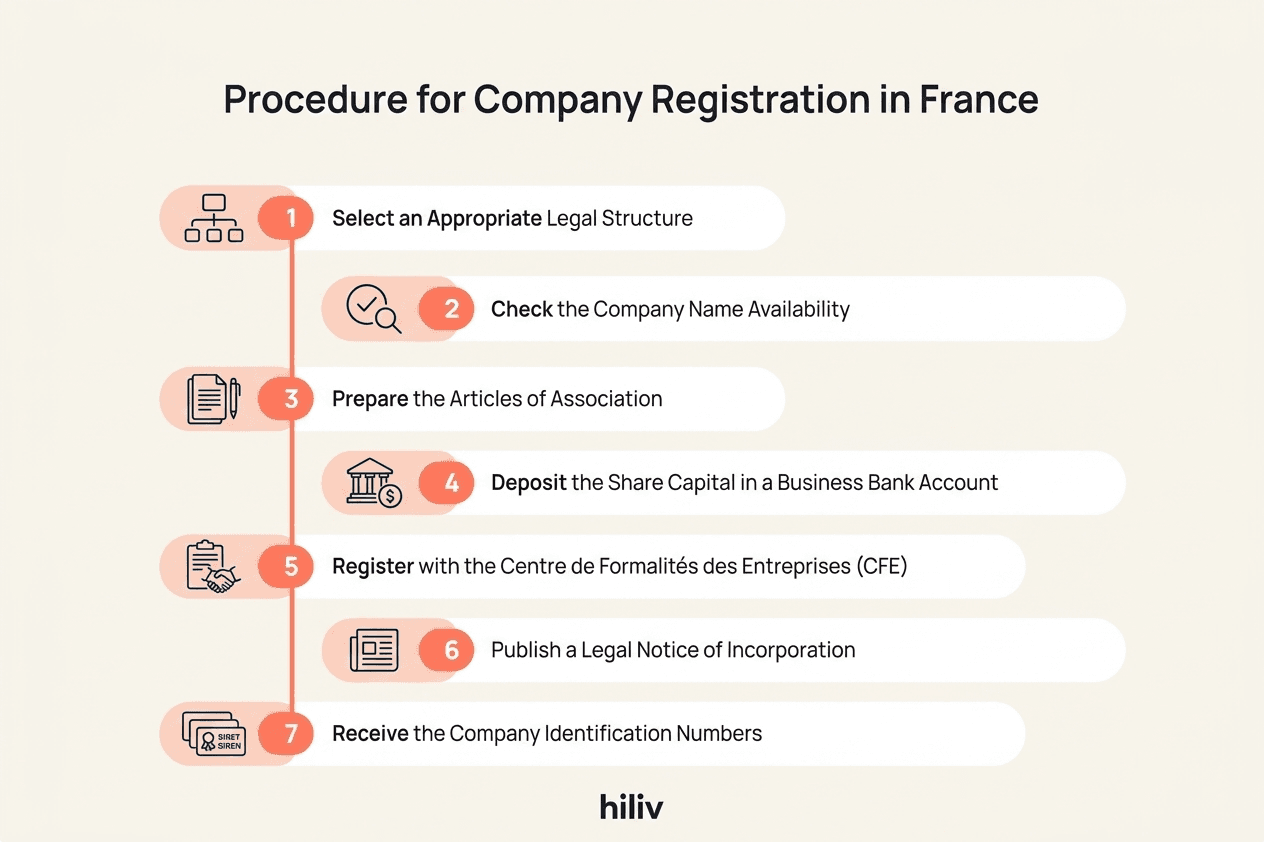
Before you can formally register a company in France, there are several preparatory steps to complete. Think of these as laying the groundwork so that the actual incorporation filing goes smoothly. Pre-incorporation involves drafting your company's constitutional documents, securing the initial capital, and fulfilling certain publication requirements. At this stage, it is crucial to clearly define your business project, as this will guide the selection of your company structure, capital requirements, and compliance steps throughout the process.
Drafting Articles of Association
Every French company (SAS, SARL, etc.) must have Articles of Association, known in French as the Statuts. This is the legal document that defines your company's identity and governance. In drafting the Articles of Association, you will need to include essential details such as:
- •Company name and address: Ensure you have chosen a unique company name that is not already registered. You will also need a registered legal address in France (this can be an actual office, co-working space, or a domiciliation service address). The legal address serves as the official location for company registration and correspondence, and you must provide proof of it during registration (e.g. lease, domiciliation certificate, or "contrat de domiciliation").
- •Business activity (objet social): A brief description of the company's purpose and activities. This should be as precise as possible, as it determines your business's scope and relevant regulations.
- •Share capital: The amount of capital and how it's divided into shares. For example, you might declare a capital of €10,000 divided into 10,000 shares of €1 each. List each shareholder's contributions (cash, or in-kind assets if any) and the percentage of shares they receive.
- •Shareholders and management: Identify who the shareholders are and who will manage the company. In an SAS, you will appoint a President (and any other officers as desired); in a SARL, one or more Gérants (managers) are named. The statutes should outline the powers of the manager(s) or president, how decisions are made, and how new shareholders can join or shares can be transferred.
- •Governance rules: Define how shareholder meetings will be conducted, voting rights, quorum and majority requirements for decisions, and other governance matters. SAS statutes can be highly customized on these points, whereas SARL statutes follow more standardized rules.
- •Duration and fiscal year: Specify the company's lifespan (often 99 years by default) and set the start and end of the financial year (often January-December, but you can choose).
- •Other clauses: Depending on your needs, you can add clauses such as pre-emption rights (giving existing shareholders first right to buy shares if someone is selling), non-compete clauses, or specific conditions for certain decisions.
Key Requirement
Depositing Share Capital in a French Bank
If your chosen structure is an SAS, SARL, or other company with share capital, you'll need to deposit the initial capital into a bank account. This step comes before official registration, because the registry will ask for proof that the capital has been paid in.
The process generally works as follows: you approach a bank in France (or occasionally a notary or specialized financial institution) to open a temporary bank account in the company's name. Since the company is not legally formed yet (no registration number at this stage), the bank opens a capital deposit account specifically for holding your funds until incorporation. You then deposit the amount of your share capital into this account. The minimum capital for SAS or SARL can be very low (even €1), but banks often expect a bit more. A few thousand euros is common for serious businesses, and certain visas like the Talent Passport may expect around €30,000 investment for credibility.
Once the funds are deposited, the bank issues an Attestation de dépôt de capital, also known as a bank certificate. This formal document certifies that the initial share capital has been deposited into the account. It is crucial for company registration, as it must be included in your incorporation application. The certificate will list the company name (as given for the account), the amount deposited, and the date. If you have multiple shareholders contributing, usually one person (often the future director) handles the deposit and you will provide details to allocate shares accordingly in the statutes.
Practical Tip: Opening a Bank Account as a Foreign Founder
Publishing a Legal Notice
France requires new companies to announce their formation to the public. This means you must publish a legal notice (avis de constitution) in an official journal of legal announcements. The purpose is to make the incorporation public information.
The process is straightforward: you prepare a short notice containing key details of your company (name, legal form, capital, address, a summary of the business activity, names of the director(s)/manager(s), and registration office city). You then submit this notice to an authorized newspaper or online service that publishes legal announcements for the department (region) where your company's registered office is located.
There are many authorized journaux d'annonces légales in each region (often local newspapers or specialized press). Today, you can complete this step online via various platforms by filling out a form with your company details. The notice will be published, and you'll receive a certificate or proof of publication (attestation de parution). This proof must be included in your company registration application.
The cost of publication depends on the length of the notice and the region, but it's usually a few dozen euros (the price is regulated per line of text). For example, publishing a standard notice might cost around €150 (prices are often fixed by law annually). The important thing is that you cannot skip this step for SAS/SARL and similar entities: the registry will not complete your company registration without the attestation of publication.
Note
Registering with the French Commercial Court (Greffe)
To incorporate in France, you must complete the business registration process with the appropriate authorities, which culminates in its entry on the Registre du Commerce et des Sociétés (RCS), the Trade and Companies Register. Business registration is a mandatory step for legal operation in France. For most businesses, this is handled via the online Guichet Unique portal.
Since 2023, France has introduced a “Guichet Unique” online portal for all company registrations and filings (formalites.entreprises.gouv.fr). This single digital window streamlines the process by forwarding your application to all relevant bodies (the Commercial Court registry, INSEE, tax office, URSSAF, etc.). As a foreign founder, you can use this platform to submit your incorporation dossier, although it is in French and you will need to create an account and follow the instructions carefully. Alternatively, you can have a company representative (such as a local lawyer, accountant, or service provider) file on your behalf. All new company registrations must be submitted through the Guichet Unique; direct paper filing at the Greffe is no longer available for new creations. The relevant Chambers (CCI, CMA) remain available to provide guidance and support throughout the process.
When registering, you will typically need to submit the following documents and information:
- •Completed registration forms: The main form is often referred to as M0 for companies (or a specific form for your entity type). On the online portal, this is done via an interactive form where you input details.
- •Articles of Association (Statuts): The final signed version of your statutes in French.
- •Share capital deposit certificate: The attestation from the bank or notary confirming capital has been deposited.
- •Proof of registered address: e.g. a lease, recent utility bill (if using your home or someone's address), or a domiciliation contract from a virtual office service. This proves the company has a legal seat in France.
- •Proof of identity for directors and shareholders: Typically a copy of the passport or ID of the company's director(s) must be provided. For foreign individuals not residing in France, a passport copy is used; if you have a French residence permit already, include that too. If a shareholder is another company, you'd provide its incorporation documents.
- •Declaration of non-conviction: A simple signed statement by each company director declaring they have not been convicted of any criminal offenses or bankruptcy that would bar them from managing a company. This is often included as a section in the registration form or as a separate attestation.
- •Legal notice publication certificate: Proof that you published the incorporation notice in a legal announcements journal (as discussed above).
- •Additional permits or documents if applicable: For certain regulated activities (e.g. restaurant, finance, healthcare), you might need to show specific licenses or qualifications. Most startups will not need extra permits at registration stage.
- •Payment of fees: There is a registration fee to pay to the Commercial Court for processing. The exact amount varies by legal form and can change annually. Always verify current fees on the official Guichet Unique portal or with the relevant Greffe du Tribunal de Commerce. If filing online, you will pay by card during the submission.
You can register various types of entities, such as SARL, SAS, or SA. Foreign companies may also establish a branch office in France, which involves specific registration requirements and documentation.
After uploading all documents and submitting the dossier via the portal, the application will be processed by the relevant authorities. The Commercial Court's registry (Greffe) will review the documents to ensure everything is in order. For foreigners, they might pay extra attention to documents like the address proof and identity documents, so ensure everything is clear and translated if needed. Passports and internationally understandable documents are usually fine, but if any document is not in French, a certified translation may be required.
Timeline
Note for Auto-entrepreneurs
Obtaining the K-bis Extract & SIRET Number
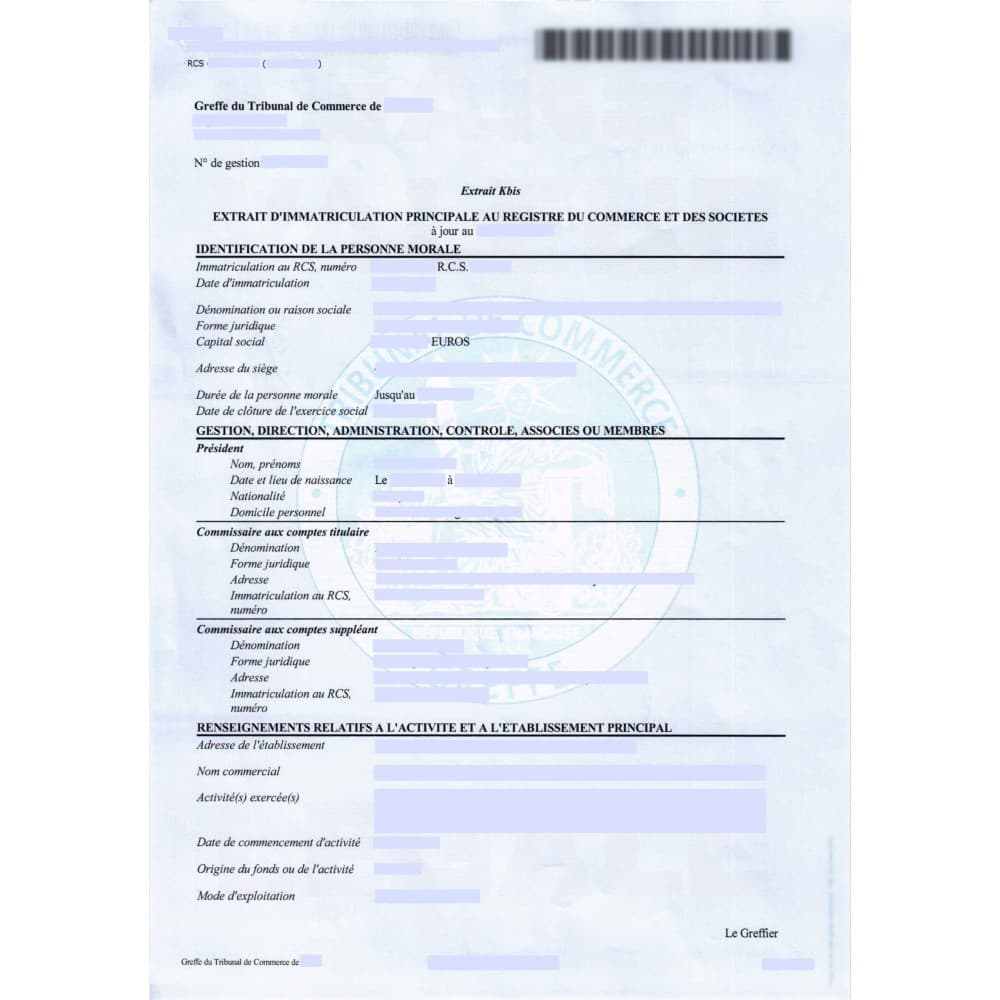
Upon successful registration, your company will be officially recorded in the French Trade and Companies Register. The proof of this registration comes in two important identifiers/documents:
The K-bis Extract
The Extrait K-bis is essentially your company's “birth certificate” issued by the Commercial Court registry. It is an official excerpt from the register that lists all the essential information about your new company: its name, legal form, address, share capital, activities, the date of incorporation, the SIREN number, the identity of the director(s), etc. This document is essential for any new business operating in France, as it serves as the primary proof of legal existence.
You will need the K-bis extract for many practical matters in France: opening a permanent business bank account (most banks require an up-to-date K-bis to fully activate corporate banking services), signing leases, engaging in contracts, or registering for certain services. The K-bis is often delivered electronically (you may receive a PDF by email or a link to download it), and you can always request updated copies via the Infogreffe website at any time.
Important
SIREN/SIRET Number
Along with the K-bis, your business is assigned a unique identification number by INSEE (the national statistics office). The SIREN is a 9-digit number identifying your company, and the SIRET is a 14-digit number which includes the SIREN plus a 5-digit establishment code. The SIRET essentially identifies your specific business location. These numbers will be on the K-bis and are used on all official documents, invoices, and tax declarations. Think of SIREN like a company ID and SIRET like the branch/location ID. For most new companies, you have just one location so SIRET = SIREN + "00001". With the SIREN/SIRET, your company can be looked up in the public directory of companies.
After incorporation, you should keep your K-bis and SIRET information handy. Typically, from the moment you receive the K-bis, you can proceed to finalize your business bank account (the bank will switch your initial deposit account into a regular account, because now you can provide the K-bis and the final signed statutes). You can also register for various other services and get a company stamp if desired.
Tax & Social-Security Registrations
Once your company is established and has its SIRET, several tax and social security registrations either happen automatically or require your attention. France's one-stop registration system usually takes care of alerting the various agencies, but as the business owner, you should verify and complete certain steps. France offers a favorable environment for foreign investors, with streamlined tax and registration procedures:
Corporate Tax Registration
Companies in France are typically liable for corporate income tax (Impôt sur les Sociétés, IS) on their profits, unless you have chosen a pass-through tax option available in some cases for SARL or SAS under specific conditions. When your company is registered, the information is forwarded to the tax authorities. You will be assigned a corporate tax office (Service des Impôts des Entreprises, SIE) based on your company address. You do not usually need to separately apply for this: you will eventually receive a letter from your SIE with your tax registration details. However, it's wise to contact them or confirm your company is on file, especially if you expect to start operations immediately. You will have to file annual tax returns and possibly quarterly or monthly advance payments depending on your revenue and profit.
VAT (TVA) Registration
If your business will be making taxable sales in France or the EU, you may need a VAT number. France does not automatically assign a VAT number to every new company. If you indicated during registration that you intend to be subject to VAT (for example, your expected turnover is above the threshold or you will voluntarily register), then a VAT number should be issued (it's often your SIREN with a special two-digit code in front). Small businesses under certain revenue thresholds might be under franchise en base de TVA (VAT exemption) by default, meaning they do not charge VAT until they exceed the limit. If you know you will need to charge VAT (for example, a B2B service provider dealing with EU clients will likely want a VAT number for intra-community transactions), you should request VAT registration through your SIE or when filling the initial forms. An accountant's help is advisable to determine your VAT status.
Social Security Affiliation (Company Director)
When you form a company, the authorities will also consider the social security status of the business owner(s). If you are the director of a SAS (President) or a minority shareholder-Gérant of a SARL, you fall under the general employee regime for social security (even if you're not drawing salary, you're considered an “assimilated employee”). If you are the majority Gérant of a SARL, you will be under the self-employed regime (SSI, formerly RSI). In either case, the registration of your company should trigger an account for you with URSSAF or the relevant social fund.
If you're a foreign founder relocating to France, once you have a residence permit and start working as the company director, you will register with the French healthcare and pension system through these contributions. It might be worth consulting a social security office (URSSAF) or professional to ensure you have properly declared your status as a company executive.
Business License Tax & Other Obligations
After registration, your company will also be subject to local business taxes like the CET (Contribution Économique Territoriale, which includes a property rental value-based tax and a fixed fee). The tax authorities handle this, and you may get a questionnaire to fill (the initial CET is small for new businesses, and startups often get an exemption the first year). Also, if your business requires any specific insurance (for example, professional liability insurance for certain professions), now is the time to arrange it.
Accounting and Bookkeeping
While not a “registration,” it's worth noting that after incorporation, French law requires you to maintain proper accounting records. If you haven't yet, consider hiring a chartered accountant (expert-comptable) or setting up accounting software to manage invoices, expenses, and payroll. Specialized services provided by certified accountants can help new companies, including those led by foreign investors, meet their legal and fiscal obligations. An accountant will also handle your tax filings and can register as your tax agent with authorities, simplifying interactions.
- ✓Corporate tax (IS): registered automatically; verify your tax office assignment
- ✓VAT: request registration through your SIE if applicable to your business
- ✓Social security: URSSAF account created upon company registration
- ✓CET local business tax: handled by tax authorities, often exempt year one
- ✓Bookkeeping: required by law; hire an expert-comptable for compliance
Hiring Employees: First Declarations & Payroll Accounts
If you plan to hire employees in France, even your very first hire triggers a new set of administrative tasks. France has robust labor laws and social security systems, so it's crucial to follow the correct procedures when bringing someone onto your team. Here are the first steps and obligations when you become an employer:
- 1Register as an Employer & DPAE: Before (or at latest, within 8 days of) your new employee's start date, you must file a Déclaration Préalable à l'Embauche (DPAE) with URSSAF. This is a mandatory pre-employment declaration. It essentially notifies the French social security authorities that you are hiring a specific individual, and it accomplishes several things at once: it registers the employee for social security, unemployment insurance, and so on under your company, and it creates your company's employer account with URSSAF if it did not exist yet. The DPAE is done online (there's a dedicated URSSAF portal for that) and requires information like the company SIRET, the employee's identity and start date, role, etc. Important: This must be submitted at least one day before the employee starts work.
- 2Set Up Payroll System: Once you're an employer, you need to run a compliant payroll. This means calculating gross and net salaries, withholding income tax and employee social contributions, and paying employer social charges. Many startups use payroll software or outsource to an accountant or payroll provider. Each month you will generate payslips (bulletins de paie) for your employee and file a DSN (Déclaration Sociale Nominative), which is a unified electronic report to the authorities with the salary and contributions data. The DSN triggers the payment of all social charges to URSSAF, health insurance funds, pension funds, etc. If you have only one or two employees, a simplified service called “TESE” (by URSSAF) might be available to handle most paperwork.
- 3Employee Information & Contracts: You are required to provide a written employment contract to your employee (in French). Ensure you draft a contract that complies with French labor law: including salary, role, probation period if any, working hours, paid vacation, etc. Also, within the company, you must start an employee register (Registre Unique du Personnel) where you enter details of all employees as they join. This is a simple log (can be on paper or digital) that labor inspectors can ask for.
- 4Occupational Medicine and Insurance: When hiring your first employee, you need to register with the occupational health service (médecine du travail) that covers your sector/region. Every employee in France must undergo a routine medical check with a workplace doctor (typically within a few months of hiring). Additionally, you should review any compulsory insurances. For instance, if you hire staff, you usually must have workers' compensation insurance for workplace injuries and possibly set up complementary health insurance (mutuelle) if mandated by your industry or company policy.
- 5Payroll Accounts with Agencies: By making the DPAE, URSSAF will assign you an employer account. You might also need to register your company with other social institutions depending on the employee's status, such as a retirement pension fund. For executives vs non-executives, France has different complementary pension institutions (AGIRC-ARRCO). Often, an accountant will handle these multi-step registrations for you.
While this may seem daunting, once the initial setup is done, the ongoing process is routine (monthly or quarterly filings and payments). Make sure to stay on top of payroll taxes and social contributions, as non-compliance can incur penalties. Many new foreign entrepreneurs in France choose to work with a payroll service or an umbrella firm when first hiring, to ensure they do not miss any steps.
For International Hires
Linking Incorporation to Your Visa Status (Talent-Passport | Entrepreneur)
If you're a non-EU foreign founder planning to live in France and run your new company, you will need to consider your business visas and long-stay visa options alongside the incorporation process. Business visas and long-stay visas are essential for non-EU nationals who wish to start or expand a business in France. The application process typically requires you to demonstrate the viability of your business plan, your financial stability, and, in some cases, your professional qualifications. France is very welcoming to international talent, but it requires the proper immigration paperwork to stay long-term and engage in business activities. There are two main visa pathways popular for startup founders and business creators:

Talent Passport (Passeport Talent) for Business Creators
Often informally called the French Tech Visa when referring to startups, the Talent Passport (Passeport Talent) is a multi-year residence permit (up to 4 years, renewable) designed for certain categories of skilled foreigners, including entrepreneurs who are starting an innovative business or making a significant economic investment in France.
To qualify under the Talent Passport (création d'entreprise) category, you must meet all four of the following conditions:
- •Hold a degree at least equivalent to a master's level (or 5 years of comparable professional experience)
- •Demonstrate a genuine and serious company creation project in France
- •Show sufficient personal resources of at least the equivalent of the full-time annual SMIC (€21,876.40 gross per year)
- •Provide proof of at least €30,000 in project funding
You may need to show proof of professional qualifications or past business experience, and financial resources to make the project viable. A key step in the application is obtaining a certificate or approval of your business plan's credibility (for example, from a French public agency or via the “Demande d'attestation” process on a platform like démarches-simplifiées).
While you do not have to have the company fully registered before applying, it greatly helps to demonstrate progress: showing that you have incorporated or at least initiated incorporation in France can lend weight to your visa application. Once approved, the Talent Passport allows you to reside in France and run your business, and your family can often get residence permits alongside you. It's an attractive option because of its relatively long duration.
For more details on the Talent Passport and its requirements, see our dedicated guides: Talent Passport France: Complete Eligibility & Visa Guide and Créer une entreprise en France (visa entrepreneur).
Standard Entrepreneur Visa (Profession Libérale or Entrepreneur)
France also offers a one-year (renewable) residence permit simply for running a business or self-employment, outside of the Talent Passport scheme. Often called the Entrepreneur/Independent Professional permit (Carte de séjour entrepreneur/profession libérale), this is suitable if you do not meet the specific criteria of the Talent Passport but still want to create a company or work for your own French business.
Requirements typically include a viable business plan, proof of sufficient financial means to sustain yourself (and the business, if applicable) during the first year, and sometimes evidence of the business entity (if you have already incorporated or are in process). This visa is slightly easier to obtain in terms of criteria (no set investment threshold like €30k, for example), but since it's shorter in duration, you will need to renew it annually by showing your business is active and can support you. For many small business owners or freelancers, this is a common route.
Timing and Strategy: Aligning Visa with Incorporation
Some founders choose to incorporate first (to have a company registration and bank account ready), then apply for the visa, using the company's existence as part of the proof of their serious intent. Others secure the visa approval first, then finalize the company setup once they are in France. Both approaches can work, but ensure you meet the requirements of the visa path you choose.
Finally, note that EU/EEA/Swiss nationals do not need a visa at all to start a business in France. They have the right to live and work in France freely, so incorporation is the only hurdle for them. But non-EU founders must not neglect the immigration piece. It's wise to consult with immigration experts or resources like the official Welcome to France website which provides detailed guidance on these visas. Getting the right residence permit will ensure you can legally stay in France to manage your company once it's set up.
Conclusion: Launch Faster with Hiliv's Admin & Partner Network
Incorporating a company in France as a foreign founder is a rewarding endeavor, opening doors to one of Europe's largest markets and a vibrant innovation scene. While the process involves numerous steps: from drafting legal documents in French to coordinating with banks, courts, and various agencies, you do not have to go it alone. Hiliv's admin and partner network is here to help streamline these administrative tasks so you can focus on what really matters: developing your business.
Hiliv is experienced in guiding international entrepreneurs through French bureaucracy. By leveraging our network of experts and partners, you can expedite steps like bank account setup, legal paperwork, and even immigration formalities. Need an English-speaking accountant or a quick route to publish your legal notice? Unsure how to navigate URSSAF or get a response from a prefecture about your visa? We've got you covered with reliable partners and a dedicated support team. Our goal is to help you launch faster and more efficiently, saving you time and avoiding costly mistakes.
Starting a business in France may seem complex, but with the right support system, it becomes an achievable project. France is actively welcoming entrepreneurs, and with Hiliv by your side, you can tap into all the opportunities the French market offers without getting bogged down by red tape. From incorporation through to hiring your first employees and staying compliant, we will assist you each step of the way.
Helpful resources to get started: Guichet Unique (official company registration portal), Business France, Bpifrance (startup funding), and Infogreffe (K-bis & company registry).
Need help with your talent visa for France?
Our team of experts helps you obtain your talent passport and settle in France.
More than 100 talent passports obtained
Frequently Asked Questions: Setting Up a Business in France
Can a foreign non-EU national incorporate a company in France?
Yes. Non-EU nationals can incorporate a French company (SAS, SARL, etc.) as shareholders. However, to legally act as the corporate officer (president of an SAS or gérant of a SARL) from within France, they must hold a valid residence permit authorizing business activity. Options include the Talent Passport (Passeport Talent Création d'entreprise) or the Entrepreneur/Profession Libérale residence permit.
EU/EEA/Swiss nationals may freely incorporate and act as company directors in France without any immigration formalities.
What is the minimum share capital required to create a company in France?
For an SAS or SARL, the minimum legal share capital is technically €1. However, having such a low amount is rarely practical: banks may be reluctant to open an account, and business partners or clients may perceive the company as insufficiently capitalized. A capital of several thousand euros is common for credibility. For the Talent Passport (Entrepreneur), French authorities typically expect a minimum investment of around €30,000 in the business project.
What is a K-bis extract and where can I get one?
The K-bis (Extrait K-bis) is the official registration certificate issued by the Commercial Court registry (Greffe). It serves as your company's birth certificate, listing all key details: name, legal form, registered address, share capital, business activity, directors, SIREN number, and incorporation date. You can download up-to-date K-bis extracts at any time from the Infogreffe website. Third parties typically require a K-bis issued within the last 3 months.
How long does it take to register a company in France through the Guichet Unique?
Once your complete dossier is submitted online via formalites.entreprises.gouv.fr, registration typically takes between 5 and 10 business days if no issues are found. Complex cases or missing documents can delay the process. Overall, from the moment you start preparing documents to receiving your K-bis, allow 2 to 4 weeks including preparation time.
What is the Guichet Unique and do I have to use it?
The Guichet Unique (formalites.entreprises.gouv.fr) is France's mandatory online portal for all company registrations and business formalities, introduced in 2023. It replaced paper-based filings at the Commercial Court. All new company incorporations must go through this single digital window, which then automatically routes your application to the relevant bodies (Commercial Court, INSEE, tax authorities, URSSAF). It is mandatory for new business creations.
What is the difference between SIREN and SIRET?
The SIREN is a unique 9-digit number assigned to your company by INSEE (France's national statistics institute). It identifies your business entity as a whole. The SIRET is a 14-digit number: it combines the SIREN (9 digits) with a 5-digit establishment code (NIC). Each physical location or establishment of your business gets its own SIRET. For most new single-location companies, your SIRET is your SIREN followed by "00001". Both numbers appear on your K-bis and must be used on all official documents, invoices, and tax filings.
Do I need to publish a legal notice when creating a company in France?
Yes, for commercial companies (SAS, SARL, SA, etc.), publishing a legal notice (avis de constitution) in an authorized journal of legal announcements (journal d'annonces légales) is mandatory before registration can be completed. The notice contains key company information and costs approximately €150, depending on the department. You will receive an attestation of publication that must be included in your registration file. Auto-entrepreneurs (micro-entrepreneurs) are exempt from this requirement.
What are the main differences between SAS and SARL?
Both offer limited liability, but they differ in several key ways:
- Governance flexibility: SAS has highly customizable bylaws; SARL follows more rigid statutory rules from the French Commercial Code.
- Investor suitability: SAS is strongly preferred for startups seeking investment, as it is easier to issue different share classes and bring in investors.
- Social contributions: SAS president falls under the employee regime; SARL gérant (if majority shareholder) falls under the self-employed regime (lower contributions but fewer benefits).
- Partners: SAS can have unlimited shareholders; SARL is capped at 100 partners.
What is the Talent Passport (Passeport Talent) for entrepreneurs?
The Talent Passport (Passeport Talent Création d'entreprise) is a multi-year residence permit (up to 4 years, renewable) for non-EU nationals who want to start an innovative business or make a significant economic investment in France. Requirements include a master's degree or equivalent experience, a viable business project certified as "réel et sérieux", personal resources equivalent to the annual SMIC, and a minimum investment of €30,000. Family members can accompany the permit holder under the "Talent Famille" status.
What is a DPAE and when must it be filed?
The DPAE (Déclaration Préalable à l'Embauche) is a mandatory pre-employment declaration that must be submitted to URSSAF at least one business day before any new employee's start date. It registers the employee with social security, unemployment insurance, and other funds, and creates your company's employer account with URSSAF. It is filed online via the URSSAF employer portal. Failure to file or late filing can result in significant penalties.
Do I need a French chartered accountant (expert-comptable)?
While not legally mandatory for all businesses, working with a French chartered accountant (expert-comptable) is strongly recommended, especially for foreign founders. They handle annual accounts, tax filings (corporate tax, VAT), payroll, and URSSAF declarations. They can also advise on fiscal optimization and ensure compliance with French law. Many offer services in English. The cost is typically offset by the time saved and errors avoided.
Can I set up a French company without being physically present in France?
Yes, France allows you to incorporate a company remotely. You can sign documents electronically or through a power of attorney, use a domiciliation service for the registered address, and submit the registration dossier online via the Guichet Unique. However, to legally act as the corporate officer while residing in France, you will need the appropriate residence permit. Non-residents can be shareholders but should seek legal advice on the management structure.