Open Bank Account Spain: A Guide for French Expats
Complete guide for French expats opening a bank account in Spain. Learn about resident vs non-resident accounts, required documents, best banks (BBVA, Santander, N26), and the opening process.

International Mobility Expert

French nationals moving to Spain will need a local bank account. In Spain, even EU citizens can open accounts with just a valid passport or national ID. Having a Spanish bank account is essential for daily life: utilities, rent, phone contracts, and local salaries typically require an IBAN starting with ES.
This guide covers everything French expats should know about opening a bank account in Spain, from who is eligible and what documents to prepare, to the types of accounts available and the recommended banks. Spanish banks serve millions of customers around the world, establishing their credibility and global presence.

Table of Contents
Need help opening a bank account in Spain?
Our team of experts helps you open your Spanish bank account quickly and easily.
More than 350 accounts successfully opened
Who Can Open a Spanish Bank Account (residents vs. non-residents)
Anyone can open a Spanish bank account: Spanish citizens, EU nationals, and even non-EU foreigners. The main difference is between resident and non-resident accounts.
- Residents (living >183 days): have the simplest process. With a valid ID and NIE (foreigner tax ID), a resident can open an account with full services, lower fees, and online banking. Proof of a Spanish address, such as a utility bill or lease, is usually required.
- Non-residents (visiting or newly arrived): can also open an account. Many major banks (BBVA, Santander, CaixaBank, Sabadell) allow non-resident accounts. A non resident bank account is specifically designed for those who do not have a permanent Spanish address. These may have higher fees and require an in-branch visit. Often a non-resident must get a “certificado de no residente” (a 10-day police certificate) to prove tax status.
- EU Citizens (like French): generally need just a passport or EU ID. Some banks may ask for a Spanish certificate for EU residency (Certificado de Registro de Ciudadano de la UE).
Each bank has its own rules, so it pays to ask in advance and compare options. It is important information for applicants to check if they are subject to additional documentation or requirements based on their residency status.
💡 Quick Tip: If you're planning to stay in Spain long-term, consider obtaining your NIE first, as it will make opening a resident account much easier and give you access to better conditions.
Required Documents (Passport or EU ID, NIE/NIE Application)
To open any account you will need:
- Identity Document: A valid passport or EU national identity card. French nationals can use their French passport or ID. Some banks may specifically require a Spanish national ID card (DNI) for certain account types.
- Foreigner Identification (NIE): If you are a resident or plan to stay long, you will need a Spanish NIE number. If you don't have it yet, banks may allow opening a non-resident account first. Non-residents often need a Certificado de No Residente from the police or consulate.
- Proof of Address: If you have one, bring a recent utility bill, rental contract, or empadronamiento (local registration). Non-residents may present an overseas address (and sometimes a home-country utility bill).
- Proof of Income/Employment: Many banks ask for a payslip, employment contract, pension statement, or proof of studies. This verifies your source of funds and helps qualify you for certain account types.
- Other Paperwork: If any document is in French, it may need a certified Spanish translation. Also bring passport-size photos if required by the bank.
- Proof of Insurance: Some banks may require proof of insurance, such as life insurance or health insurance, especially for non-residents as part of the account opening process.
Having all your paperwork in order will speed up the process.
💡 Expert Tip
Pro Tip: Before your appointment, call the bank to confirm exactly which documents they require. Requirements can vary between branches and banks, so it's better to be over-prepared than to make multiple trips.
Types of Accounts (Basic Payment Account, Current Account)
Spanish banks offer a few key account types for expats:
- Basic Payment Account: This is a simplified account (Cuenta Bancaria Básica) available by law. It allows deposits, withdrawals, transfers, and a debit card for free or low cost. It is ideal if you lack a residence permit or just need basic services. It comes with online banking access and is designed to be accessible to foreigners. Deposits in Spanish banks are protected up to the maximum guaranteed amount of 100,000 euros per depositor by the Deposit Guarantee Fund.
- Current/Checking Account: The standard account (Cuenta Corriente) used by most residents. It includes a debit card, online banking, and the ability to set up direct debits (for bills or rent). Some current accounts offer perks or waive fees if you meet conditions (like regular salary deposits). Many current accounts also offer credit cards or credit facilities, making it easier to access credit for payments or cash withdrawals. These accounts make it easy to manage bills, subscriptions, and everyday money transfers, giving you control over your finances. Deposits are protected up to the maximum guaranteed amount of 100,000 euros per depositor.
- Savings Account: For deposit and savings purposes. It pays interest on the balance and still allows withdrawals or transfers. Foreigners may face more requirements for a savings account. These accounts help expats save money for future needs, such as travel, emergencies, or property purchases. Deposits are protected up to the maximum guaranteed amount of 100,000 euros per depositor.
- Investment Account: For buying/selling stocks, bonds, or funds. Not needed unless you plan to invest in Spain. These accounts can also be used if you are considering buying property or obtaining a mortgage in Spain. Deposits are protected up to the maximum guaranteed amount of 100,000 euros per depositor.
Some banks also offer multi-currency accounts, which allow expats to manage funds in different currencies. This is especially useful for handling money transfers, saving on exchange fees, and managing finances across borders.
For most expats, a regular current account is recommended; basic accounts work but may have limits or fewer features.

Recommended Banks (BBVA, Santander, Caixa, Sabadell) and Online Alternatives
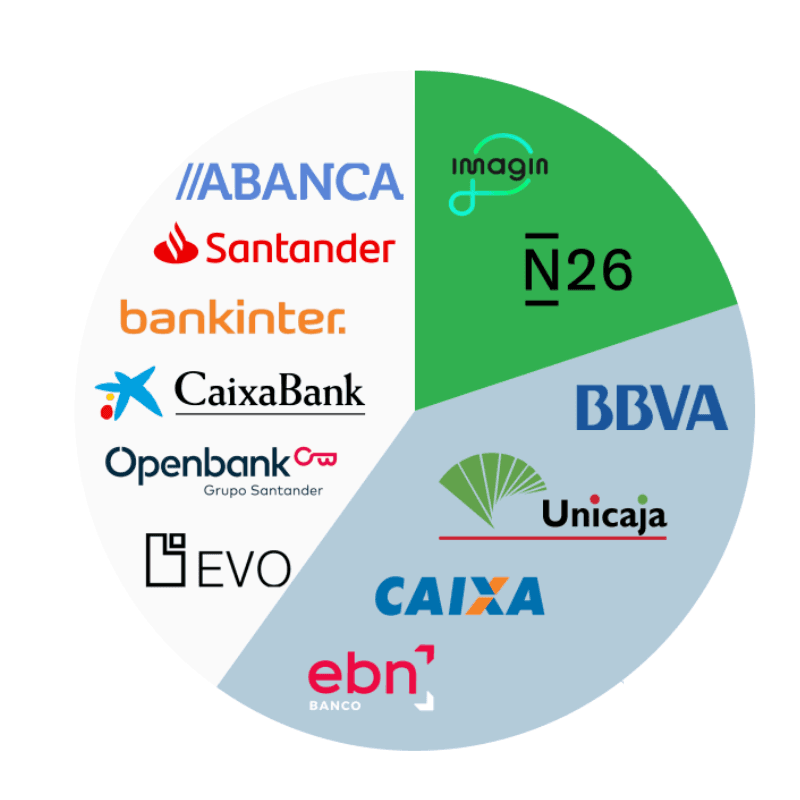
Spain's major banks all serve expats. Here are top picks to help you find the best bank for your needs as an expat or non-resident:
Santander: A global bank with a strong presence in Spain
Known for its wide network of branches and ATMs. Santander allows account opening in many branches with a passport or NIE. It often offers accounts with low or no fees if you set up e-statements and regular deposits. Its English-language website and mobile app make managing your finances simple and convenient.
BBVA: Excellent mobile app and digital banking
A global bank known for its excellent mobile app and digital banking features. BBVA allows account opening in many branches with passport or NIE. BBVA often offers fee-free accounts if you sign up for e-statements and direct deposits. Its English-language site and apps make management easy.
Abanca: Personalized service and strong regional presence
A Spanish bank known for its personalized service and strong regional presence, especially in Galicia. Abanca allows account opening in many branches with a passport or NIE. It often offers fee-free accounts if you opt for e-statements and set up regular deposits. Its website and mobile app are user-friendly, with English options available to simplify account management.
N26: German mobile-only bank with Spanish IBANs
A German mobile-only bank now offering Spanish IBANs. You open it fully online, get a debit card, and pay no maintenance fees by default. You can withdraw cash at ATMs and manage your cash easily through the app.
Banco Sabadell: Popular with foreign residents
Popular with foreign residents. Sabadell has dedicated info services (InfoSabadell, InfoExpat) and handles accounts in English or French. Their “Cuenta Expansión” can be set up for non-residents and converted to a resident account later.
Online/Neobanking Alternatives: If you prefer digital banking, consider these fully digital options:
- N26: A German mobile-only bank now offering Spanish IBANs. You open it fully online, get a debit card, and pay no maintenance fees by default. You can withdraw cash at ATMs and manage your cash easily through the app.
- Revolut: A fintech account with a Euro IBAN. Great for multi-currency transfers and low fees. You can open it from France or Spain entirely online. Revolut allows you to withdraw cash at ATMs and manage cash conveniently.
- Wise (formerly TransferWise): Provides an EU IBAN and a debit card. Wise is excellent for low-cost international transfers and receiving euros, making it easy to transfer money internationally. The standard account is free.
- ING (Spain): An online Dutch bank with operations in Spain. ING Spain offers a euro account that can be opened online, with no maintenance fees.
With certain providers, you can open a Spanish bank account online by submitting your personal information, verifying your identity (often via video), and accepting terms and conditions—even as a non-resident.
Traditional banks give in-person service and full Spanish banking features. Digital banks are convenient and often cheaper, especially for those who want a fully digital experience. Many expats use a mix: a Spanish bank account for salaries and official needs, and a digital account for travel, transfers, and easy access to cash. Banking fees and services in Spain can differ from other EU countries, so it's worth comparing options to find the best deal for your situation.
Need help opening a bank account in Spain?
Our team of experts helps you open your Spanish bank account quickly and easily.
More than 350 accounts successfully opened
Opening Process (In-Branch vs. Online, Non-Resident Certificate)
Follow these steps to open your account:
- Gather documents: Ensure you have your ID, NIE or residency docs, proof of address, income proof, etc.
- Book an appointment or go online: For non-residents, most banks require an in-person branch visit to open the account. Residents can often start online but may finalize with a branch visit. Some banks (like Santander) allow fully online sign-up with video ID. If you open your account online, you will need to fill out a form with your personal details and identification, and accept the terms and conditions to complete the process.
- Visit the branch: Present your paperwork. You may need a Spanish speaker to help (bank staff often understand English or French though).
- Sign the agreement: Review and sign the contract. Check any fees, minimum balance, or required direct debits first.
- Receive your IBAN and card: The bank will give you an IBAN immediately. Your debit card is usually issued on the spot or mailed in a few days. Activate your online/mobile banking and card.
- Activate and deposit: If a deposit is required (some banks ask a small opening deposit), do it. Start using your account.
If you are opening an account as a non-resident, you may be asked for a Certificado de No Residente (non-resident certificate). This 10-day document proves you are not taxed in Spain. Some banks will assist in getting this.
Most accounts open quickly. Typically your new Spanish account is ready within 1–2 hours on the day of your appointment. After that, you can use your IBAN for transfers, set up bill payments, etc.
💡 Expert Tip
Time-Saving Tip: If you're a non-resident, call the bank beforehand to ask if they can help you obtain the Certificado de No Residente. Some banks have partnerships with local authorities to streamline this process, saving you a separate trip to the police station.
Costs and Fees Associated with Bank Accounts
Understanding the costs and fees linked to your bank account in Spain is crucial for managing your finances as an expat. Whether you're opening a resident or non-resident account, Spanish banks may charge a variety of fees, and these can differ significantly depending on the bank and the type of account you choose.
Common Fees to Watch For:
- Account maintenance fees: Typically €3-€15 per month, often waived if you meet conditions like regular salary deposits or e-statements
- Card fees: Some banks charge for debit or credit card issuance or annual maintenance
- ATM withdrawal fees: Vary by bank; some offer free withdrawals at their own ATMs
- International transfer fees: Can be significant; digital banks often offer better rates
- Overdraft fees: Charges if you exceed your account balance
Digital banks like N26, Revolut, and Wise typically offer fee-free accounts with no maintenance charges, making them attractive options for expats who want to minimize banking costs.
💡 Money-Saving Tip: Always ask about fee waivers when opening your account. Many banks will waive maintenance fees if you set up direct deposits, use e-statements, or maintain a minimum balance. Don't be afraid to negotiate or compare offers from multiple banks.
Need help opening a bank account in Spain?
Our team of experts helps you open your Spanish bank account quickly and easily.
More than 350 accounts successfully opened
Need Help Opening Your Bank Account?
Opening a bank account in Spain can be complex, especially if you're navigating the process as a non-resident or don't speak Spanish fluently. At Hiliv, we specialize in helping French expats with all their administrative procedures in Spain, including bank account opening.
Our team can help you understand the requirements, prepare your documents, choose the right bank for your needs, and even accompany you to appointments if needed. We'll ensure you get the best account conditions and avoid unnecessary fees. Let us handle the paperwork so you can focus on settling into your new life in Spain.
Frequently Asked Questions
Can I open a Spanish bank account as a non-resident?
Yes, absolutely! Non-residents can open bank accounts in Spain. Many major banks like BBVA, Santander, CaixaBank, and Sabadell offer non-resident accounts. You may need a "Certificado de No Residente" (a 10-day police certificate) to prove your tax status. Non-resident accounts may have higher fees and typically require an in-branch visit.
What documents do I need to open a bank account in Spain?
You will need: (1) A valid passport or EU national identity card, (2) Your NIE (Número de Identidad de Extranjero) or NIE application, (3) Proof of address (utility bill, rental contract, or empadronamiento), (4) Proof of income/employment (payslip, employment contract, pension statement), and (5) Sometimes passport-size photos. Non-residents may also need a Certificado de No Residente.
Do I need a NIE to open a bank account in Spain?
Not necessarily for non-residents. Some banks allow you to open a non-resident account first without a NIE, and you can convert it to a resident account later once you obtain your NIE. However, having a NIE makes the process easier and gives you access to better account conditions. For residents, a NIE is typically required.
What is the difference between a resident and non-resident bank account?
Resident accounts (for those living in Spain more than 183 days per year) offer full services, lower fees, online banking, and better conditions. Non-resident accounts are designed for those without a permanent Spanish address, may have higher fees, and often require in-branch visits. Non-residents typically need a "Certificado de No Residente" to prove their tax status.
Can I open a Spanish bank account online?
Yes, some banks allow fully online account opening. Digital banks like N26, Revolut, and Wise offer Spanish IBANs and can be opened entirely online with video ID verification. Traditional banks like Santander also offer online sign-up with video ID. However, non-residents may still need to visit a branch for some banks.
What is a Basic Payment Account (Cuenta Bancaria Básica)?
A Basic Payment Account is a simplified account available by law in Spain. It allows deposits, withdrawals, transfers, and comes with a debit card for free or low cost. It is ideal if you lack a residence permit or just need basic services. It includes online banking access and is designed to be accessible to foreigners. Deposits are protected up to €100,000 per depositor.
Which bank is best for expats in Spain?
The best bank depends on your needs. Traditional banks like BBVA, Santander, CaixaBank, and Sabadell offer in-person service and full Spanish banking features. Digital banks like N26, Revolut, and Wise are convenient, often free, and ideal for a fully digital experience. Many expats use a combination: a Spanish bank for salaries and official needs, and a digital account for travel and transfers.
How long does it take to open a bank account in Spain?
Most accounts open quickly, typically within 1-2 hours on the day of your appointment. You will receive your IBAN immediately. Your debit card is usually issued on the spot or mailed within a few days. After activation, you can start using your account for transfers, bill payments, and other services.
Are my deposits protected in Spanish banks?
Yes, deposits in Spanish banks are protected by the Deposit Guarantee Fund up to a maximum guaranteed amount of €100,000 per depositor per bank. This protection applies to all types of accounts: basic payment accounts, current accounts, savings accounts, and investment accounts.
What fees should I expect with a Spanish bank account?
Fees vary by bank and account type. Traditional banks may charge maintenance fees (around €5/month) if you do not meet conditions like regular salary deposits or e-statements. Digital banks like N26 and Revolut are often free. Always check for fees on ATM withdrawals, international transfers, and account maintenance before opening an account.