
Spain Job Visa 2026: Skilled Worker Visas, Requirements and Application Process
Learn how non-EU citizens can get a Spain work visa in 2026: skilled worker routes, EU Blue Card, requirements, application steps and post-arrival formalities.

International Mobility Expert

Non-EU nationals (including UK citizens) who want a Spain job visa generally need a Spanish residence and work authorisation and, when applying from abroad, a national long-stay (type D) visa before they can legally work in Spain. EU/EEA/Swiss citizens enjoy free movement and do not need a visa to work in Spain. By contrast, most people from outside the EU/EEA/Switzerland must secure the right authorisation before taking up employment. (A short-stay Schengen visa, or visa-free entry for eligible nationalities, covers visits of up to 90 days in any 180-day period but does not in itself allow you to work in Spain. ETIAS, the EU's future travel authorisation for visa-exempt travellers, is not a visa and gives no work rights. Any long-term job requires the appropriate residence and work authorisation and, from abroad, a national type D visa.) In practice, for employees this usually means having a valid job offer, an employer who applies for the authorisation, and approval from the Spanish authorities before applying at the consulate.
If you are a non-EU/EEA/Swiss national planning to move to Spain for work, this guide explains which Spanish work visa may fit your situation, the main eligibility rules and documents, how options such as the Highly Qualified Professional permit and EU Blue Card differ, how the application process works, and what you need to do after arrival to stay compliant and start work legally. Getting these steps right from the start helps you avoid delays, refusals, and immigration problems.
Who Needs a Work Visa in Spain?
Any foreign national who is not an EU/EEA/Swiss citizen generally needs a work authorisation (and, if coming from abroad, a visa) to be employed in Spain. British citizens lost their EU free-movement rights after Brexit, so UK nationals moving to Spain now also fall under this rule; UK nationals who were legally resident in Spain before 1 January 2021 and are covered by the Withdrawal Agreement keep their rights. In other words, if you're a third-country (non-EU) national planning to work for a Spanish employer, you will normally need a residence and work authorisation. EU/EEA or Swiss nationals do not apply for a visa; if they stay longer than three months, they apply for an EU registration certificate (certificado de registro de ciudadano de la Unión) at the Foreigners' Office (Oficina de Extranjería) or the relevant National Police station. Short-term activities (tourism, business meetings, conferences) may be visa-exempt depending on your nationality, and some specific profiles (for example certain researchers, scientists or university teachers invited or hired by Spanish institutions) are exempt from needing a work authorisation, but regular employment in Spain requires the appropriate authorisation process.
A short stay is not a work permit
Tourism, business meetings and conferences can be visa-exempt depending on your nationality. They do not authorise regular employment. ETIAS, once it applies, will be a travel authorisation, not a visa and not a right to work.
Need help with your expatriation to Spain?
Our experts accompany you in all your administrative procedures and installation.
Main Spanish Work Visa Options
Spain offers several long-stay visa categories for foreign workers. The most common are:
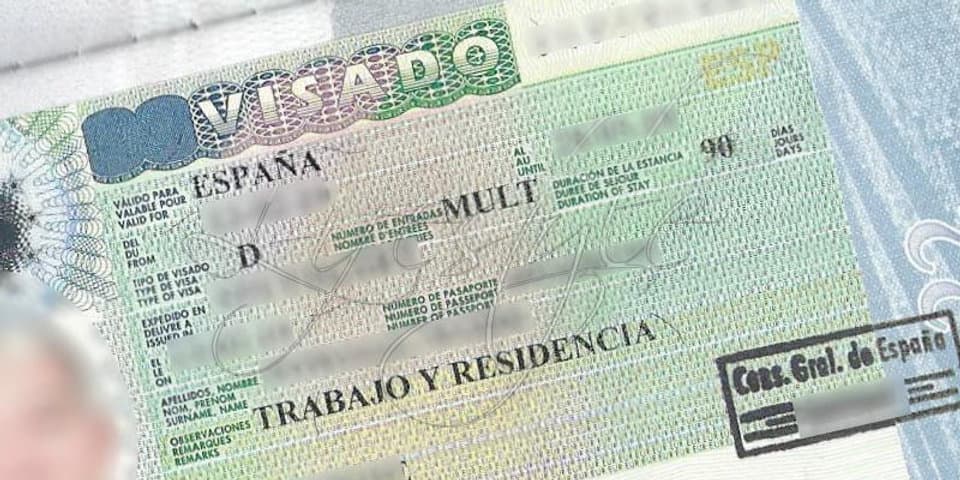
Standard Employee Work Visa (Visa por cuenta ajena)
This is the classic work visa for salaried employment. A Spanish employer must apply on your behalf: it obtains an initial residence and work authorisation from the provincial Foreigners' Office (Oficina de Extranjería), then you apply for a national work visa at the Spanish consulate within one month of the employer being notified. Under the immigration regulation in force since 20 May 2025 (Royal Decree 1155/2024), the initial authorisation is granted for up to 1 year, and renewals are generally granted for 4 years. This route requires a valid job contract and the employer to prove compliance with labour and Social Security rules (including the labour-market test if the position is not on the Catalogue of Hard-to-Fill Occupations, or Catálogo de Ocupaciones de Difícil Cobertura, and no other exemption applies).
Highly Qualified Professional (HQP) Visa
A special fast-track category under Law 14/2013 for high-skilled roles. It targets non-EU professionals in managerial or highly qualified positions (for example managers, engineers or scientists). Applications are filed online with the Large Companies and Strategic Groups Unit (UGE-CE), bypass the labour-market test and must be decided within 20 days (if no decision is notified in that time, the application is deemed approved). Eligibility requires a higher education qualification or, exceptionally, at least 3 years of comparable professional experience, plus a salary meeting the current threshold (see below). An HQP permit is valid for up to 3 years (or the length of the contract plus three months, if shorter), can be renewed for two-year periods if the requirements are still met (Article 71 of Law 14/2013), and is linked to the job offer and employer that supported the application.
EU Blue Card
An EU residence and work permit for highly skilled workers that also allows easier intra-EU mobility. The Blue Card requires a higher education qualification of at least 3 years (EQF level 6) or at least 5 years of comparable professional experience (3 years within the last 7 for ICT managers and professionals), and a valid contract or binding job offer with a Spanish employer for at least 6 months. Spain's Blue Card salary threshold for applications from June 2026 is €41,356.36 gross per year (or €33,085.09 for qualifying shortage occupations and recent graduates). Its validity is up to 3 years (or the contract duration plus three months, if shorter), and your family can join you. A major benefit is that after 12 months of legal residence as a Blue Card holder, you can move to another EU country that applies the Blue Card rules by applying for a Blue Card there.
Self-Employed Visa (Visado de trabajo por cuenta propia)
For entrepreneurs and freelancers who want to start a business or work independently in Spain. To qualify, you must present a business project indicating the planned investment, its expected profitability and, where relevant, the jobs to be created, and show that the investment is sufficient and available (or backed by financial institutions). There is no fixed official minimum amount: what matters is that the investment and resources are sufficient for your specific project. You also need any professional qualifications and licences required for your activity. In practice, many applicants submit a viability report (informe de valoración) from an authorised self-employed workers' organisation such as ATA, UPTA, CIAE or UATAE. The initial authorisation is valid for 1 year, limited to one autonomous community and one sector of activity, and renewals are granted for 4 years. Unlike the entrepreneur visa under Law 14/2013 (which targets innovative business projects), this self employment visa leads to a self employment permit and covers any viable business idea or professional service, including projects that may contribute to international trade, provided it meets all legal and financial criteria.
Each of these visa types ultimately requires a work contract, job offer or business project that meets Spanish rules. Other routes include the Spain digital nomad visa (international teleworker), created by Law 28/2022 (the Startups Act), in force since 23 December 2022: a visa issued by a consulate is valid for up to one year, while a residence authorisation requested from within Spain through the UGE-CE can be granted for up to three years and renewed for two-year periods. The main applicant must show income of at least 200% of the monthly minimum wage, which is about €2,849 gross per month in 2026 (based on the 2026 minimum wage of €1,221 in 14 payments, i.e. €1,424.50 per month over 12 months). Intra-Company Transfer (ICT) permits are for employees of multinational groups moving to a Spanish entity of the same company or group, and are also processed by the UGE-CE. Seasonal work authorisations allow work for a maximum of nine months per calendar year and, under the 2025 regulation, can be granted for up to four years.
Spain Work Visa Requirements
All work visas in Spain share certain basic requirements, and the exact requirements depend on the visa category and the applicant's circumstances:
- •Job Offer or Business Plan. For employee visas, you need a concrete job contract or offer from a Spanish employer. In practice, most work permit applications are based on an actual job offer. For self-employment visas, you must instead submit a robust business plan outlining your economic project and showing it is feasible and financially backed.
- •Qualifications and Experience. Your academic or professional credentials must match the job. For skilled routes, this usually means having a higher education degree or equivalent experience. For example, the EU Blue Card requires a qualification of at least 3 years (or 5 years' comparable experience). The national HQP permit requires a managerial or highly qualified position and a higher education qualification (at least MECES level 1 in Spain) or, exceptionally, 3 years' comparable professional experience. Your qualifications will be checked, and foreign documents usually need to be legalised or apostilled and translated by a sworn translator.
- •Employer Compliance. For standard employee permits, the employer applies to the Foreigners' Office (Oficina de Extranjería) in the province where the work will take place; for HQP and Blue Card permits, it applies online to the UGE-CE. The employer must be registered with Social Security, be up to date with its tax and Social Security obligations, and have sufficient means to meet the obligations of the contract. For example, if the job is not on the Catalogue of Hard-to-Fill Occupations and no other exemption applies, the company must generally show that no suitable candidate was available on the local labour market. (However, both the HQP and EU Blue Card routes waive the labour-market test: no need to advertise the position.) The employer must also be licensed for its activity where applicable.
HQP and Blue Card skip the labour-market test
Both the HQP and EU Blue Card routes waive the labour-market test: there is no need to advertise the position. The standard employee route does not, unless the job is on the Catalogue of Hard-to-Fill Occupations or another exemption applies.
Applicants also need a valid passport, a criminal record certificate with no relevant convictions, and must not be in Spain irregularly when the application is filed.
Highly Qualified Professional vs EU Blue Card
Spain offers two premium routes for skilled workers. The choice depends on your situation:
- •Eligibility: Both require a firm job offer from a Spanish employer. The EU Blue Card is a route for highly qualified workers in roles that require a higher education qualification of at least three years (or five years' comparable experience). In contrast, the Spanish HQP permit has slightly more flexible criteria (for example, MECES level 1 in Spain or three years' comparable experience). Both categories skip the local labour-market test (the employer does not need to advertise the job first).
- •Salary and Qualifications: Since the June 2026 update published by the UGE-CE, the general salary threshold is the same for both routes: €41,356.36 gross per year. For the national HQP permit, this is a single threshold with no reduced rate, and the former reduction for applicants under 30 no longer applies. For the EU Blue Card, the threshold is set at 1.4 times the average gross annual salary published by the National Statistics Institute (INE), under Order PJC/44/2026, with a reduced threshold of €33,085.09 (80%) for certain shortage occupations in groups 1 and 2 of the occupational classification and for applicants who obtained their qualification within the three years before applying. These figures are updated when INE publishes new salary data (between 31 January and May 2026, the Blue Card threshold was €39,269.92). The contract should clearly state the gross annual salary, and applications below the applicable threshold are generally refused.
- •EU Mobility: The Blue Card offers an extra advantage: after 12 months of legal residence in Spain as a Blue Card holder, you can move to another EU country that applies the Blue Card rules (Denmark and Ireland do not) for highly qualified work, applying for a Blue Card there under simplified conditions, and you can carry out business activities in other EU countries for up to 90 days in any 180-day period, under European Union mobility rules. Your family (spouse or partner and children) can generally accompany you, and family members are generally allowed to work. By contrast, the Spanish HQP permit is a national permit; while you can renew it and bring family, it does not give the same mobility rights in other EU countries. In short: choose the Blue Card for flexibility across the European Union (especially if you might relocate elsewhere later) and the HQP permit if you intend to stay in Spain or meet its criteria but not the Blue Card's qualification requirements.
Below the threshold, the file is usually refused
The contract should state the gross annual salary in euros. For applications from June 2026, a general offer under €41,356.36 (or under €33,085.09 where the reduced Blue Card rate applies) is generally refused. The old reduction for HQP applicants under 30 no longer applies.
How to Apply for a Spanish Work Visa
The application process begins before you travel:
- •Work Authorisation: First, your employer applies for your initial residence and work authorisation: at the Foreigners' Office of the province where you will work for standard employee permits (form EX-03), or online through the UGE-CE for HQP and Blue Card permits. They submit documents such as your contract, proof of qualifications and company documentation, and pay the corresponding fees (for standard permits, fee 790 code 062 is paid by the employer and fee 790 code 052 by the worker). If the job is on the Catalogue of Hard-to-Fill Occupations, the labour-market test does not apply; otherwise the company may need to prove there were no suitable candidates available. Once the authorisation is granted, the employer is notified and you have one month to apply for the visa.
- •Visa Application: Next, you apply in person for a national work visa (Type D) at the Spanish consulate or embassy with jurisdiction over your place of legal residence. You will usually need the national visa application form, a passport generally valid for at least one year, a photograph, a copy of the approved authorisation, a copy of your employment contract (requirements vary by consulate), a criminal record certificate from the country or countries where you have lived in the last five years (apostilled or legalised and translated where required), and a medical certificate issued within the last three months stating that you do not suffer from any disease with serious public health implications under the 2005 International Health Regulations. Depending on the route, proof of health insurance may also be requested (for example, the HQP authorisation requires health insurance unless you are covered by the Spanish National Health System through your employment). Confirm exact procedures and fees with your local Spanish consulate.
- •Consular Appointment & Fee: Attend your appointment (an interview may occasionally be requested) and pay the visa fee, which varies by nationality due to reciprocity: for example, from 1 January 2026 the Spanish Embassy in Washington lists $190 for US citizens and $106 for most other nationalities, while UK nationals pay a higher reciprocity fee that must be confirmed with the consulate. The consulate generally decides within one month for standard employee visas and within ten working days for HQP visas, although overall timelines vary. Hiliv Solution can assist at this stage if you need a Spanish NIE number in advance (for example for practical or financial steps): our 100% online NIE Express service helps you obtain your foreigner identification number remotely. In many cases a NIE is also assigned during the authorisation process, and it will appear on your TIE once you are in Spain.
- •Receiving Your Visa: If approved, you must collect the visa in person within one month of notification. The long-stay work visa in your passport is usually valid for three months, during which you must enter Spain to begin your job. (Keep the visa and authorisation papers with you, as you'll need them to finalise everything in Spain.)
Two clocks start when the visa is issued
Collect the visa in person within one month of notification. Once it is in your passport, you generally have three months to enter Spain and start the job. Missing either deadline means starting the process again.
Throughout this process, remember that the rules and forms are set by Spain's Ministry of Inclusion, Social Security and Migration (applied through the Foreigners' Offices and the UGE-CE), while visas are issued by consulates under the Ministry of Foreign Affairs. If any documentation is missing or unclear, the process can be delayed, so it's crucial to double-check requirements or seek professional guidance. In complex cases, an immigration lawyer can be useful, for example for US citizens dealing with document apostilles or for applicants switching from a student permit to a work permit.
What Happens After Approval
Once you arrive in Spain, there are a few formalities to complete to start and continue working legally:
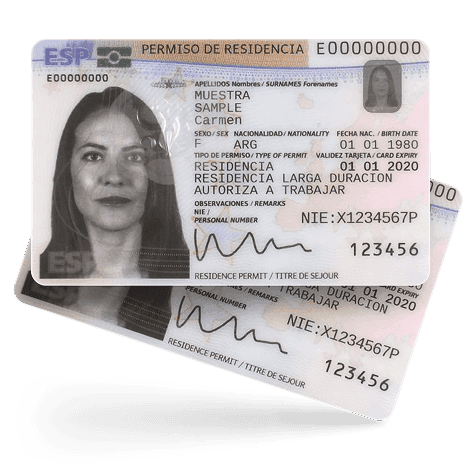
- •TIE (Tarjeta de Identidad de Extranjero): Within one month of your registration with Social Security (which must take place within three months of entry), you must apply in person for your Foreigner Identity Card (TIE) at the Foreigners' Office or the National Police station in your province, after booking an appointment (cita previa). The TIE is your physical residence card and biometric residence card (it displays your NIE and permit expiry date), and it is required when your authorisation lasts more than six months. You'll bring your passport, the authorisation resolution, a photograph, form EX-17 and proof of payment of fee 790 code 012. After your fingerprints are taken, the TIE is usually ready within a few weeks. (If you are an EU citizen staying more than three months, you instead apply for an EU registration certificate at the Foreigners' Office or the relevant National Police station, within three months of arrival; Hiliv's Residence Certificate service can help obtain that.)
- •Social Security Number (NUSS): As a worker, you must be registered with Spanish Social Security (affiliation and "alta") before you start working. Typically, your employer will request your NUSS (Social Security number) and register you. This number is essential for payroll, contributions, and accessing public healthcare, and you cannot start working legally without being registered with Social Security. To obtain it, form TA.1 is submitted to the General Treasury of Social Security (TGSS) together with your identity document (passport or NIE) and, where relevant, your authorisation. Once assigned, the number generally stays with you for life. (Hiliv offers a Social Security/NUSS service to help new arrivals complete this registration quickly.)
- •Bank Account: Many newcomers open a Spanish bank account to receive their salary and manage expenses. Resident accounts (for long-term stay) usually offer full services; non-resident accounts may have more limitations. To open a resident account, you will generally need your NIE, passport, and proof of address (like a rental contract). Under EU SEPA rules, an employer should be able to pay your salary into any euro account located in the EU, so a Spanish account is not strictly mandatory, but it is often practical for rent, utilities and local direct debits. (Hiliv can also assist with bank account opening remotely or upon arrival, choosing a suitable bank and handling paperwork.)
- •Other Registrations: You should also register on the local "padrón" (municipal register) at your new address: under Article 15 of Law 7/1985, everyone living in Spain must register in the municipality where they usually reside. Empadronamiento is often requested for public services (schools, the regional health card) and other administrative procedures. Hiliv offers a padrón registration service to cover this step easily.
Once these steps are done, you'll be fully documented as a legal resident with authorisation to work in Spain under the conditions of your permit. You can work, contribute to Social Security (which gives you access to public healthcare), and live in Spain under your new status, remembering to renew your authorisation on time.
Need help navigating Spain's immigration process? Hiliv Solution provides specialized relocation services for working in Spain. From obtaining your NIE from afar (NIE Express) to securing your social security number and even opening a local bank account, our dedicated experts guide you through every step. The employer still requests the work authorisation and the consulate still issues the visa. Hiliv takes care of the identification, registration and banking formalities that sit around that process.
Your administrative plan to leave for Spain
Generate a personalized calendar of all your procedures for your expatriation for free.
Your data is protected and secure


Last reviewed: 26 October 2026. Based on official information from the Spanish Ministry of Inclusion, Social Security and Migration, Spanish consulates and the BOE. Immigration rules, fees and salary thresholds change regularly; always check with the competent authority before applying.
Frequently asked questions
Who needs a work visa to take a job in Spain?
Any foreign national who is not an EU, EEA or Swiss citizen generally needs a residence and work authorisation to be employed in Spain, and a national long-stay (type D) visa when applying from abroad. EU, EEA and Swiss citizens enjoy free movement and do not apply for a work visa. If they stay longer than three months, they apply for an EU registration certificate (certificado de registro de ciudadano de la Unión) at the Foreigners’ Office or the relevant National Police station.
Do UK citizens need a Spain work visa after Brexit?
Yes, in most cases. British citizens lost EU free-movement rights after Brexit, so UK nationals moving to Spain for work now follow the same rules as other non-EU nationals. UK nationals who were legally resident in Spain before 1 January 2021 and are covered by the Withdrawal Agreement keep their rights. A short-stay Schengen visa, visa-free entry, or the future ETIAS travel authorisation does not allow you to work.
What is the standard employee work visa (visa por cuenta ajena)?
It is the classic work visa for salaried employment. A Spanish employer applies for the initial residence and work authorisation at the provincial Foreigners’ Office. You then apply for a national work visa at the Spanish consulate within one month of the employer being notified. Under the immigration regulation in force since 20 May 2025 (Royal Decree 1155/2024), the initial authorisation is granted for up to 1 year, and renewals are generally granted for 4 years. If the job is not on the Catalogue of Hard-to-Fill Occupations and no other exemption applies, the employer must generally pass a labour-market test.
How do the Highly Qualified Professional permit and the EU Blue Card differ?
Both require a firm job offer, skip the local labour-market test, and are filed online with the Large Companies and Strategic Groups Unit (UGE-CE). Since the June 2026 update, the general salary threshold is the same for both routes: €41,356.36 gross per year. The EU Blue Card requires a higher education qualification of at least 3 years (EQF level 6) or at least 5 years of comparable professional experience (3 years within the last 7 for ICT managers and professionals), and a contract of at least 6 months. It also has a reduced threshold of €33,085.09 for certain shortage occupations and recent graduates. The national HQP permit is slightly more flexible on qualifications (MECES level 1, or exceptionally 3 years of comparable experience) but has no reduced salary rate. After 12 months as a Blue Card holder you can move to another EU country that applies the Blue Card rules (Denmark and Ireland do not). The Spanish HQP permit does not give the same mobility rights.
What salary do I need for a Spain EU Blue Card in 2026?
For applications from June 2026, Spain’s Blue Card salary threshold is €41,356.36 gross per year. A reduced threshold of €33,085.09 (80%) applies to certain shortage occupations in groups 1 and 2 of the occupational classification and to applicants who obtained their qualification within the three years before applying. The threshold is set at 1.4 times the average gross annual salary published by the National Statistics Institute (INE), under Order PJC/44/2026. Between 31 January and May 2026, the Blue Card threshold was €39,269.92. The contract should state the gross annual salary, and applications below the applicable threshold are generally refused.
Can I work in Spain as a freelancer or start a business?
The self-employed visa (visado de trabajo por cuenta propia) is for entrepreneurs and freelancers. You must present a business project showing the planned investment, expected profitability and, where relevant, the jobs to be created, and show that the investment is sufficient and available. There is no fixed official minimum amount. Many applicants submit a viability report from an authorised organisation such as ATA, UPTA, CIAE or UATAE. The initial authorisation is valid for 1 year, limited to one autonomous community and one sector, and renewals are granted for 4 years. This is different from the entrepreneur visa under Law 14/2013, which targets innovative projects, and from the digital nomad visa for international teleworkers.
What is the Spain digital nomad visa, and is it a job visa?
The international teleworker route, created by Law 28/2022 (the Startups Act) and in force since 23 December 2022, is for remote work, not for a standard Spanish employment contract. A visa issued by a consulate is valid for up to one year. A residence authorisation requested from within Spain through the UGE-CE can be granted for up to three years and renewed for two-year periods. The main applicant must show income of at least 200% of the monthly minimum wage, about €2,849 gross per month in 2026 (based on the 2026 minimum wage of €1,221 in 14 payments, that is €1,424.50 per month over 12 months).
Who files the work authorisation, and how long does the visa decision take?
Your employer files first: form EX-03 at the Foreigners’ Office of the province where you will work for a standard employee permit, or online through the UGE-CE for HQP and Blue Card permits. For standard permits, fee 790 code 062 is paid by the employer and fee 790 code 052 by the worker. Once the authorisation is granted, you have one month to apply in person for a type D visa at the Spanish consulate covering your place of legal residence. The consulate generally decides within one month for standard employee visas and within ten working days for HQP visas. HQP applications themselves must be decided within 20 days, and are deemed approved if no decision is notified in that time.
Which documents are usually required for the consular visa?
You will usually need the national visa application form, a passport generally valid for at least one year, a photograph, a copy of the approved authorisation, a copy of your employment contract (requirements vary by consulate), a criminal record certificate from the country or countries where you have lived in the last five years (apostilled or legalised and translated where required), and a medical certificate issued within the last three months stating that you do not suffer from any disease with serious public health implications under the 2005 International Health Regulations. Health insurance may also be requested depending on the route. Confirm the exact list and fees with your local Spanish consulate. From 1 January 2026 the Spanish Embassy in Washington lists $190 for US citizens and $106 for most other nationalities. UK nationals pay a higher reciprocity fee that must be confirmed with the consulate.
What must I do after I arrive in Spain with a work visa?
Register with Spanish Social Security (affiliation and alta) before you start working. This must take place within three months of entry, and your employer usually requests your NUSS. Within one month of that Social Security registration, apply in person for your TIE (Tarjeta de Identidad de Extranjero) after booking a cita previa, if your authorisation lasts more than six months. Bring your passport, the authorisation resolution, a photograph, form EX-17 and proof of payment of fee 790 code 012. You should also register on the local padrón under Article 15 of Law 7/1985. A Spanish bank account is practical for salary and local bills, but under SEPA rules an employer should be able to pay a euro salary into any EU euro account.
Do I need a NIE before I apply for a Spain work visa?
Not always. In many cases a NIE is assigned during the authorisation process, and it appears on your TIE once you are in Spain. Some people still need a Spanish NIE earlier for practical or financial steps. The number identifies you as a foreigner in Spain. It is not the same as the TIE, which is the physical residence card.
How can Hiliv help with a move to Spain for work?
Hiliv helps with the administrative steps around a work move to Spain: obtaining a NIE from abroad (NIE Express), the EU residence certificate for eligible EU citizens, Social Security (NUSS) registration, padrón registration, and opening a Spanish bank account. The employer still files the work authorisation, and the consulate still issues the visa. Hiliv’s specialists guide you through the formalities that follow, or run in parallel with, that immigration process.