Spain Digital Nomad Visa 2026: Requirements for Remote Workers and Freelancers
Spain Digital Nomad Visa 2026: check income requirements, W-2 rules, Spanish client limits, taxes, documents and how to apply from Spain or abroad.

International Mobility Expert
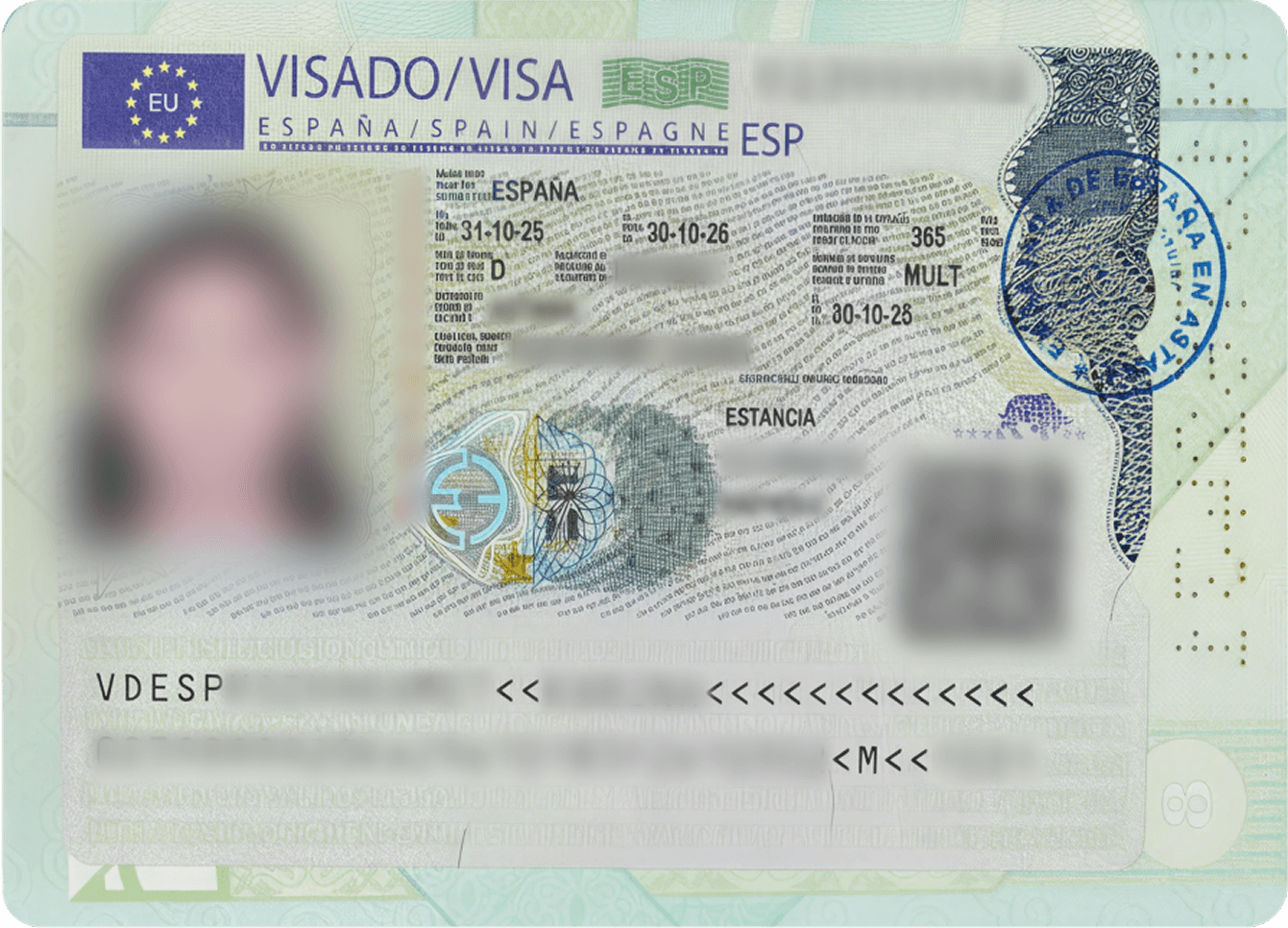
2026 income update
Digital Nomad Visa Spain 2026: Requirements for Remote Workers and Freelancers
Spain's Digital Nomad Visa gives eligible non-EU remote employees, freelancers and independent professionals a legal route to live in Spain while working primarily for businesses located outside the country. Officially, Spain calls this the international telework visa and residence authorization (visado/autorización de residencia para teletrabajo de carácter internacional). The scheme was created by Spain's Startup Law and is governed primarily by Law 14/2013.
For 2026, one of the biggest changes applicants need to know is financial: Spain's minimum wage has risen to €17,094 gross per year, which raises the minimum income benchmark for the main digital nomad applicant to €34,188 gross per year.
This guide explains the digital nomad visa Spain requirements for employees and freelancers, the 2026 income threshold, the rules for Spanish clients, the specific issues facing US W-2 employees, Social Security, taxes, application routes and the administrative steps to complete after approval.
2026 at a glance: the main applicant must generally demonstrate economic resources equivalent to 200% of Spain's SMI, have worked with the relevant foreign employer or client for at least three months, show that the foreign company has operated for at least one year, and prove that the work can genuinely be performed remotely. Employees may work only for foreign companies under this authorization, while independent professionals can carry out limited professional activity for Spanish businesses.
Relocating under this route involves more than the visa file alone. Hiliv helps international residents with practical steps before and after approval, including NIE assistance, Social Security and NUSS registration, Padrón registration, and guidance through the full moving to Spain checklist.
Need help obtaining your green NIE in Spain?
Our team of experts helps you obtain your green NIE (resident) quickly and efficiently.
More than 800 green NIEs obtained
What Is Spain's Digital Nomad Visa?
Does Spain have a digital nomad visa? Yes. It has had a dedicated immigration route for international remote workers since the Startup Law introduced the international telework category into Law 14/2013.
What is commonly called the Spanish Digital Nomad Visa, Spain remote work visa, Spain remote worker visa or remote working visa Spain is actually two closely connected immigration routes:
The visa itself is sufficient authorization to live in Spain and perform the approved remote work during its validity. A person who wants to remain after the visa can apply for the residence authorization during the 60 calendar days before the visa expires, provided the qualifying conditions continue to be met. The residence authorization may subsequently be renewed in two-year periods.
That distinction is important. Articles about "digital nomad visas Spain" sometimes describe the visa as a three-year permit. Technically, that is not correct: the consular visa can be granted for up to one year, whereas the residence authorization available from within Spain can be granted for up to three years.
Visa vs residence authorization
The route is designed for third-country nationals whose job or professional activity can be performed remotely through computer, telecommunications and similar systems. EU citizens, and people whose residence rights derive from EU free-movement law, do not use this immigration category.
The work must also genuinely be remote. Spain's immigration authority may examine the applicant's functions, the structure and activity of the employer, and whether the role requires physical supervision, production work, in-person sales visits or other functions incompatible with fully remote work.
For the most reliable information, applicants searching for the Spain digital nomad visa official website should prioritize the Spanish Ministry of Inclusion's official UGE page for international teleworkers, Spain's Ministry of Foreign Affairs and the Spanish consulate responsible for their place of residence. The UGE page is particularly relevant to residence applications filed from Spain. Detailed consular submission procedures can vary by jurisdiction.
Who Qualifies?
The core eligibility rules are similar for employees and self-employed professionals, but there is a critical legal distinction between the two.
In both cases, the applicant must be a qualified professional and demonstrate either a qualifying higher-education or professional qualification, such as a University Degree or Professional Certificate, or at least three years of professional experience relevant to the position. Spain's law refers to graduates or postgraduates from recognized universities, vocational-training institutions and recognized business schools, while also expressly allowing the three-year experience alternative.
The foreign company or group with which the applicant works must also demonstrate real and continuous activity for at least one year, and the applicant must have maintained the relevant employment or professional relationship for at least the three months immediately preceding the application.
Other requirements normally include lawful immigration status when applying from Spain, sufficient financial resources, compliance with Social Security rules, Health Insurance / Private Health Insurance comparable to Spain's public healthcare system, and the required criminal-record documentation, including a Criminal Background Check and Criminal Record Certificate. Current official instructions require criminal-record certificates covering the country or countries where the applicant has lived during the previous two years, together with a declaration concerning the previous five years. Foreign public documents may require legalization or an Apostille and, where applicable, an official Spanish translation.
Remote Employees
Employees qualify when they have a genuine employment relationship with a company established outside Spain.
At minimum, the applicant needs to demonstrate that:
- •the foreign employer has been genuinely operating for at least one year;
- •the employment relationship has existed for at least three months before applying;
- •the employer expressly authorizes the employee to work remotely from Spain;
- •the position can be performed entirely through remote technological means; and
- •the applicant satisfies the qualification or three-year-experience requirement.
The employer authorization letter is more important than a generic "remote work allowed" statement. UGE's current documentation guidance asks for information including the employee's role, principal functions, confirmation that the work can be performed telematically, remuneration expressed in euros and the conditions under which the employee will work remotely.
An important restriction applies: an employee holding this authorization may work only for companies located outside Spain. The Digital Nomad Visa does not authorize that employee to take a second employment contract with a Spanish company.
Freelancers and Contractors
Freelancers, contractors and other independent professionals can also obtain the digital nomad visa Spain, provided their professional relationships satisfy the rules.
A freelancer must normally demonstrate a commercial or professional relationship with one or more companies outside Spain for at least the preceding three months and provide documentation establishing the terms under which that work will continue remotely.
Unlike employees, independent professionals are allowed to carry out some work for companies established in Spain. However, the Spanish portion is limited, as explained below.
Freelancers should also pay particular attention to Spanish Social Security. Current UGE guidance treats a qualifying self-employed digital nomad as self-employed for Spanish Social Security purposes and requires registration in RETA, Spain's Special Scheme for Self-Employed Workers.
Family members
Digital Nomad Visa Income Requirements
The digital nomad visa Spain income requirements are linked to Spain's Salario Mínimo Interprofesional or SMI, and the Minimum Income Requirement is benchmarked against the Spanish National Minimum Wage rather than to a fixed amount permanently written into the visa rules.
The main applicant must demonstrate resources equivalent to 200% of the applicable SMI. A family consisting of the principal applicant plus one dependent requires an additional amount equal to 75% of the SMI, and each further dependent adds another 25% of the SMI. UGE states that these amounts are assessed on a gross basis, before deductions such as taxes and Social Security contributions.
Spain's SMI, or Spain's Minimum Wage, for 2026 is €1,221 per month in 14 payments, equivalent to €17,094 gross per year.
That produces the following 2026 thresholds:
| Applicant household | 2026 annual requirement | 12-month equivalent |
|---|---|---|
| Main applicant | €34,188 | €2,849/month |
| Main applicant + 1 dependent | €47,008.50 | €3,917.38/month |
| Main applicant + 2 dependents | €51,282 | €4,273.50/month |
| Each additional dependent after the first | + €4,273.50/year | + €356.13/month |
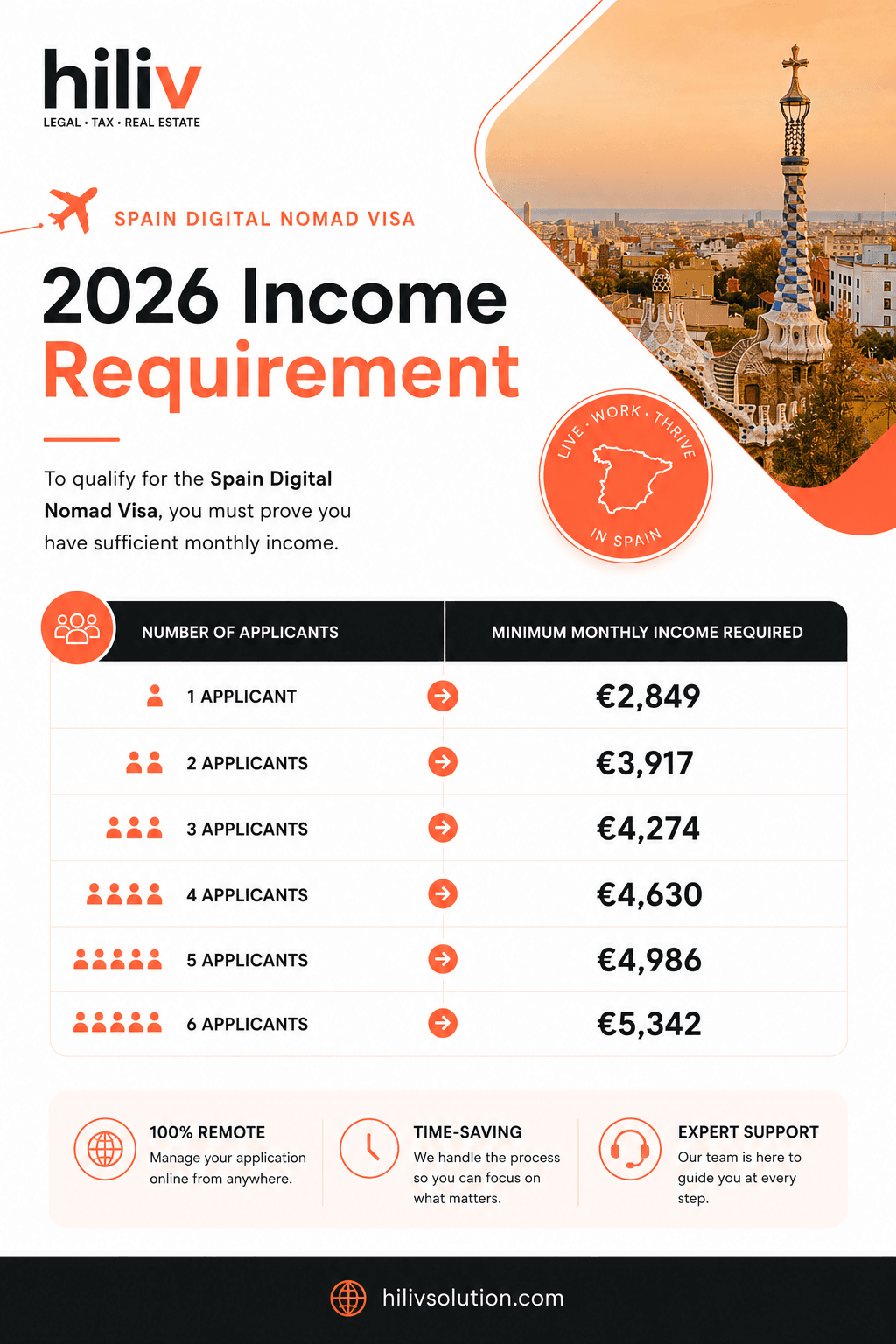
The Minimum Monthly Income for the main applicant in 2026 is €2,849/month.
Using the family-threshold row shown above, a couple with one child would need about €4,273/month in 2026.
There is an important point here for applicants comparing different 2026 guides.
Spain officially expresses the 2026 minimum wage as €1,221 × 14 payments, not as twelve equal monthly payments. Therefore:
200% of €1,221 = €2,442, but that figure applies across 14 salary payments.
The same annual requirement expressed over twelve months is:
€34,188 ÷ 12 = €2,849 per month.
So €2,442 × 14 and €2,849 × 12 represent the same €34,188 annual threshold. Using the annual requirement is the clearest way to compare an international salary that is normally paid in twelve monthly installments.
Do not use outdated 2025 figures
For evidence, UGE's current residence-authorization checklist requests recent documentation such as three months of payslips or invoices and corresponding bank evidence showing receipt of that income.
There is also a useful nuance for applicants whose recurring employment or professional income falls slightly below the threshold. UGE's current residence-authorization checklist states that the difference may be supported through documented savings or other liquid resources sufficient to cover the shortfall throughout the authorization period. That should not be interpreted as meaning that savings automatically replace the underlying remote-work income requirement: the official FAQ still frames the required economic resources around income generated from work, and applicants using the consular visa route should follow the evidence rules of their specific consulate.
Working with Spanish Clients
Whether a holder of the Spanish Digital Nomad Visa may work for Spanish companies depends on whether that person is an employee or an independent professional.
This is one of the most important distinctions in Spain's legislation, because the rules are not interchangeable.
The 20% Rule for Independent Professionals
Independent professionals may carry out professional activity for a company located in Spain, but the Spanish work must represent no more than 20% of their total professional activity.
The wording of the statute matters. It refers to 20% of total professional activity. It does not literally state that "up to 20% of income can come from Spain," even though that is how the rule is sometimes simplified online.
For that reason, freelancers with both Spanish and international clients should maintain clear contracts, invoices and records separating their foreign and Spanish professional activity. Where a case is close to the 20% ceiling, the safest approach is to assess the applicant's actual professional structure rather than relying solely on a simplistic revenue percentage.
For example, an independent software consultant whose core contracts remain with clients in the United States, Canada and the United Kingdom could potentially add limited Spanish client work, provided the statutory 20% limit remains satisfied. The rule does not turn the Digital Nomad Visa into a general Spanish self-employment authorization.
Rules for Employees
Employees face a stricter rule.
A remote employee holding the international telework authorization may only perform employment activity for companies located outside Spain. There is no equivalent 20% allowance permitting that employee to take a Spanish employment contract.
This means:
A remote employee who later wants to move to a Spanish employer should therefore assess whether a different work or residence authorization is required rather than assuming that the digital nomad authorization covers the change.
| Situation | Permitted under DNV rules? |
|---|---|
| Employee working remotely for US employer | Yes, if all other requirements are met |
| Employee working remotely for UK employer | Yes, if all other requirements are met |
| Employee takes a second employment contract with Spanish company | No |
| Freelancer serves primarily foreign clients + limited Spanish professional activity | Potentially yes |
| Freelancer's Spanish professional activity exceeds 20% of total activity | Not compatible with the DNV rule |
Spain Digital Nomad Visa for US W-2 Employees
A particularly common question is whether the Spain digital nomad visa works for W-2 employees.
It can.
There is no rule excluding a worker simply because they receive a US Form W-2. But W-2 status by itself does not make someone eligible either. Spanish authorities are interested in the underlying employment relationship, the employer's authorization of remote work, the applicant's salary and qualifications, and, critically, the Social Security arrangement for work physically performed from Spain.
In practice, the largest obstacle for many US W-2 applicants is not immigration eligibility but whether their US employer is prepared to support the Spanish Social Security requirements.
Employer Documentation
A US W-2 employee should expect the application file to establish several things separately.
First, the employment relationship must have existed for at least three months before the application. A W-2 tax form alone does not prove all of the information required by Spain. The application normally relies on the employment contract, recent payslips, corresponding bank records and employer documentation.
Second, the US employer must establish that it has been genuinely operating for at least one year. Official corporate-registration evidence is normally used for this purpose.
Third, the employer should provide a detailed remote-work authorization covering the applicant's position, functions, confirmation that the role can be performed remotely from Spain, remuneration and remote-working conditions.
A strong W-2 application therefore distinguishes between:
- •Proof of employment: employment agreement, payslips and payment records.
- •Proof of employer: corporate registration and evidence of the company's continuing activity.
- •Proof of remote-work authorization: a letter expressly permitting the work to be performed from Spain.
- •Proof of Social Security compliance: either an acceptable home-country certificate under the US-Spain Social Security Agreement or the documentation required to bring the employment within Spain's Social Security system.
Social Security Issues
This is the issue US applicants should resolve before assuming their employer can support the move.
Spain's current UGE guidance starts from the principle that a person working from Spain must comply with Spanish Social Security rules. For an employee, the normal Spanish route requires the foreign employer to register with Spanish Social Security as a non-resident foreign entity without a workplace in Spain so that the employee can be enrolled in the Spanish General Social Security Scheme.
There is an alternative where an applicable international Social Security agreement assigns coverage to the home country. Spain and the United States have such an agreement. A qualifying worker may be able to remain covered under US Social Security and prove that coverage through a Certificate of Coverage issued under the agreement.
However, US W-2 employees should not assume that a Certificate of Coverage is automatic.
Under the US-Spain agreement's standard detachment rule, a person who is already covered in one country and is sent by the employer to work in the other country can remain subject to the first country's system when the expected assignment does not exceed five years. The US Social Security Administration determines whether US coverage applies and issues the US Certificate of Coverage where appropriate.
This distinction can be important for someone who independently decides to move to Spain and simply asks their employer to let them work there. That situation is not necessarily identical to an employer-directed temporary assignment. Whether the US-Spain agreement assigns US coverage depends on the actual circumstances and the competent authorities' application of the agreement.
Spain also requires more than a vague statement that the employee "continues paying US Social Security." Current UGE guidance says that where foreign Social Security coverage replaces Spanish registration, the relevant authority must issue documentation under the applicable international agreement that expressly confirms coverage for the teleworker in Spain.
For a US W-2 applicant, this creates two practical pathways:
| Social Security pathway | What it means |
|---|---|
| US coverage accepted under the US-Spain agreement | Obtain an appropriate SSA Certificate of Coverage satisfying the Spanish immigration requirement |
| Spanish coverage applies | US employer generally needs to register as a foreign employer in Spain and enroll the employee in Spain's General Social Security Scheme |
Resolve Social Security early
How to Apply for Spain's Digital Nomad Visa
There are two main application strategies, and choosing the correct one can materially affect the initial validity of the authorization in the overall visa application process.
Applying from Outside Spain
A person who is outside Spain and intends to relocate as a remote worker normally applies for the international telework visa through the local Spanish consulate or local Spanish embassy with jurisdiction over their place of legal residence, depending on the post assigned to that jurisdiction.
The visa can be valid for up to one year. If the employment or professional activity is authorized for a shorter period, the visa will generally be limited accordingly. It is also renewable and can lead to a total stay of up to five years if later residence authorization and renewals are granted.
The exact checklist and appointment system should always be confirmed with the relevant Spanish consulate, but the substantive application normally needs to establish the required documents:
| Requirement | Typical evidence |
|---|---|
| Identity | Valid passport, passport photos proof and application documentation |
| Foreign employer/client relationship | Employment or commercial contracts |
| Minimum relationship period | Evidence covering at least the previous 3 months |
| Employer activity | Evidence foreign business has operated for at least 1 year |
| Remote nature of work | Employer authorization / professional terms |
| Qualifications | Eligible qualification or at least 3 years' relevant experience |
| Economic means | Payslips/invoices, bank statements, bank evidence and other permitted financial evidence |
| Social Security | Spanish registration pathway or qualifying foreign coverage |
| Health coverage | Public or qualifying private coverage as applicable |
| Background requirements | Criminal-record documentation and required declarations |
| Foreign documents | Apostille/legalization and translation where required |
These requirements derive from Law 14/2013 and the Spanish immigration administration's implementing guidance, although the mechanics of filing and the precise format of consular documents can differ by consulate.
Law 14/2013 establishes an expedited framework for visas in this category, including a 10-working-day statutory decision period for visas, subject to the circumstances and consultations contemplated by the legislation. Applicants should not confuse that legal decision period with the total time needed to collect apostilles, criminal records, employer documents, translations, Social Security evidence and a consular appointment. In practice, the full application can take roughly 15 to 45 days once appointments and document collection are factored in. The visa fee is typically around €80 to €100, subject to nationality and consular practice.
Once issued, the telework visa itself is sufficient legal authority to reside and perform the authorized remote work in Spain during its validity.
Applying While Already in Spain
A non-EU national who is lawfully in Spain can instead apply directly for the international teleworker residence authorization. This route is handled by Spain's Unidad de Grandes Empresas y Colectivos Estratégicos (UGE) rather than through an overseas consulate.
The key practical advantage is duration: the initial residence authorization can be issued for up to three years, subject to the duration of the qualifying work.
Being physically present in Spain is not enough: the applicant must be there regularly/lawfully at the time of the application. Someone who has overstayed their permitted stay cannot rely on this route simply because they remain geographically inside Spain.
UGE applications are filed electronically. The Spanish Ministry provides the official electronic procedure for international-mobility authorizations, including initial applications, additional documentation and renewals.
A useful application sequence is therefore:
- 1Before filing: confirm employee versus freelancer status, verify the three-month relationship and one-year employer tests, calculate the 2026 income floor and settle the Social Security strategy.
- 2Build the evidence: obtain employer/client documents, qualification or experience evidence, recent income evidence, banking documentation, criminal records, insurance documentation and apostilles/translations where needed.
- 3File through the correct authority: consulate from abroad; UGE for a qualifying person legally in Spain.
- 4Respond quickly to requests for additional evidence: immigration authorities can request clarification where the remote character of a role, company activity, professional experience or other requirement is not sufficiently demonstrated.
- 5Complete post-approval registrations: the immigration approval is only the beginning of the relocation process.
Need help with your expatriation to Spain?
Our experts accompany you in all your administrative procedures and installation.
Digital Nomad Visa Taxes
The Spain Digital Nomad Visa and Spanish taxes are separate legal questions.
Receiving the visa does not automatically make someone a Spanish tax resident on the approval date, and receiving the visa does not automatically grant the special tax regime commonly called the Beckham Law. Digital Nomad Visa holders may still need to pay taxes in Spain depending on whether they become tax resident and which regime applies.
Spanish tax residence is determined under tax law. Among the principal domestic tests, an individual can become Spanish tax resident by spending more than 183 days in Spain during a calendar year or when Spain is the principal center or base of their economic activities or interests, directly or indirectly. Treaty rules can also become relevant when another country simultaneously regards the person as resident.
A person who is an ordinary Spanish tax resident is generally subject to Spanish personal income tax on worldwide income after more than 183 days in Spain, subject to applicable double-tax treaties and the mechanisms available to relieve double taxation. Those double taxation agreements help reduce the risk of being taxed twice on the same income, and Spain has double taxation treaties with over 90 countries.
Digital nomads should therefore avoid treating "183 days" as the only tax question. Tax residence, treaty residence, the location where employment is physically performed, employer payroll, Social Security and the special impatriate regime can interact differently depending on the applicant's country and circumstances. See our guide to taxes and taxation in Spain for broader context.
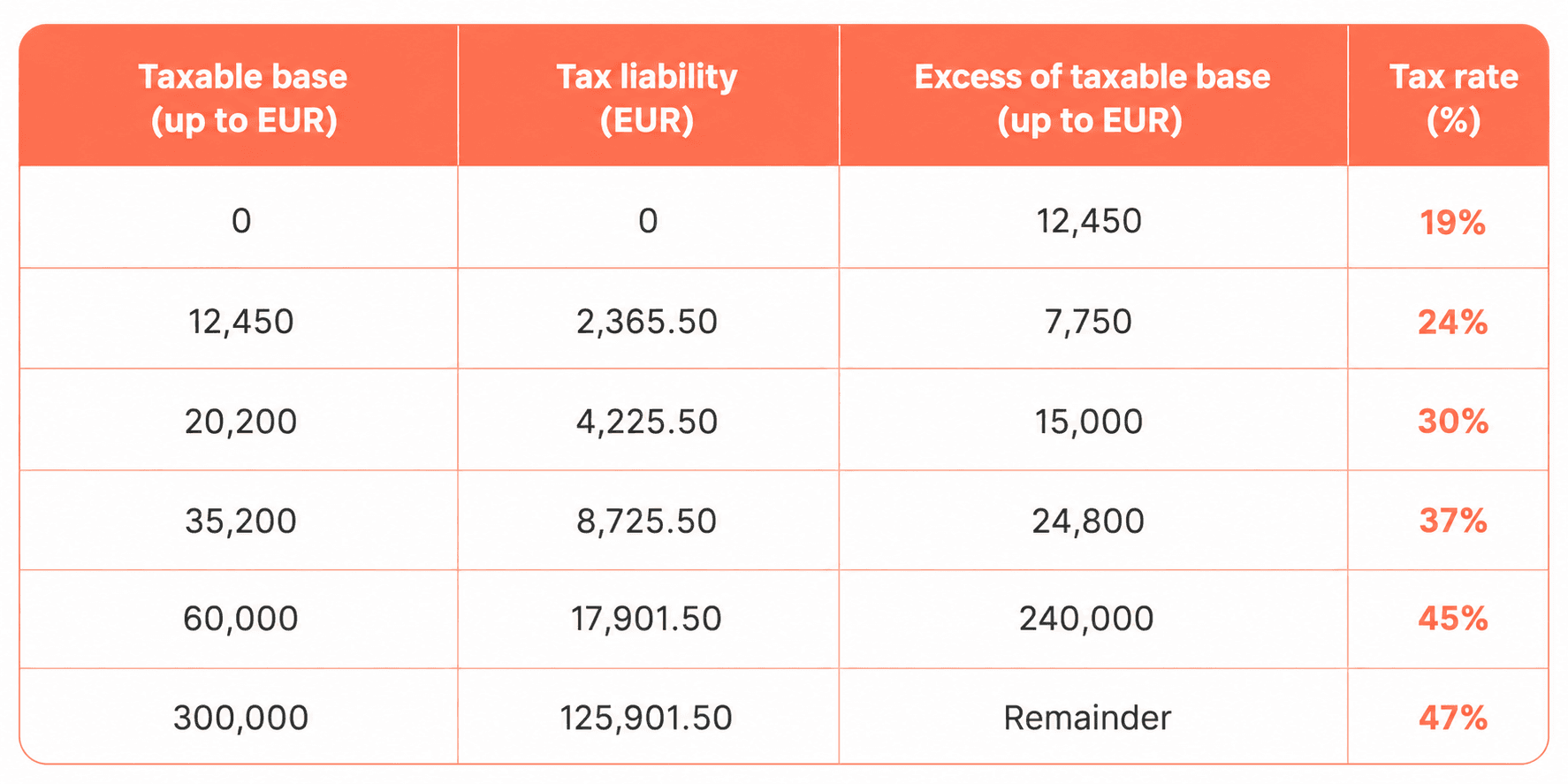
Spain's special impatriate tax regime under Article 93 of the IRPF Law can be particularly relevant to remote employees. Since the Startup Law reforms, employees who relocate to Spain to perform their employment remotely through computer and telecommunications systems are expressly contemplated, and Spanish tax guidance specifically recognizes employees holding the international telework visa. Eligible Digital Nomad Visa holders may benefit from this special expat tax regime for up to six years.
Among the principal conditions, the applicant generally must not have been Spanish tax resident during the five tax periods preceding the move and must satisfy one of the qualifying reasons for relocating contained in Article 93.
For taxpayers who qualify for the special regime, the Beckham Law applies a flat 24% rate on employment income up to €600,000, and the 2026 scale applicable to the general taxable base is:
| Taxable base | Article 93 rate |
|---|---|
| Up to €600,000 | 24% |
| Above €600,000 | 47% on the excess |
These percentages should not be described simply as "Spain taxes digital nomads at 24%." The special regime has eligibility rules, its own treatment of different categories of income, and a separate scale for qualifying savings income.
The Article 93 regime is generally available for the tax year in which Spanish tax residence is acquired and the five following tax years, provided its conditions continue to be met. The election is made using Modelo 149. For a principal taxpayer moving under the current rules, the option normally has to be exercised within six months from the relevant start-of-activity date, determined by Spanish Social Security registration, qualifying documentation maintaining the home-country Social Security system, or the corresponding supporting document where registration is not required.
Freelancers should be particularly careful here. Holding a Digital Nomad Visa does not automatically give every self-employed freelancer access to Article 93. The tax law has separate qualifying categories for entrepreneurial activity and for certain highly qualified professionals serving certified startups or conducting qualifying training, research, development or innovation activities. By contrast, employee teleworkers are expressly contemplated by the remote-employment provision.
The right tax analysis therefore starts with the applicant's actual status (employee, freelancer, business owner, director or another category), not simply with the words "digital nomad visa." Time spent under this legal residence route can also count toward permanent residence and, eventually, Spanish citizenship if continuous legal residence is maintained, although the number of years required for citizenship varies by nationality, generally around ten years, with shorter periods available for nationals of certain countries. See our guide on how to get permanent residency in Spain for the broader pathway.
What Happens After Approval
Getting the Spain remote worker visa or residence authorization solves your immigration status, but several administrative steps remain after the move. The exact sequence depends in part on whether you obtained a one-year visa abroad or a multi-year residence authorization in Spain, and after approval that status may also be referred to in practice as a Residence Permit.

TIE
The TIE (Tarjeta de Identidad de Extranjero) is the physical foreign-national identity card documenting a residence authorization in Spain and serving as the usual Residency Permit for longer stays.
An important distinction is often missed in guides to the digital nomad visa:
If you hold only the one-year international telework visa, Law 14/2013 states that the visa itself is sufficient to reside and work remotely during its validity.
If you obtain a residence authorization valid for more than six months, the rules require the corresponding TIE.
That means someone who applies from Spain and receives the typical multi-year residence authorization should plan for the TIE process, including the required in-person police formalities. The Ministry of the Interior maintains the official information on Spain's Foreign National Identity Card procedure.
Do not confuse the TIE with the NIE. The NIE is an identification number; the TIE is a physical card documenting immigration status.
Padrón
The padrón municipal is Spain's municipal population register. Spanish local-government legislation requires people habitually living in Spain to register with the municipality where they normally reside. The resulting certificado or volante de empadronamiento is widely used as evidence of the person's local address for administrative procedures.
Registration is handled by the relevant town hall, and the exact evidence required (such as a rental contract, authorization from the property holder or other address documentation) can differ by municipality.
For newcomers who prefer assistance with this part of the relocation, Hiliv provides a dedicated Padrón registration service.
NUSS
The NUSS (Número de la Seguridad Social) is the Spanish Social Security number used for participation in the Spanish system.
It is particularly relevant when the Digital Nomad Visa holder must enter Spanish Social Security.
For an employee covered by the Spanish system, the foreign employer must normally complete the necessary Spanish registration and the employee is enrolled in the General Scheme. For an independent professional, current UGE guidance requires registration in RETA.
By contrast, an employee who is validly kept under a foreign Social Security system pursuant to an applicable international agreement and has the required certificate may not follow the same Spanish-enrollment path. A NUSS should therefore not be presented as a universal post-approval requirement for every digital nomad regardless of Social Security status.
Applicants who do need Spanish Social Security registration can use Hiliv's Social Security and NUSS assistance.
Banking and Housing
Neither buying property in Spain nor having a Spanish bank account is, by itself, a statutory eligibility condition for the Digital Nomad Visa. Indeed, UGE's own residence-authorization guidance expressly accepts financial certificates from Spanish or foreign financial institutions when documenting qualifying liquid resources.
Both become considerably more useful once you actually settle in Spain.
A Spanish bank account can simplify rent, utilities, mobile plans, insurance, tax payments and recurring direct debits. Hiliv offers assistance with opening a Spanish bank account, including options for people arranging their move before or after arrival.
Housing is equally important because your real Spanish address affects practical matters such as the padrón and local administration. Hiliv's housing search service can assist with finding suitable listings and navigating the local rental search. A Spanish residence permit can also make travel within the European Union easier for Non-EU Citizens, subject to Schengen rules.

Spain enjoys sunny weather most of the year. Depending on the source and spending category, the cost of living in Spain is generally estimated at roughly 10% to 25% lower than in France. Spain has 17 autonomous regions with diverse cultures. Spain is also among the countries with the most UNESCO World Heritage Sites, with around 50 recognized sites.
The most efficient relocation sequence for many successful applicants is therefore:
immigration approval → Social Security solution where applicable → housing → padrón → TIE where required → banking and other local registrations.
The precise order can vary because some steps depend on appointments, your employer's Social Security route and the documentation required by your municipality.
For anyone planning a digital nomads Spain relocation in 2026, the most important work is actually done before the application: correctly classifying the employment relationship, verifying the employer's willingness to cooperate with Social Security, using the current 2026 SMI rather than an outdated income figure, and choosing the correct consular or in-Spain application route. The Digital Nomad Visa is comparatively flexible once those elements fit the law, but problems in any one of them, particularly Social Security for foreign employees, can determine whether an otherwise strong application is viable.
Research verification
Frequently Asked Questions: Spain Digital Nomad Visa 2026
Does Spain have a digital nomad visa in 2026?
Yes. Spain has had a dedicated immigration route for international remote workers since the Startup Law introduced the international telework category into Law 14/2013. What is commonly called the Spanish Digital Nomad Visa is officially the international telework visa and residence authorization (visado/autorización de residencia para teletrabajo de carácter internacional).
What is the minimum income for the Spain Digital Nomad Visa in 2026?
The main applicant must demonstrate resources equivalent to 200% of Spain's SMI. For 2026, Spain's minimum wage is €1,221 per month in 14 payments, equivalent to €17,094 gross per year. That produces a minimum income requirement of €34,188 gross per year, or about €2,849 per month expressed over twelve months.
Can remote employees work for Spanish companies on a Digital Nomad Visa?
No. A remote employee holding the international telework authorization may only perform employment activity for companies located outside Spain. There is no 20% allowance permitting that employee to take a Spanish employment contract. Independent professionals face different rules and may carry out limited professional activity for Spanish businesses up to 20% of total professional activity.
Can US W-2 employees get the Spain Digital Nomad Visa?
Yes, in principle. There is no rule excluding a worker simply because they receive a US Form W-2. However, the largest obstacle for many US W-2 applicants is whether their US employer is prepared to support the Spanish Social Security requirements, either through an acceptable Certificate of Coverage under the US-Spain agreement or by registering with Spanish Social Security.
What is the difference between the consular visa and the in-Spain residence authorization?
A person outside Spain normally applies through a Spanish consulate for an international telework visa valid for up to one year. A person lawfully in Spain can apply directly to UGE for a residence authorization that can be issued for up to three years. The visa itself is sufficient to live and work remotely during its validity; a multi-year residence authorization generally requires obtaining a TIE.
How long must I have worked for my foreign employer before applying?
The applicant must have maintained the relevant employment or professional relationship for at least the three months immediately preceding the application. The foreign company or group must also demonstrate real and continuous activity for at least one year.
What qualifications are required for the Digital Nomad Visa?
Applicants must demonstrate either a qualifying higher-education or professional qualification, such as a university degree or professional certificate, or at least three years of professional experience relevant to the position. Spain's law refers to graduates or postgraduates from recognized universities, vocational-training institutions and recognized business schools, while also expressly allowing the three-year experience alternative.
What health insurance is required?
Applicants normally need health insurance comparable to Spain's public healthcare system. Current official instructions also require compliance with Social Security rules, criminal-record documentation and lawful immigration status when applying from Spain.
Can savings make up a shortfall in income?
UGE's current residence-authorization checklist states that if recurring employment or professional income falls slightly below the threshold, the difference may be supported through documented savings or other liquid resources sufficient to cover the shortfall throughout the authorization period. This should not be interpreted as meaning savings automatically replace the underlying remote-work income requirement.
Do Digital Nomad Visa holders pay taxes in Spain?
Receiving the visa does not automatically make someone a Spanish tax resident. Tax residence is determined under tax law, commonly where a person spends more than 183 days in Spain in a calendar year or where Spain is the principal center of economic interests. Eligible employee teleworkers may be able to elect Spain's special impatriate regime under Article 93, often called the Beckham Law, for up to six years if conditions are met.
What is the Beckham Law rate for Digital Nomad Visa holders in 2026?
For taxpayers who qualify for the special regime under Article 93, employment income up to €600,000 is taxed at a flat 24%, with income above €600,000 taxed at 47% on the excess. Freelancers do not automatically qualify; employee teleworkers are expressly contemplated by the remote-employment provision.
Do I need a TIE after approval?
If you hold only the one-year international telework visa, the visa itself is sufficient to reside and work remotely during its validity. If you obtain a residence authorization valid for more than six months, the rules require the corresponding TIE (Tarjeta de Identidad de Extranjero).
What administrative steps remain after approval?
After immigration approval, many applicants still need to resolve Social Security registration where applicable, secure housing, complete Padrón registration, obtain a TIE where required, and open a Spanish bank account. Hiliv can assist with several of these post-arrival steps.
Can family members join the principal applicant?
Yes. Family members may accompany or join the principal applicant, including a spouse or equivalent partner and eligible dependent children or ascendants. Residence authorizations issued to qualifying family members under Law 14/2013 allow them to work in Spain without the same employment restrictions imposed on the principal digital-nomad employee.
How does the Digital Nomad Visa differ from the Non-Lucrative Visa?
The Spain Non-Lucrative Visa is for residence without employment or professional activity. The Digital Nomad Visa is for qualifying international remote workers whose income comes from work performed remotely for businesses outside Spain, with limited exceptions for independent professionals serving Spanish clients.
How long does the application process take?
Law 14/2013 establishes an expedited framework including a 10-working-day statutory decision period for visas, subject to consultations contemplated by the legislation. However, the full process can take roughly 15 to 45 days once appointments, apostilles, criminal records, employer documents, translations and Social Security evidence are factored in. The visa fee is typically around €80 to €100, subject to nationality and consular practice.
Your administrative plan to leave for Spain
Generate a personalized calendar of all your procedures for your expatriation for free.
Your data is protected and secure