Spain Non-Lucrative Visa 2026: Requirements, Income, Costs & Application
Complete 2026 guide to Spain's Non-Lucrative Visa: IPREM financial thresholds (€28,800), required documents, health insurance, application steps, costs, remote-work rules, renewal, tax residency, TIE and post-arrival steps.

International Mobility Expert
2026 legal framework
Important distinction
Spain Non-Lucrative Visa 2026: Requirements, Income, Costs & Application
The Spain Non-Lucrative Visa is a residence visa for non-EU nationals who want to live in Spain without carrying out employment or professional activities. It is aimed in particular at retirees, financially independent people, individuals living from investments or pensions, and families who have enough savings or recurring non-employment income to support themselves in Spain and want a legal residence route without working.
For 2026, the minimum financial requirement is based on Spain's IPREM, which remains €600 per month. The main applicant must demonstrate resources equal to 400% of IPREM: €2,400 per month, or €28,800 for the initial 12-month residence period. Each qualifying dependant adds 100% of IPREM: €600 per month, or €7,200 for the first year.
One important point is often misunderstood: the Spanish Non-Lucrative Visa is sometimes marketed as a Spain passive income visa, but Spanish law does not require applicants to receive only passive income. The rules allow applicants to prove either sufficient economic resources for the residence period or a periodic source of income. Savings can therefore qualify. What matters is that you can support yourself in Spain without needing to work, and getting the rules right matters because outdated or incomplete advice can lead to refusal or problems after arrival.
Another major point for 2026 is that many older guides are now outdated. Spain's current immigration framework is governed by Royal Decree 1155/2024, which has applied since May 2025 and replaced the previous immigration regulation commonly cited in older NLV articles.
Relocating to Spain on a Non-Lucrative Visa involves more than the consular application alone. Hiliv helps international residents with practical steps after approval, including obtaining your NIE, Padrón registration, bank account opening, and housing search. See our moving to Spain checklist for a complete relocation roadmap.
Need help with your expatriation to Spain?
Our experts accompany you in all your administrative procedures and installation.
Here is the Spain Non-Lucrative Visa 2026 at a glance:
| Requirement | 2026 rule |
|---|---|
| Main applicant financial requirement | €2,400/month or €28,800 for 12 months |
| Each qualifying dependant | +€600/month or +€7,200 for 12 months |
| Employment in Spain | Not permitted |
| Remote work from Spain | Not compatible with the NLV |
| Initial residence authorization | 1 year |
| Ordinary renewal | 2 years |
| Health insurance | Required |
| Criminal records | Countries of residence during the previous 5 years |
| Application location | Competent Spanish consulate where you reside |
| TIE after arrival | Apply within 1 month |
| Presence required for renewal | More than 183 days during the calendar year |
| Likely Spanish tax residency | Generally yes if you exceed 183 days in Spain |
This guide covers the Spain non lucrative visa requirements, financial thresholds, required documents, health insurance, application process, costs, remote-work rules, denial risks, renewal rules, post-arrival steps such as the TIE and local registration, and Spanish tax residency as they apply in 2026.
What Is Spain's Non-Lucrative Visa?
The Spanish Non-Lucrative Visa, officially the residence visa for residencia temporal no lucrativa, allows eligible third-country nationals and certain family members to establish legal residence in Spain without undertaking employment or professional activity.
It is therefore a residence permit, not an extended tourist visa.
The initial non-lucrative residence authorization lasts one year, with its validity beginning when the holder enters Spain. After that initial period, a qualifying resident can normally renew for two years.
The route generally applies to people who are not citizens of the EU, European Economic Area or Switzerland and who are not covered by the EU free-movement regime through an eligible family relationship.
EU, EEA and Swiss citizens do not need a Spain Non-Lucrative Visa to move to Spain. They follow a different residence-registration procedure.
The term "Spain passive income visa" is widely used online but is not the official legal name of the visa. More importantly, "passive income" should not be confused with a strict legal requirement.
Spanish regulations allow applicants to demonstrate:
sufficient economic resources for the requested residence period, or a periodic source of income.
Depending on the applicant's circumstances and the documentation accepted by the relevant consulate, financial capacity may therefore be demonstrated through resources such as savings, pension income, investment income, rental income, financial portfolios or other documented funds that are actually available to the applicant.
The decisive issue is whether the applicant can maintain themselves and their qualifying family members in Spain without needing to perform employment or professional activities.
Who Is the Non-Lucrative Visa Designed For?
The non-lucrative visa Spain route is particularly well suited to people whose lifestyle and finances genuinely allow them to stop working while resident in Spain.
Typical profiles include retirees receiving a pension, financially independent people with substantial savings, investors who do not need to actively work in Spain, people living from rental or investment income, and individuals taking an extended career break without continuing professional activity remotely.
It can also be attractive for couples and families relocating together, provided the principal applicant has enough resources to cover everyone included in the application.
Under the immigration rules applicable in 2026, qualifying family members for this specific NLV route include:
- •a spouse, registered partner or sufficiently proven stable partner;
- •unmarried minor children who have not formed their own family unit, whether children of the applicant or their spouse or qualifying partner;
- •certain adult children who have a disability requiring support or who are objectively unable to provide for their own needs because of their health.
For an unregistered stable partnership, the current regulation treats a durable relationship as established where the couple can prove at least one continuous year of marital-type cohabitation. Where the couple has a child together, proving stable cohabitation is sufficient without the one-year requirement.
There is also an important 2026 distinction regarding parents.
Ascendant parents are not included in the definition of qualifying family members under Article 61.3 of the current Non-Lucrative Residence rules. This is a point on which some older online guides can be misleading because other Spanish family-reunification routes do provide possibilities for qualifying ascendants.
Applicants intending to move with a dependent parent should therefore assess the parent's immigration position separately rather than assuming they can simply add them to an NLV application.
Who Should Choose Another Spanish Visa?
The Spain Non-Lucrative Visa is the wrong route if you intend to continue working from Spain.
Another Spanish visa or residence authorization is likely to be more appropriate if you plan to:
- •remain employed by an overseas company while working online from Spain;
- •freelance from Spain;
- •actively provide consulting or professional services;
- •work for Spanish clients;
- •take employment with a Spanish company;
- •actively run a business from Spain;
- •relocate primarily for study;
- •establish or develop a professional or entrepreneurial activity.
For qualifying international remote workers, Spain's Digital Nomad Visa, legally structured around international teleworking, is usually the route that should be examined instead.
If you do not genuinely fit the NLV, review alternative visa routes rather than forcing a non-working application.
This distinction matters even where your employer or clients are entirely outside Spain.
The Non-Lucrative Visa is not simply a visa that prohibits working for a Spanish employer. Its legal basis is residence without employment or professional activity, and Spanish consular guidance expressly treats remote work as inconsistent with the nature of the NLV.
Choosing the right route from the beginning is particularly important for applicants of working age. An application that says you will not work while simultaneously showing that your future financial resources depend on continuing your existing job can create an obvious inconsistency.
Spain Non-Lucrative Visa Requirements
Consulate-specific documentation
Health insurance warning
The main Spain non lucrative visa requirements in 2026 are sufficient financial resources, qualifying health insurance, acceptable criminal and medical records and a complete application meeting both the national immigration rules and the documentary requirements of the competent Spanish consulate.
The current national requirements include:
- ✓sufficient financial resources for the applicant and qualifying family members without working;
- ✓public or private health insurance meeting the required standard;
- ✓no relevant criminal-record or public-order impediment;
- ✓no disease that may have serious public-health repercussions under the International Health Regulations;
- ✓payment of the applicable residence-processing fee;
- ✓compliance with general residence-visa requirements.
The exact documents requested can differ between Spanish consulates.
That distinction is essential when preparing an application:Spanish immigration law sets the underlying requirements, while the consulate responsible for your place of residence determines how it expects those requirements to be documented in your jurisdiction.
Financial Requirements
The Spain non lucrative visa income requirements are linked to the IPREM (Indicador Público de Renta de Efectos Múltiples).
For 2026, the monthly IPREM remains €600.
The legal minimum is:
Main applicant: 400% of IPREM
€600 × 400% =€2,400 per month
For the initial one-year authorization:
€2,400 × 12 =€28,800
For every qualifying family member:
Additional 100% of IPREM
€600 × 100% =€600 per month
For the initial year:
€600 × 12 =€7,200 per dependant
This gives the following 2026 minimums:
| Application | Monthly financial requirement | Minimum for initial year |
|---|---|---|
| Main applicant | €2,400 | €28,800 |
| Main applicant + 1 dependant | €3,000 | €36,000 |
| Main applicant + 2 dependants | €3,600 | €43,200 |
| Main applicant + 3 dependants | €4,200 | €50,400 |
| Each additional qualifying dependant | +€600 | +€7,200 |
These amounts are statutory minimum thresholds, not guaranteed approval balances.
A person showing exactly €28,800 does not acquire an automatic right to the visa simply because the mathematical threshold has been reached. The authorities must still be satisfied that the resources are genuinely available, appropriately documented and sufficient for the period of residence.
The legal threshold also should not be confused with the applicant's future cost of living. A household that legally qualifies with the minimum amount may realistically need substantially more depending on rent, location, family size, lifestyle and healthcare arrangements.
One of the most useful distinctions for applicants is that €28,800 is not a €28,800 salary requirement.
The current regulation expressly contemplates applicants who have sufficient economic resources or a periodic source of income.
This means an applicant does not necessarily need to demonstrate €2,400 arriving in a bank account every month.
For example, a retiree may rely heavily on a documented pension. Another applicant may qualify primarily through sufficient accessible savings. Someone else may use a combination of savings and recurring non-employment income.
Depending on the case and consular checklist, applicants commonly rely on evidence such as:
- •bank balances and bank certificates;
- •savings accounts;
- •pension statements;
- •investment or brokerage accounts;
- •dividends or investment distributions;
- •rental income;
- •annuities;
- •other properly documented assets or recurring income.
The current regulation is unusually useful on the question of evidence because it states that availability can be proved through any legally admissible means and specifically refers to evidence such as property titles, certified checks and credit cards supported by a bank certificate showing the credit available.
For foreign bank accounts or financial instruments, the 2026 legal framework goes further. The financial information provided may include:
- •the full name and address of the financial institution;
- •complete identification of the account;
- •opening, closing or authorization dates where applicable;
- •the balance at December 31 of the previous year;
- •the average balance during the previous year.
That last point is particularly important for 2026 applications.
Applicants should not assume that showing a screenshot of today's bank balance is necessarily the strongest possible financial evidence. The current regulation expressly contemplates a longer financial history for foreign accounts.
As a practical matter, the financial file should make three things easy to understand:
Whose money is it? Is it genuinely available? Can the applicant support themselves for the residence period without working?
A substantial transfer into an account immediately before the appointment is not automatically prohibited, but where the source or ownership of the funds is unclear it can create questions that a stable, well-documented financial history may avoid.
Where funds come from ownership interests in companies located in Spain, the regulation specifically requires evidence that the applicant is not carrying out employment activity in those companies, together with an appropriate declaration.
That reflects the central principle of the entire NLV: financial resources are acceptable; continuing professional activity is not.
Each qualifying family member increases the minimum by €600 per month in 2026.
So, for the first year:
A single applicant needs at least €28,800.
A couple needs at least:
€28,800 + €7,200 =€36,000
A couple with one qualifying child needs:
€28,800 + €7,200 + €7,200 =€43,200
A couple with two qualifying children needs:
€28,800 + €7,200 + €7,200 + €7,200 =€50,400
The financial resources should support the family unit as a whole.
Where family members apply together, applicants should also prepare the relevant marriage, partnership, birth or dependency documentation necessary to establish that each person actually qualifies as a family member under the NLV rules.
Health Insurance
Applicants must have public or private health insurance with an insurer authorized to operate in Spain.
For private insurance, the safest approach is to obtain a policy expressly designed to comply with Spanish residence-visa requirements rather than relying on ordinary international travel insurance.
Official Spanish consular checklists commonly require private insurance to cover the risks covered by Spain's public healthcare system. Several Spanish consulates expressly require unlimited coverage with no copayment or deductible, and some also state that there should be no coverage limit.
In practice, check whether the policy:
- •is issued by an insurer authorized to operate in Spain;
- •covers healthcare throughout Spain;
- •provides comprehensive medical and hospital coverage;
- •contains no deductible;
- •has no co-payments where prohibited by the relevant consulate;
- •does not impose an overall coverage limit incompatible with the consulate's requirements;
- •is valid for the required residence period.
A €30,000 Schengen travel-insurance policy should not be assumed to satisfy an NLV application simply because it would be acceptable for some short-stay visa purposes.
Travel insurance and residence health insurance serve different purposes.
Applicants should ask the insurer for written confirmation of NLV compliance and compare the policy certificate against the exact wording published by their competent consulate before paying for a long-term policy.
Criminal Record and Medical Certificate
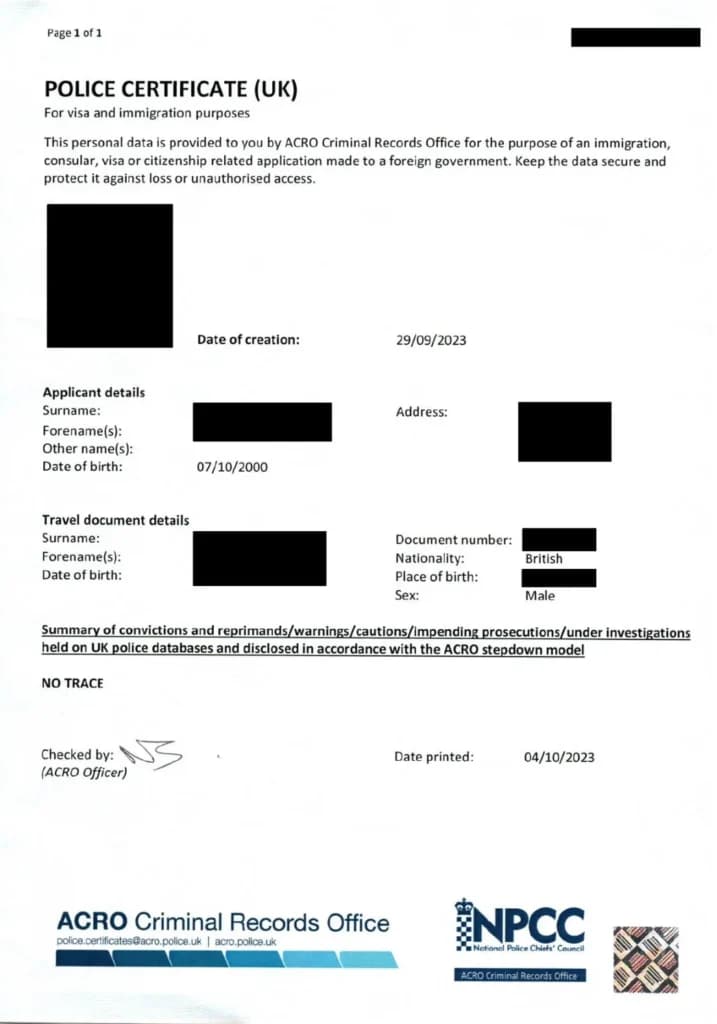
Applicants who have reached the age of criminal responsibility must provide criminal-record documentation covering the relevant countries in which they have lived during the previous five years.
This is another area where older online information can cause confusion.
The current Spanish regulation refers to criminal records from the countries where the applicant has resided during the last five years, rather than simply requesting a certificate from the applicant's country of citizenship.
Applicants who have lived in several countries during that period should therefore check whether multiple certificates will be necessary.
Foreign public documents generally need to be properly legalized or apostilled, unless an applicable international agreement removes that requirement.
They may also need an official translation into Spanish.
For applicants in the United States, current Spanish consular guidance is particularly specific. For example, the Spanish Consulate in Los Angeles requires applicants over 18 to provide an FBI criminal record check certificate, and the relevant federal apostille requirements must be followed. A state or local criminal-record certificate should not automatically be assumed to replace the federal document where the consulate specifically requires the FBI record.
The medical certificate must confirm that the applicant does not suffer from diseases that could have serious public-health repercussions in accordance with the International Health Regulations of 2005. Consulates also typically expect a medical certificate confirming the applicant does not have diseases with serious public-health repercussions under the International Health Regulations.
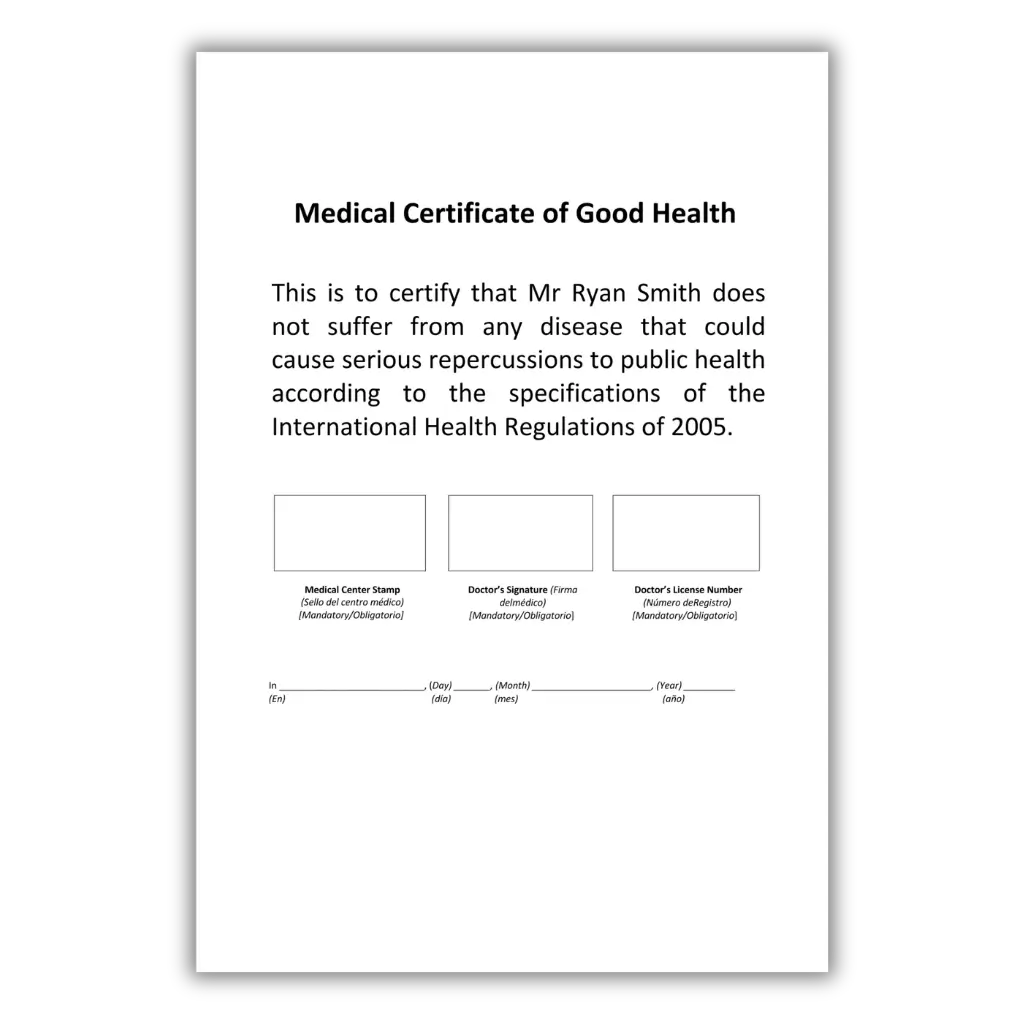
Because consulates can prescribe preferred wording, applicants should check the local NLV checklist before asking a doctor to issue the certificate.
A generic letter stating simply that the patient is "in good health" may not contain the required language.
Accommodation and Other Supporting Documents
Proof of long-term accommodation is not listed as a universal core financial requirement in Articles 61 and 62 of the national NLV regulation.
Need help with your expatriation to Spain?
Our experts accompany you in all your administrative procedures and installation.
However, that does not mean every applicant can ignore accommodation.
Individual Spanish consulates can request additional evidence concerning the applicant's intended residence in Spain. Some consular checklists ask for proof of accommodation; for example, particular U.S. consulates have required evidence such as an initial rental agreement.
The practical rule is therefore:
Do not assume that a one-year lease is universally required, but do not assume that accommodation evidence is never required either. Follow the current checklist of your competent consulate.
This can prevent applicants from taking the unnecessary risk of signing an expensive long-term lease before receiving a visa solely because an outdated third-party checklist said it was compulsory everywhere.
Other required documents commonly forming part of an NLV application file include:
- •the relevant residence application form, including EX-01, and the national visa application form or national visa form required by the consulate;
- •the national visa documentation requested by the consulate;
- •an unexpired passport with sufficient validity;
- •passport photographs where required;
- •proof of legal residence in the consular jurisdiction;
- •evidence of financial resources;
- •proof of compliant health insurance;
- •criminal-record certificates;
- •medical certificate;
- •marriage, partnership or birth certificates for accompanying family members;
- •supporting documentation for an eligible adult child where applicable, including documents proving financial dependence where relevant;
- •proof of payment of the applicable fee;
- •additional declarations or documents required by the particular consulate.
The Spanish Ministry's current guidance requires the passport or recognized travel document used for the procedure to have a minimum validity of one year.
Applicants should build the file around the current checklist of the Spanish consulate responsible for them rather than copying a document list from an applicant in another country, since completeness matters and the consulate may request additional documents if something is missing or unclear.
How to Apply for a Non-Lucrative Visa in Spain
The initial non lucrative residence visa Spain procedure is started through the competent Spanish consular authorities abroad.
The visa application simultaneously initiates the application for the underlying temporary non-lucrative residence authorization.
For the non lucrative visa application, a sensible sequence is:
- 1Identify the Spanish consulate responsible for your legal place of residence and download its current 2026 NLV checklist.
- 2Calculate the correct financial requirement for your family and obtain compliant health insurance.
- 3Request criminal-record and civil-status documents early, then complete any required apostille or legalization procedures and official Spanish translations where required.
- 4Book your consulate appointment 3 to 4 months in advance where appointment availability is limited, then submit the application and pay the applicable fees.
- 5Respond promptly to any request for additional documentation.
- 6Once approved, collect the visa, enter Spain within its validity period, and apply for the TIE after arrival.
The order matters because some documents have limited practical validity, while apostilles, translations and criminal-record checks can take time to obtain.
Where to Submit the Application
The general rule is that applicants submit through the Spanish consular office in whose consular district they reside.
Depending on the country and jurisdiction, the physical submission may take place:
- •directly at the Spanish embassy or consulate;
- •through an authorized external visa service provider, sometimes labeled a Spain Visa Application Center;
- •in another consular post specifically designated by the Spanish authorities.
You normally cannot simply choose whichever Spanish consulate has the earliest appointment.
The consulate may require evidence showing that you legally reside within its jurisdiction.
This is particularly relevant to highly mobile applicants and people applying from a country of which they are not citizens.
For example,Spain Non-Lucrative Visa for US citizens applications are handled according to the applicant's place of residence within the United States. Different Spanish consulates cover different states and may publish slightly different documentary instructions.
A U.S. citizen living in California should therefore not assume that the checklist or submission procedure published for New York, Chicago or Washington applies identically to their case.
The financial threshold itself comes from Spanish national law, but documentary implementation is consulate-specific, and applicants still need to follow the broader Spanish visa system and the local submission method set by their jurisdiction.
Documents and Translations
One of the biggest sources of avoidable problems is preparing all the required documents but not preparing them in a form Spanish authorities can use.
A foreign marriage certificate, criminal-record certificate or birth certificate can be completely authentic in its issuing country but still be unacceptable in a Spanish immigration procedure if the required authentication or translation is missing.
As a general rule, foreign public documents may need either:
an Apostille of The Hague, where the Hague Apostille Convention applies,
or
legalization through the appropriate procedure, where it does not.
Foreign documents must also be translated into Spanish or, where appropriate, the co-official language accepted for the procedure, generally through an accepted sworn translator where required.
The apostille or legalization normally authenticates the foreign public document. The translation makes it usable for the Spanish procedure. These are separate requirements.
Applicants should also pay close attention to:
Names: spellings should be consistent across passport, bank records, civil-status documents and forms.
Dates: do not submit certificates that have become too old under the consulate's rules.
Family relationships: a child's birth certificate or marriage certificate may require the same apostille and translation process as the applicant's own background check.
Financial documentation: make sure the account holder, institution, balances and relevant history can be identified.
Finally, make sure the visa application form and national visa application match all of this supporting documentation exactly.
Copies and originals: follow the consulate's exact rules on what must be submitted as an original, copy or certified copy.
For applicants moving between several countries, document legalization is one area where preparation should begin particularly early.
Processing and Approval
There are several different procedural stages, which is why statements such as "the NLV takes one month" can be misleading.
Under the current regulation, once the competent Spanish immigration office receives the communication from the consular office, it has a maximum of one month to decide the underlying residence authorization.
If that stage receives no response within the prescribed period, the application is treated as refused by administrative silence under the current NLV procedure.
Separately, the general residence-visa rules provide for the consular office to resolve and issue the visa within a maximum period after receiving a favorable residence decision.
These statutory internal periods should not be interpreted as a guaranteed one-month door-to-door processing time from the day you start preparing the application.
The overall timeline can also be affected by:
- •appointment availability;
- •use of an external visa centre;
- •requests for missing or additional documents;
- •personal interview;
- •verification of documents;
- •criminal or security checks;
- •the workload of the competent authorities.
Applicants should therefore avoid purchasing non-refundable travel based solely on an estimated approval date.
Once the residence visa has been granted, current Ministry guidance states that the applicant has one month from notification to collect it personally. The applicant receives notification of approval, refusal, or any further procedural step through the consular channel used for the case. Failure to collect it within that period can be treated as a waiver of the granted visa.
After collection, the applicant must enter Spain during the validity of the visa, which cannot exceed three months. Spanish consulates commonly issue the NLV with a 90-day entry-validity period.
The underlying initial residence authorization then lasts one year from the date of entry into Spain.
That date matters. It becomes the starting point of your Spanish residence status and determines subsequent TIE and renewal planning.
How Much Does the Spain Non-Lucrative Visa Cost?
There is no single global answer to non lucrative visa Spain cost because the total depends on nationality, country of application, currency conversion, external service providers, document authentication, translation and insurance.
Applicants should distinguish between government fees and the real preparation cost.
Government-related costs can include:
| Cost | What to expect |
|---|---|
| National residence visa fee | Varies by nationality and consular jurisdiction |
| Residence authorization fee (Modelo 790-052) | Payable as part of the residence procedure |
| Visa centre service fee | Applies in jurisdictions using an external provider |
| TIE fee | Paid after arrival for the residence card |
Additional preparation costs can include:
- •criminal-record certificates;
- •apostilles or legalization;
- •sworn translations;
- •medical examination and certificate;
- •private health insurance;
- •passport photographs;
- •travel to the consulate or visa centre;
- •professional immigration assistance where used.
For the residence authorization itself, the official Modelo 790 Código 052, heading 2.1.1 fee for an initial non-lucrative residence authorization is currently €10.94 in Spain's official fee schedule.
The visa fee is separate.
Spain Non-Lucrative Visa for US citizens: 2026 fees
For U.S. citizens applying in the United States, official Spanish consular fee schedules for 2026 list a $140 consular visa fee.
The corresponding initial residence-authorization fee is published by U.S. Spanish consulates in local currency and is currently around $13.
So the basic government charges for a U.S. applicant are approximately:
$140 visa fee + $13 residence fee = $153
This total basic visa application fee burden is separate from the residence authorization fee itself and any external service charge, before insurance, FBI background checks, apostilles, translations, medical documentation and other preparation costs.
Applicants should verify the amount with their own consulate immediately before applying because consular fees can be adjusted according to exchange rates.
Nationality also matters.
Spain applies reciprocity to certain nationalities, which can make the visa fee substantially higher than the standard fee. For example, official Spanish consular fee schedules in the United States currently publish different rates for U.S., Canadian and Australian citizens.
This is why a generic article stating that the Spain Non-Lucrative Visa costs one fixed amount worldwide is not reliable.
The larger real-world expense is usually not the government residence fee itself. Health insurance, translations, authentication and relocation-related expenses can account for a considerably larger portion of the total budget.
Can You Work on a Non-Lucrative Visa?
No.
This is one of the clearest rules of the Spanish non lucrative visa.
The current immigration regulation defines non-lucrative temporary residence as residence in Spain without carrying out employment or professional activities.
The applicant must also demonstrate that they can support themselves without needing such activity.
That means the NLV should not be approached as a low-cost alternative to a work visa or Digital Nomad Visa.
Receiving money is not itself prohibited. A pension, investment return or rental payment, for example, is fundamentally different from earning money in return for work you actively perform from Spain.
The important question is:
Does receiving this money require you to continue performing employment or professional activity while you live in Spain?
If the answer is yes, the NLV is generally not the correct route.
Remote Work and the NLV
Remote work is one of the areas in which applicants encounter the most outdated information online.
Older articles sometimes suggest that remote work was acceptable as long as the employer and clients were outside Spain.
That is not a safe interpretation for a 2026 application.
Spanish consular guidance now expressly states that working remotely is contrary to the nature of the Non-Lucrative Visa and directs remote workers toward the Digital Nomad route.
Accordingly, the NLV is not appropriate for someone planning to move to Spain and continue:
- •working full-time for a U.S. employer;
- •working online for a British, Canadian or Australian company;
- •freelancing for foreign clients;
- •operating an active consultancy;
- •performing professional services from a laptop;
- •managing an active business as their professional occupation.
This remains the case even if every client is overseas and every payment goes into a foreign bank account.
The geographic location of the client does not transform active professional activity into passive financial resources, even for non-EU citizens applying for residence without work authorization.
There is also an important distinction between owning a company or investments and working in the business.
An applicant can have financial assets. But where an applicant's financial evidence involves company ownership, the authorities may examine whether the applicant will genuinely refrain from carrying out professional activity in the company during their NLV residence.
Applicants should therefore avoid trying to relabel active salary, freelancing or business income as "passive income" merely for immigration purposes.
When the Digital Nomad Visa Is More Appropriate
Spain's Digital Nomad Visa exists specifically for qualifying third-country nationals who want to live in Spain while working remotely using telecommunications technology for companies outside Spain.
That makes it fundamentally different from the NLV.
| Spain Non-Lucrative Visa | Spain Digital Nomad Visa |
|---|---|
| Designed for residence without working | Designed for international remote work |
| Active employment/professional activity not permitted | Remote professional activity is the purpose of the route |
| Savings or non-work financial resources can support eligibility | Applicant normally relies on active professional income |
| Particularly suitable for retirees and financially independent applicants | Particularly suitable for qualifying remote employees and professionals |
| Initial NLV residence: 1 year | Different visa/residence durations apply under the telework regime |
For an employee under the international teleworking rules, the professional activity is performed for companies located outside Spain.
Qualifying self-employed professionals have somewhat broader rules: Spanish law allows a professional teleworker to carry out work for a company located in Spain provided that the Spanish activity does not exceed 20% of their total professional activity.
There are also qualification, employment-history, company-history, financial and Social Security requirements that are separate from those of the NLV.
So the decision between the two should begin with one question:
Will you continue actively working after you move to Spain?
If yes, investigate the Digital Nomad Visa or another work-authorized route in Spain.
If no, and you can support yourself independently, the Spain Non-Lucrative Visa may be the more appropriate residence option.
Why Are Non-Lucrative Visas Denied?
There is no credible single percentage that represents the Spain Non-Lucrative Visa denial rate across all Spanish consulates, and applicants should be cautious about websites claiming a universal approval or refusal rate without official data.
A refusal can occur where the applicant fails to establish one or more of the legal visa or residence requirements.
The current rules require authorities to provide the grounds and legal basis for a refusal and indicate the available appeal route and deadline.
In practical terms, many avoidable problems fall into two categories:financial evidence and insurance/documentation.
Financial Evidence Problems
An applicant can have significant wealth and still submit an unclear financial file.
Potential problems include:
Insufficient resources. The applicant does not reach the required 400% IPREM for themselves plus 100% for each qualifying dependant.
Resources are not demonstrated for the full relevant period. The requirement relates to the residence period, not simply a single month's expenses.
Ownership is unclear. Statements do not clearly identify the applicant or show their ability to access the funds. Poorly presented bank statements can weaken an otherwise sufficient financial case.
Foreign-account information is incomplete. The current regulation specifically addresses identification of foreign financial institutions and accounts, previous year-end balances and average annual balances.
The applicant depends on continuing employment. A person may show a large salary but simultaneously undermine their NLV case if that salary can only continue through active work from Spain.
Company assets and personal resources are confused. Money belonging to a company is not automatically the applicant's personally available money.
Family finances do not cover all applicants. The financial threshold increases for every qualifying dependant.
Evidence is internally inconsistent. For example, the stated source of wealth does not match bank documents or other material submitted with the application.
There is no rule saying that an applicant must maintain a mysterious percentage "above the minimum." The legal amounts are minimums.
Nevertheless, from a document-preparation perspective, an applicant whose finances are easy to verify and comfortably sustainable presents a clearer case than someone whose entire application depends on a borderline balance and ambiguous evidence.
The objective is not to inflate the bank balance artificially. It is to provide credible evidence of genuine financial independence.
Insurance and Documentation Problems
A second group of refusal risks arises even where the applicant easily satisfies the financial threshold.
Examples include:
Non-compliant health insurance. A travel policy, deductible, copayment, restricted coverage or inappropriate insurer may fail the consulate's requirements.
Missing apostille or legalization. A valid foreign public document may still be unusable in Spain if it has not been authenticated correctly.
Missing official Spanish translation.
Wrong criminal-record documentation. This can be particularly relevant for applicants who lived in several countries during the previous five years.
Incorrect medical-certificate wording.
Expired or outdated supporting documentation.
Passport validity below the required standard.
Applying through a consulate that is not competent for the applicant's place of residence.
Failure to demonstrate the claimed family relationship.
Including a relative who does not qualify under the current NLV definition of family.
Contradictory evidence regarding work. For example, an applicant declares an intention not to work but provides documentation showing an ongoing full-time remote job that will continue after moving.
A non lucrative visa Spain denied decision should be read carefully before deciding what to do next.
Spanish consular guidance generally provides for an administrative reconsideration appeal within one month of notification of refusal. The refusal notification itself should identify the applicable remedies and deadlines.
Whether an appeal or a new application is more appropriate depends on the specific reason for refusal. A factual documentary omission presents a very different situation from a disagreement over the applicant's substantive eligibility.
Non-Lucrative Visa Renewal and Spanish Tax Residency
Tax planning before you move
US citizens
The initial NLV authorization lasts one year.
An ordinary renewal is then valid for two years, unless the applicant is instead entitled to another residence status such as long-term residence. After five years of continuous legal residence, holders can normally apply for permanent residency.
Under the 2026 rules, an NLV renewal should normally be filed during the two months before the current authorization expires.
A late application can also be submitted during the three months after expiry, but this can trigger sanction proceedings, so it should not be treated as the normal filing window.
A timely renewal application extends the validity of the existing authorization until the renewal procedure is resolved.
The current renewal requirements include:
- •continuing to have sufficient financial resources for yourself and qualifying family members;
- •maintaining qualifying health insurance;
- •having school-age children properly enrolled where applicable;
- •paying the applicable fee;
- •meeting the residence requirement;
- •continuing to satisfy relevant legal conditions.
The new 183-day renewal requirement
One of the most important changes for people comparing old NLV guides with the 2026 rules is that renewal now expressly requires the applicant to have actually and effectively resided in Spain for more than 183 days during the calendar year.
This makes the NLV materially less suitable for people who want a Spanish residence permit while spending most of the year elsewhere.
The Non-Lucrative Visa should now be thought of as a route for genuine residence in Spain, not merely as a residence card to retain while living mainly in another country.
How much money is required for NLV renewal?
The financial requirement must cover the period for which the authorization is being renewed, so you must show sufficient financial means for the full renewal period.
Because the standard renewal is two years, that means demonstrating resources for 24 months. For the main applicant, that is equivalent to proving 800% of the annual IPREM at renewal.
Using the 2026 IPREM of €600 purely as the calculation basis:
Main applicant:
€2,400 × 24 =€57,600
Each qualifying dependant:
€600 × 24 =€14,400
For example:
| Renewal household | 24-month amount using €600 IPREM |
|---|---|
| Main applicant | €57,600 |
| Main + 1 dependant | €72,000 |
| Main + 2 dependants | €86,400 |
| Main + 3 dependants | €100,800 |
However, do not assume these will necessarily be the figures when your own renewal comes due.
The regulation expressly ties the threshold to the IPREM applicable at the time of the renewal application. If IPREM changes in a future year, the required amount changes with it.
Spain Non-Lucrative Visa taxes
Immigration residence and tax residence are separate legal concepts.
Receiving an NLV does not by itself automatically answer every tax-residency question.
However, Spain generally treats an individual as tax resident where, among other tests, they spend more than 183 days in Spanish territory during the calendar year. Spain can also treat a person as tax resident where their main base or centre of activities or economic interests is in Spain, and certain family-residence presumptions may apply.
This creates an important overlap:
The immigration rules now require more than 183 days of real and effective residence in Spain in the calendar year for NLV renewal, while Spanish tax law also uses a more-than-183-day calendar-year test for tax residence.
As a result, an NLV holder satisfying the physical-presence requirement for renewal will generally also need to consider themselves within the Spanish tax-residency framework, subject to the precise facts and any applicable tax treaty.
Spanish tax residents are generally subject to Spanish Personal Income Tax on worldwide income, subject to the allocation and double-taxation-relief rules contained in applicable tax treaties. An NLV holder who becomes tax resident in Spain may also have to pay taxes there on worldwide income, subject to treaty relief and the precise income category.
That can potentially affect:
- •foreign pensions;
- •dividends;
- •interest;
- •investment gains;
- •foreign rental income;
- •other foreign-source income.
It does not mean every type of foreign income is taxed in exactly the same way. Pension rules, for example, can vary according to the nature of the pension and the relevant double-tax treaty.
For this reason, the NLV's informal label "passive income visa" does not mean passive income is tax-free in Spain.
This is one of the most important financial points to assess before moving, rather than after becoming a Spanish tax resident.
Depending on your assets and circumstances, separate Spanish foreign-asset reporting obligations may also need to be reviewed.
Spain Non-Lucrative Visa taxes for US citizens
Tax planning deserves particular attention for U.S. citizens moving to Spain.
U.S. citizenship generally continues to carry U.S. federal tax filing obligations even when the citizen lives abroad, and U.S. taxpayers are generally subject to U.S. reporting on worldwide income, subject to available credits, exclusions and treaty rules.
At the same time, a U.S. citizen who becomes Spanish tax resident can also become subject to Spanish taxation of worldwide income.
The Spain-U.S. tax treaty and domestic foreign-tax-credit mechanisms are therefore important, but they do not mean that an American NLV holder can simply choose which of the two countries to file in.
Anyone moving to Spain with substantial investments, retirement accounts, pensions, companies, trusts, rental property or complex financial assets should ideally review the cross-border tax consequences before establishing Spanish tax residence.
Immigration planning answers whether you can legally reside in Spain. Tax planning answers what happens financially once you do. They should not be treated as the same analysis.
What to Do After Arriving in Spain
Visa approval is not the end of the relocation process.
After entering Spain, the most important practical steps include obtaining your TIE, registering on the Padrón Municipal, arranging local banking where useful and securing suitable housing.
The initial residence authorization starts on your date of entry into Spain and lasts one year.
TIE
The Foreigner Identity Card (TIE, Tarjeta de Identidad de Extranjero) is the physical foreigner's identity card showing your legal residence status in Spain.
Because the Non-Lucrative Residence authorization lasts longer than six months, you must apply for your foreigner identity card personally.
For an NLV holder, the application must be made within one month after entering Spain, that is, within 30 days of arrival.
The process normally involves an appointment, usually booked at the local foreign nationals office or police station depending on the local procedure, and includes fingerprinting. In some areas, applicants also deal with the foreign nationals office for the residence card stage after arrival.
Depending on the procedure and local office, applicants should expect documentation such as:
- •passport;
- •visa;
- •proof of entry where required;
- •TIE application form;
- •passport-size photograph meeting the required specifications;
- •evidence of payment of the applicable TIE fee;
- •other documentation requested for the particular issuance.
Your TIE and your NIE (Número de Identidad de Extranjero) are not the same thing.
The NIE is your unique foreigner identification number.
The TIE is the physical card documenting your immigration status.
A standalone NIE does not give a non-EU national the right to reside in Spain and does not replace the Non-Lucrative Visa or TIE.
Where an NIE is needed separately before relocation for a specific Spanish transaction, Hiliv's NIE Express service can help obtain an NIE remotely. For an NLV applicant, however, whether a separate NIE application is useful should be assessed based on the stage of the immigration process rather than automatically ordered as an extra visa requirement.
Padrón
The Padrón Municipal de Habitantes is Spain's municipal population register.
Spanish local-government law requires people living in Spain to register in the municipality where they habitually reside. Someone who lives in several municipalities should register in the one where they spend the greatest amount of time during the year.
Padrón registration is separate from immigration residence.
Being registered on the padrón does not, by itself, turn someone into a legal immigration resident. For an NLV holder, however, it records the person's municipal address and becomes relevant to many practical administrative procedures.
The exact documents required vary by municipality because registration is handled by the local Ayuntamiento.
They generally revolve around two questions:
Who are you?
and
What is your right to live at the address you are registering?
Depending on the town hall and housing arrangement, that can involve identity documents, a lease, property documentation or authorization relating to the dwelling.
Hiliv provides Padrón registration assistance for international residents who need help with the local process and municipality-specific requirements.
Bank Account
A Spanish bank account is not a statutory requirement for receiving the Non-Lucrative Visa.
It can, however, make everyday life in Spain substantially easier.
A Spanish account is commonly useful for:
- •paying rent;
- •electricity and utility direct debits;
- •internet and mobile contracts;
- •insurance payments;
- •subscriptions;
- •local transfers;
- •taxes and administrative payments.
Spanish banks must perform identity and anti-money-laundering checks, so account-opening documentation can depend on whether you are already resident, which identification documents you hold and the bank's own compliance requirements.
The Banco de España notes that non-EU foreign residents may be asked for their TIE, while non-residents can be asked to document their non-resident status.
That is why the practical experience of opening an account before receiving residence documentation can differ from opening one once your TIE is available.
Hiliv offers Spanish bank account opening assistance, including options relevant to newcomers who are navigating residence and local banking at the same time.
Housing
Housing affects both the immigration process and your life after arrival, but the two issues should not be confused.
At the visa stage, proof of accommodation depends on the competent consulate's checklist. There is no national rule that means every applicant must automatically sign a one-year Spanish rental contract before their visa is approved.
After relocation, however, a stable address becomes much more practically important.
It can affect:
- •padrón registration;
- •correspondence from public authorities;
- •TIE-related local administration;
- •banking;
- •utilities;
- •insurance;
- •schooling and other municipal services.
For applicants arranging accommodation remotely, the safest approach is not to commit large sums merely to make the visa application appear stronger unless the consulate actually requires that evidence.
Once the move is confirmed, Hiliv's housing search service in Spain can assist with finding suitable housing and navigating the rental process from abroad.
Ultimately, the Spain Non-Lucrative Visa 2026 is one of Spain's most straightforward residence routes conceptually: you must have enough money to live in Spain, appropriate health insurance and a compliant personal record, and you must genuinely intend to reside without working.
But straightforward does not mean automatic.
The strongest applications align four elements:
Your immigration route matches your real lifestyle. You are not planning to work remotely under a visa that prohibits professional activity.
Your finances are clear. You meet the 400% IPREM requirement plus the additional 100% for every qualifying dependant and can demonstrate genuine availability of those resources.
Your documentation complies with your consulate's rules. Criminal records, apostilles, translations, medical certificates and insurance are prepared in the required form.
Your long-term plan makes sense. You understand that renewal requires genuine residence of more than 183 days during the calendar year and that this has significant implications for Spanish tax residency; after five years of legal residence, holders can normally apply for permanent residence.
For 2026, that means a minimum of €28,800 for one applicant, plus €7,200 for each qualifying family member for the initial year.
For retirees and financially independent people who genuinely want to make Spain their home without working, the NLV remains a highly relevant route.
For people who plan to keep their job, continue freelancing or operate professionally from Spain, the Digital Nomad Visa or another work-authorized residence category should be considered instead.
Frequently Asked Questions: Spain Non-Lucrative Visa 2026
What is the Spain Non-Lucrative Visa in 2026?
The Spain Non-Lucrative Visa is a residence visa for non-EU nationals who want to live in Spain without carrying out employment or professional activities. The initial authorization lasts one year and can normally be renewed for two years if requirements are met.
How much money do I need for the Spain Non-Lucrative Visa in 2026?
The main applicant must show resources equal to 400% of IPREM: €2,400 per month or €28,800 for the initial 12-month period. Each qualifying dependant adds 100% of IPREM: €600 per month or €7,200 for the first year.
Can I work remotely on a Spain Non-Lucrative Visa?
No. Spanish consular guidance treats remote work as inconsistent with the Non-Lucrative Visa. If you plan to continue working from Spain, the Digital Nomad Visa or another work-authorized route is generally more appropriate.
Do I need passive income only, or can savings qualify?
Savings can qualify. Spanish regulations allow applicants to demonstrate sufficient economic resources for the residence period or a periodic source of income. Pensions, investments, rental income and documented savings may all be acceptable if properly evidenced.
What health insurance is required for the NLV?
Applicants need public or private health insurance with an insurer authorized to operate in Spain. Many consulates require comprehensive coverage with no copayment, deductible or overall limit incompatible with residence-visa requirements.
Which criminal records must I provide?
Applicants must provide criminal-record documentation for countries where they have resided during the previous five years, not only their country of citizenship. Foreign documents generally need apostille or legalization and official Spanish translation.
Where do I apply for the Spain Non-Lucrative Visa?
You apply through the competent Spanish consulate in whose consular district you legally reside. You normally cannot choose a different consulate simply because it has earlier appointments.
How long does NLV processing take?
Statutory internal periods exist, but overall timelines vary widely. Appointment availability, document verification, interviews and consular workload can all extend the process well beyond one month from first submission.
How much does the Spain Non-Lucrative Visa cost?
Government fees depend on nationality and jurisdiction. For U.S. citizens applying in the United States in 2026, official schedules commonly list about $140 for the visa fee and about $13 for the initial residence fee, plus insurance, translations, apostilles and other preparation costs.
Can parents be included on a Non-Lucrative Visa application?
Under Article 61.3 of the current Non-Lucrative Residence rules, ascendant parents are not qualifying family members on this route. A dependent parent's immigration position must be assessed separately.
What is the 183-day renewal requirement?
Renewal now requires the applicant to have actually and effectively resided in Spain for more than 183 days during the calendar year. The NLV is therefore suited to genuine residence in Spain, not merely keeping a card while living mainly elsewhere.
How much money is needed to renew the NLV?
Because ordinary renewal is for two years, the main applicant must generally prove 800% of annual IPREM at renewal. Using 2026 IPREM of €600 as the basis, that is €57,600 for the main applicant, plus €14,400 per qualifying dependant for 24 months.
Will I become a Spanish tax resident on an NLV?
Immigration residence and tax residence are separate concepts, but an NLV holder who meets the renewal presence requirement will generally also need to consider Spanish tax residency, especially if present in Spain more than 183 days in a calendar year.
What must I do after arriving in Spain on an NLV?
After entry, apply for your TIE within one month, register on the municipal Padrón, arrange local banking where useful and secure suitable housing. The initial residence authorization starts on your date of entry and lasts one year.
What is the difference between the NLV and the Digital Nomad Visa?
The NLV is for residence without working. The Digital Nomad Visa is for qualifying international remote workers. Savings or non-work resources can support NLV eligibility, while the Digital Nomad route normally relies on active professional income.