How to Get an Internship Visa in France (VLS-TS): Complete Guide 2026
Planning an internship in France? Learn everything about the internship VLS-TS visa, convention de stage, application process, and eligibility for non-EU interns.

International Mobility Expert

France is a popular destination for internships, and this guide is designed for international interns seeking to complete an internship in France. If you are a non-European intern—specifically, a non-EU citizen—planning to stay longer than three months, you will need a special visa.
Citizens of the European Union, however, do not need to apply for a long-stay visa, but may still need a residence permit. The long-stay internship visa (internship VLS-TS) is designed for interns coming to France for a professional training placement.
This article explains what the internship VLS-TS visa is, who needs it, the eligibility criteria, and the step-by-step application process. We also cover work rules during the internship and how to extend or change your status if your internship leads to a job offer.
Introduction to Internship Visas
Internship visas are an essential part of the process for international students who want to gain professional experience in France. The French government offers several types of visas for interns, including the long stay internship visa (internship VLS-TS) and the short stay visa, each with specific requirements and regulations.
To obtain an internship visa, you must prepare a set of required documents, such as a valid convention de stage (internship agreement) signed by all parties, proof of sufficient financial resources to support your stay, and, in some cases, a valid residence permit.
These documents demonstrate your eligibility and commitment to your internship in France. Understanding the differences between the long stay internship visa and the short stay visa, as well as the importance of having a valid agreement and proof of residence, is crucial for international students planning to intern in France. By meeting these visa requirements, you can ensure a smooth application process and focus on making the most of your professional experience as an intern in France.
Need help with your administrative procedures in France?
Our experts accompany you in all your visa, residence permit and installation procedures in France.
What is the France Internship Visa?
The France internship visa is officially called a visa long séjour valant titre de séjour mention stagiaire (often abbreviated as VLS-TS). It is a long-stay visa that doubles as a residence permit for interns.
In fact, the VLS-TS serves as a type of residency permit for the duration of your internship in France. This visa allows you to stay in France for more than three months to complete your internship or professional training. Internships shorter than three months typically use a short-stay Schengen visa instead.
Overview of the internship VLS-TS (internship long-stay visa)
The internship VLS-TS visa lets you enter France and complete a training placement at a company or public hospital. It is equivalent to a temporary residence permit, meaning you don't need a separate residency card immediately after arrival.
Once you arrive in France, you must validate the visa online with the French Office of Immigration and Integration (OFII) to activate its full duration. The internship VLS-TS is generally valid for up to six months per academic year.
This visa covers only the specific internship in your convention de stage; if your internship is renewed or extended beyond the initial duration, you will need to request a temporary residence permit as described below.
Who needs an internship visa (non-EU interns in France)
Non-European students or recent graduates (non-EU/EEA/Swiss/UK nationals) who plan to intern in France for more than three months must obtain the internship VLS-TS visa before entering France. EU/EEA/Swiss citizens do not need a visa and can work freely.
For others, this visa is mandatory for any internship that is part of a formal training program or study course. You should apply while still in your home country at the French consulate.
Finding an Internship in France
Securing an internship in France is a key step for international students looking to enhance their professional experience and language skills. Start your search by exploring popular job boards like Indeed France and Welcome to the Jungle, which list a wide range of internship opportunities across various industries.

Many universities also offer valuable resources, such as career centers and study abroad offices, to help students connect with potential host companies. Networking is another effective strategy—reaching out directly to companies or leveraging connections through professors and alumni can open doors to unique internships.
When applying, make sure to tailor your CV and cover letter to each position, highlighting your relevant skills and motivation for interning in France. Many French companies welcome international students, offering a chance to gain hands-on experience, improve your language skills, and build your career prospects in a global environment.
Eligibility Criteria
Before applying, make sure you meet all the eligibility requirements. The main conditions are:
Must have an internship agreement (convention de stage)
You must have a valid internship contract (convention de stage) signed by you, your foreign training institution or university, and the host company or organization in France. This tripartite agreement outlines the internship period, objectives, and terms, and by law it cannot grant employee status.
Internship related to studies or career development
The internship should be part of your education or professional development. Usually, you are expected to be enrolled in a course, university, or training program in your home country, and the internship is a required or elective part of that program.
Internships under approved EU or international training schemes also qualify. In short, you should be a student or recent graduate doing an internship linked to your studies or career goals, with a clear educational purpose.
Sufficient funds and insurance for stay
You need to prove that you have enough funds to live in France and valid health insurance. French rules require that interns have at least the basic French scholarship allowance per month (currently about €615/month) as a minimum resource.
If your host provides a stipend, that can count toward this total. Bank statements or stipend letters are used as proof. Additionally, you should have comprehensive health and travel insurance covering medical expenses and repatriation for the entire stay.
Application Process for Internship Visa
Follow these steps to apply for the internship VLS-TS visa:
Collect required documents (internship contract, host attestation, etc.)
Prepare your visa application file with the following documents:
- ✓Passport: Valid for the internship duration plus at least 3 extra months, with blank visa pages.
- ✓Internship agreement (Convention de stage): The tripartite contract signed and validated by the DREETS/DDETS (regional labor department).
- ✓Proof of accommodation in France: Rental contract, hotel booking, or a formal letter of hospitality.
- ✓Proof of funds: Bank statements, scholarship award or company stipend confirmation showing at least €615/month.
- ✓Travel health insurance: Policy covering all health expenses and repatriation for the entire stay.
- ✓Passport-size photos: Two recent photos meeting French visa photo standards.
- ✓Visa application form: Filled out and printed from the France-Visas portal.
- ✓Cover letter or enrollment proof: A letter explaining the internship role and your status as a student may be helpful.
Some consulates may ask for additional papers (e.g. vaccination certificate, criminal record check, or country-specific forms). Always check the exact requirements on the official visa website or your French consulate's instructions.
Fill out visa application form (long-stay student/intern category)
On the France-Visas website, create an account and complete the long-stay visa application. Select the category related to internships (usually under Studies/Training or equivalent).
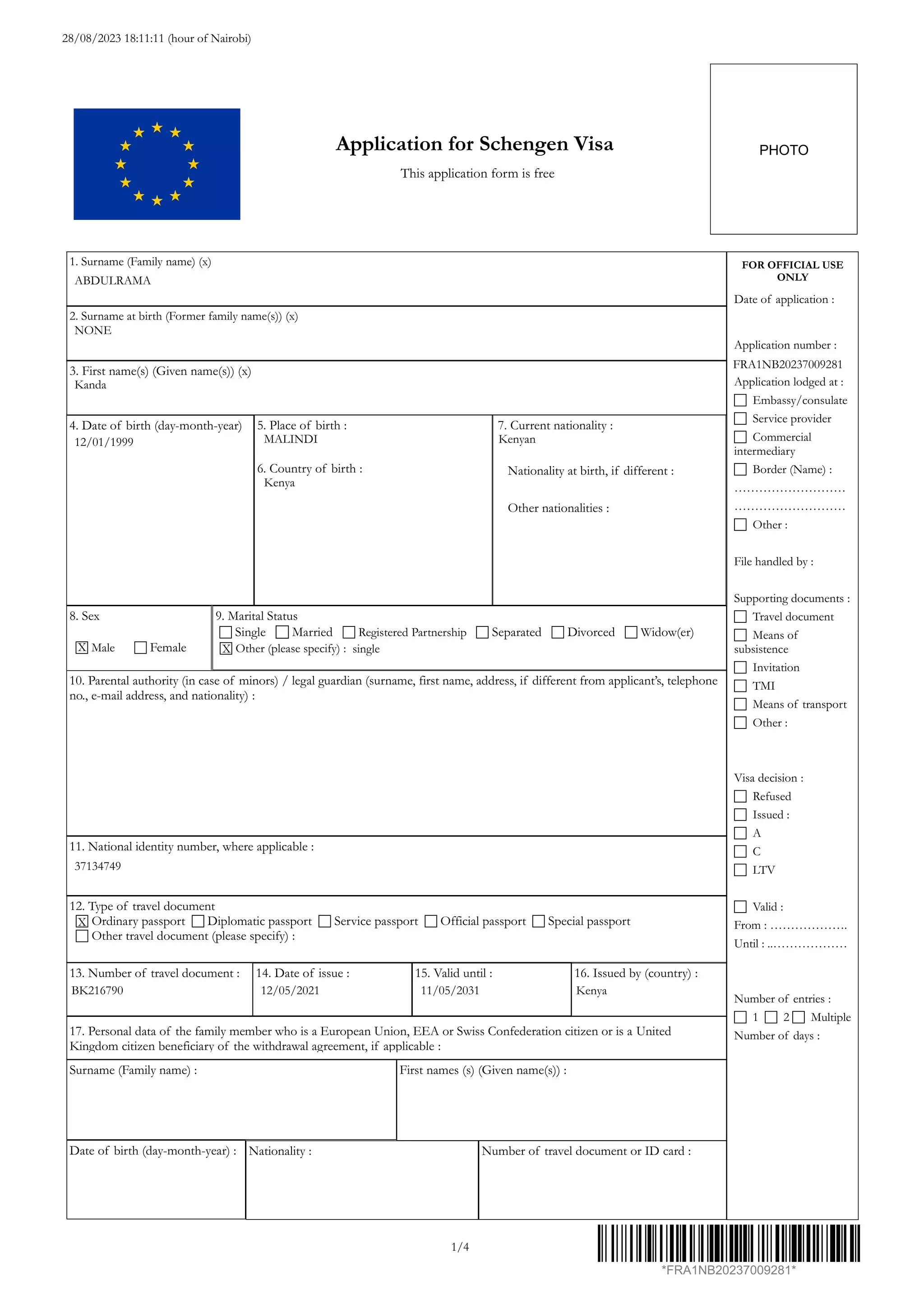
Provide all personal details, internship information, and upload scanned documents as requested. Review the information carefully before submitting. The portal will then guide you to schedule an appointment with a consulate.
Book appointment at French consulate and submit biometrics
Using the appointment letter from the portal, schedule a meeting at the nearest French consulate or visa application center. The consulate or visa application center acts as the service provider responsible for processing your visa application.
At the appointment, bring your original documents. The consular officer will check your file, take your fingerprints and photo (biometrics), and may ask brief questions about your internship. You will also pay the visa fee at this time. It's best to make this appointment well in advance, as slots can fill up quickly.
Fee Payment and Processing Times
Pay the visa fee (around €99 for a long-stay visa) during your appointment (some countries require online payment first). Once submitted, processing usually takes 2–4 weeks, but times can vary by consulate and time of year.
You can often track the status on the France-Visas portal. Apply at least 2–3 months before your internship starts to allow for any delays or requests for additional documents.
Need help with your French visa application?
Our team of experts assists you with all procedures to obtain your French visa, regardless of type.
More than 400 visas successfully obtained
Short Stay Visa Exceptions
If you are planning an internship in France that lasts less than three months, you may qualify for a short stay visa exemption, depending on your nationality. Citizens of the European Economic Area (EEA), Switzerland, and certain other countries may not need a short stay visa to enter France for an internship.
However, even if a visa is not required, you will still need to comply with registration requirements if staying beyond 90 days. It is important to check the specific visa requirements for your country of residence, as regulations can vary. Ensuring you have the correct documentation will help you avoid any legal issues and allow you to focus on your internship experience in France.
During and After the Internship
Working conditions on an internship visa (stipend, hours)
- ✓Paid internship: French law mandates a minimum stipend for internships longer than 2 months, typically at least 15% of the hourly social security ceiling (approx. €4.35/hr or €640/month for full-time work). This allowance must be paid by the host company.
- ✓Work hours: Internships normally run 35 hours per week. Interns have the right to breaks and basic labor protections, but they do not receive full employee benefits like paid vacation.
- ✓Additional work: Interns on the internship VLS-TS visa are not permitted to take on any separate paid job outside their internship. If you wish to work beyond your internship, you must obtain the appropriate work visa first.
Extending or changing status if hired (internship to work visa)
If your host company offers you a full-time position, you cannot continue on the internship visa. You must switch to a work visa. Your options are:
- ✓Change of status in France: If eligible (usually after 3 months of residence), you may apply at your local préfecture for a change to a salaried worker permit. Your employer typically needs to file a work permit application on your behalf.
- ✓Apply from your home country: More commonly, you will return home and apply for a new long-stay work visa (such as a salaried employee visa or "passeport talent" visa) at the French consulate. This requires a job contract and a work permit approval from French labor authorities.
Make sure you obtain the correct work visa before starting your new job to stay in compliance with French law.
Validating visa and getting residence permit for internship (if needed)
After arriving in France with a internship VLS-TS, you must validate your visa online with OFII within 3 months. The consulate provides instructions and a validation form. You will pay a small fee and may need a medical check as part of this process.
If your internship is extended or your stay will exceed the visa duration, you must apply for a carte de séjour temporaire – stagiaire (temporary intern residence permit) at the préfecture at least two months before your visa expires. This requires your passport with visa, the approved internship agreement (or any amendment), proof of address, and other documents specified by the préfecture.
International Student Considerations
International students planning to undertake an internship in France should carefully consider several important factors to ensure a successful stay. First, you must demonstrate sufficient financial resources to cover your living expenses, as the French government requires proof of a basic monthly maintenance allowance.
While some international students may receive a stipend or scholarship, it is essential to budget for your entire stay. Health insurance is another requirement—make sure you have comprehensive coverage that meets French standards.
Additionally, your internship must be part of a recognized training course or professional work placement, as outlined by your educational institution and the French authorities. Language skills can greatly enhance your experience, both in the workplace and daily life, so consider improving your French before arrival.
By understanding these visa requirements and preparing the necessary supporting documentation, international students can make the most of their internship in France and gain valuable professional and cultural experience.
For more tips, check our guide on French student visa requirements.
Common Questions (FAQ)
Can you do multiple internships on one visa?
No. The internship visa is issued for the specific internship and agreement you provided. If you complete one internship and plan another with a different host, you would need a new internship agreement and typically a new visa (or an extension if the host submits an amendment). If the second internship is with the same employer and extends your current internship, the company can get an avenant (amendment) approved to renew your visa.
Can interns work part-time outside the internship?
No. An intern on the VLS-Stage visa cannot take on a separate part-time job. Your authorized activity in France under this visa is strictly the internship described in your convention de stage. (For comparison, full-time students on a student visa can work up to 964 hours/year, but this allowance does not apply to interns on a stagiaire visa.)
What happens if you get a job offer?
If you receive a job offer, you must change your immigration status before starting employment. Typically, you would either apply for a change of status at the préfecture (if eligible) or return to your home country and obtain a work visa at the French embassy. Your employer will usually initiate the work permit process. Do not begin the new job under the internship visa—ensure you have the correct work visa in hand to comply with French regulations.
Is the stipend mandatory?
Yes, French law mandates a minimum stipend for internships longer than 2 months, typically at least 15% of the hourly social security ceiling (approx. €4.35/hr or €640/month for full-time work). This allowance must be paid by the host company.
Do I need to validate my visa after arrival?
Yes, after arriving in France with a internship VLS-TS, you must validate your visa online with OFII within 3 months. The consulate provides instructions and a validation form. You will pay a small fee and may need a medical check as part of this process.
Conclusion – Gaining professional experience in France
Obtaining the France internship visa (internship VLS-TS) requires careful preparation of your documents and meeting the official requirements, but it is a straightforward process if you follow the guidelines. By securing the necessary internship agreement, proving your resources, and applying through the official channels, you can legally intern in France and gain valuable experience.
Remember to validate your visa upon arrival and be aware of your visa's expiry date. With the right planning, your internship in France can be a rewarding part of your career journey.